2026

John 16:21–22

Temporary or Eternal?

“When a woman is in labor, she is in anguish because her hour has arrived; but when she has given birth to a child, she no longer remembers the pain because of her joy that a child has been born into the world. So you also are now in anguish. But I will see you again, and your hearts will rejoice, and no one will take your joy away from you.”

Reflection:

When we live fully united to Christ, we can endure anguish with confidence and determination. Without Christ, even small, temporary trials become so burdensome that we tend to avoid them. Though trials are not desirable in themselves, God permits them to strengthen us in virtue and prepare us for eternity. The anguish that accompanies them is temporary, but the victory over them is eternal. If we refuse to endure the temporary, we risk losing the eternal.

Our Gospel illustrates this point well. The purpose of pregnancy is to cooperate with God’s creative power and to bring forth into the world a precious new soul who will exist for all eternity. What a joy it is for parents to learn of their pregnancy, endure the nine months and the labor, hold their newborn child, and accompany that child throughout life and into Heaven.

In order to give birth to that child, the woman must endure labor pains. These pains are not desirable or sought for their own sake, but a woman willingly endures them as a necessary condition for the great joy of new life. Afterward, a loving mother does not regret having a baby because the labor was painful. The joy of holding her newborn is so rewarding that it puts the pain in perspective.

Just as a woman willingly endures labor pains for the joy of new life, we too must embrace temporary trials to receive eternal blessings. Trials are a consequence of Original Sin. In the beginning, God did not will that trials would be part of our lives. After the Fall, many forms of trials entered human existence. To enable us to overcome these trials, the Son of God took on flesh and overcame everything we endure. Therefore, when we face trials, God looks at us and invites us to follow His example: to carry our crosses with His strength, to do what He already did.

When Jesus told His Apostles, “So you also are now in anguish,” He was speaking not only to them but also to us. Jesus was fully aware of the anguish the Apostles would endure through His coming Passion, and He is fully aware of every anguish we will endure. His awareness is active, offering hope: “I will see you again, and your hearts will rejoice, and no one will take your joy away from you.” This is His promise to each of us as we confidently endure the trials of life. Our endurance will lead to eternal joy, for we will share in the victory of Christ’s Resurrection.

Reflect today on whether you are willing to endure the anguish of temporary trials so as to share in the eternal blessing that will come after. Are you living for what is temporary or eternal? Do you avoid trials out of fear, or do you embrace them with trust in Christ’s promise? Reflect on how you might unite your daily struggles with His Passion and seek His grace to persevere. Turn to Jesus, Who has already endured every trial and triumphed, and imitate Him so that you share in His victory and rejoice with Him for all eternity.

Source: https://catholic-daily-reflections.com/2026/05/14/temporary-or-eternal/

John 16:21–22 Read More »

The Ascension of the Lord

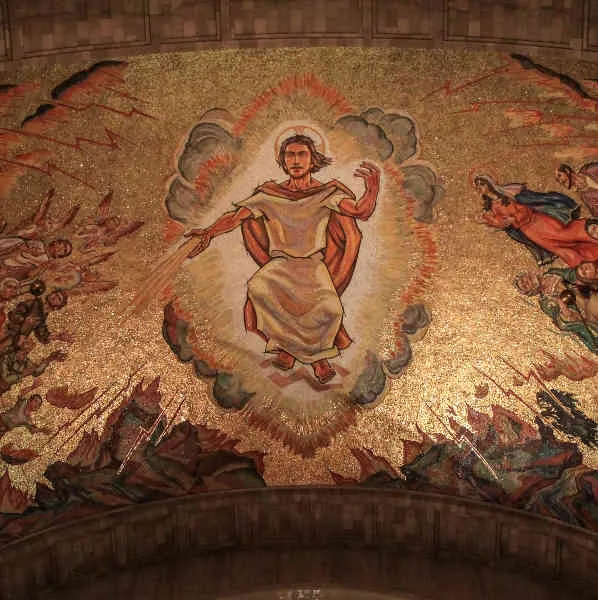
The Solemnity of the Ascension of the Lord commemorates the fortieth day after the Resurrection when Jesus ascended body and soul into Heaven and took His seat at the right hand of His Father. Traditionally, the location of the Ascension is believed to be less than a mile east of the Old City of Jerusalem, and that spot is marked by the Chapel of the Ascension, which is said to contain a miraculous imprint of the footprints of Christ before He ascended. The event of the Ascension is found in the Gospels and Acts (Mark 16:19–20; Luke 24:50–53; Acts 1:6–12). It is also alluded to in various other passages (John 6:62; Ephesians 4:7–10; 1 Timothy 3:16; 1 Peter 3:21–22).

Only Jesus and His Blessed Mother have entered into the glories of Heaven, body and soul. Jesus’ Ascension implies that He did so by His own authority and power. The Blessed Virgin Mary’s Assumption implies that she entered Heaven, body and soul, by God’s power, and not her own.

The Ascension marks the completion of Jesus’ earthly mission. He first united His divine nature with human nature through the Incarnation at the moment of the Annunciation. Saint Thomas Aquinas teaches that from that moment on, Jesus, the Son of God, experienced three types of knowledge. First, being God, He had beatific knowledge, that is, a direct knowledge of His essence, the Father’s essence, and the Holy Spirit’s essence. Second, He had the perfection of infused knowledge, that is, a bestowal of all truths given to the angels in Heaven, especially those truths necessary for the completion of His divine mission. Third, He began to acquire learned knowledge, or experiential knowledge. This was the form of knowledge attained through His human nature from the senses and His human reason.

As Jesus fulfilled His mission through life, His learned knowledge continued to grow until it was perfected in human form. It was never imperfect in the sense of sin, but only in the sense of growth through human experience and human love. He experienced all things, allowed the perfection of His beatific and infused knowledge to guide His human experiences and brought those human experiences and knowledge to perfection. His free embrace of the Cross manifested the perfection of divine love in human form, and His Resurrection brought that perfect unity of human and divine love to a new and transformed resurrected state of human existence. But that was not all. Today we commemorate the fact that Jesus took His perfected human nature into the Beatific Vision, enabling humanity itself to follow. The Blessed Virgin Mary was the first to do so given her sinless state.

The final stage of the salvation of humanity will take place when Jesus returns to judge the living and the dead. At that time, every human body will rise, will endure the final purification and transformation, and will share in the new and resurrected state in which the faithful will be able to stand, body and soul, before the Most Holy Trinity and experience the fullness of the Beatific Vision forever. What Jesus has already accomplished in His human form is what we look forward to in hope at the end of time.

The Feast of the Ascension was celebrated annually from as early as apostolic times. Saint John Chrysostom, Saint Gregory of Nyssa, and Saint Augustine all attest to this fact. When the Council of Nicaea set the date for the celebration of the Resurrection in 325, it chose to keep Easter on the first Sunday after the first full moon occurring on or after the vernal equinox in spring. This decision also set the day for the Ascension being forty days after Easter, on a Thursday. Today, many ecclesiastical provinces transfer the Thursday celebration to the following Sunday to provide for a wider celebration.

Though every aspect of Christ’s life is shrouded in mysteries which will only be fully understood by the faithful when they stand before Him and behold the Beatific Vision, today we especially ponder this beautiful and profound mystery of our faith. As we celebrate the Ascension, try to prayerfully meditate upon the perfect unity of Jesus’ human and divine natures. Ponder further the truth that because the Son of God is both God and man, and He beholds His Father and the Holy Spirit as both God and man, He invites each of us to begin to share in that glorious vision. Only after we fully die in and with Him and rise to new life in and with Him will we be able to know Him clearly and share in His glorious resurrected and ascended life. Until that moment comes, it’s important to ponder that which is incomprehensible. We must know that we do not know, believe what is beyond belief, hope in that which is more than we can understand. God is a mystery; the Ascension is a mystery—but they are mysteries that must be penetrated by prayer. Do so today as we commemorate this holy culmination of the earthly life and mission of Christ.

Source: https://mycatholic.life/saints/saints-of-the-liturgical-year/the-ascension-of-the-lord/

The Ascension of the Lord Read More »

Matthew 28:18–20

Evangelizing All Nations—One of the Twelve

“All power in heaven and on earth has been given to me. Go, therefore, and make disciples of all nations, baptizing them in the name of the Father, and of the Son, and of the Holy Spirit, teaching them to observe all that I have commanded you. And behold, I am with you always, until the end of the age.”

Reflection:

What a monumental task the Apostles were given! These are Jesus’ parting words as He stands on the Mount of the Ascension, the final words recorded in Matthew’s Gospel. They are powerful words by which Jesus entrusts extraordinary responsibility to eleven of His closest companions. Their mission was not merely to gain new followers but to proclaim the Gospel to every nation. Additionally, they were to baptize all nations and teach them everything Jesus had commanded.

This incredible task would have seemed daunting, if not impossible. Yet it is grounded in divine authority: “All power in heaven and on earth has been given to me. Go, therefore…” These are not mere words of encouragement but a divine command, rooted in the authority entrusted to Jesus by the Father. With this declaration, Jesus equips the Apostles with the grace to fulfill their mission, knowing they act under His authority.

The Ascension marks a fundamental transition in salvation history. Before the Incarnation, God established covenants with His people and sent prophets to call them to fidelity and prepare them for the coming of the Messiah. With Jesus’ Incarnation, a new era of salvation history began. Through His Passion and Resurrection, Jesus opened the floodgates of grace and inaugurated the final phase of God’s eternal plan. This phase continues today and will only reach its fulfillment when Christ returns in glory to judge the living and the dead and establish the new Heaven and new Earth.

Because we live in this final phase of salvation history, Jesus’ words to His Apostles also apply to us. We are not only among the “all nations” called to be disciples, but we also share in the Apostles’ mission to evangelize the world. While the Apostles, as the first bishops, had a unique role, every baptized person participates in Christ’s mission through the priestly, prophetic, and kingly offices conferred at baptism.

The recently canonized Saint John Henry Newman beautifully illustrates this shared mission in a prayer he wrote: “God has created me to do Him some definite service. He has committed some work to me which He has not committed to another. I have my mission…I am a link in a chain, a bond of connection between persons….” Each of us has a unique role to play, and we can be certain that God has given us some definite service to act as a link in a chain and a bond of connection between God and others.

Newman continues: “If I am in sickness, my sickness may serve Him, in perplexity, my perplexity may serve Him. If I am in sorrow, my sorrow may serve Him.” This reminds us that Jesus, the all-powerful God who holds “all power in heaven and on earth,” can use every aspect of our lives for His glory and mission—if we let Him.

Reflect today on two truths. First, consider your place among the “all nations” called to become disciples. Second, reflect on your duty as a disciple to share in Christ’s mission to evangelize the world. As we celebrate our Lord’s Ascension, hear His commission spoken to you. Embrace the privilege and responsibility of His command, allowing His authority and presence to guide your life and your mission.

Source: https://catholic-daily-reflections.com/2026/05/13/evangelizing-all-nations/

Matthew 28:18–20 Read More »

Our Lady of Fátima

1916-1917

Three Portuguese shepherd children named Lúcia (age nine), Francesco (age eight), and Jacinta (age six), received three apparitions from the Guardian Angel of Portugal in 1916 and six apparitions from Our Lady of the Rosary in 1917. Lúcia later became a religious sister and received several more apparitions from Our Lady and Jesus Himself. These apparitions and their messages are among the most inspiring spiritual events to occur in modern times.

The first apparition took place in the spring of 1916 while the children were tending their sheep. While taking refuge in a cave during a storm, the children had eaten their lunches and prayed the rosary. They were playing games when they saw an angel in the form of a young boy on a cloud, who was whiter than snow, yet transparent and radiant with the sun. The angel said, “Do not fear! I am the Angel of Peace. Pray with me.” With that, the angel bowed to the ground with the children and prayed three times: “My God, I believe in Thee, I adore Thee, I hope in Thee, and I love Thee. I ask pardon for all those who do not believe in Thee, do not adore Thee, do not hope in Thee, and do not love Thee,” and then disappeared.

During the summer of 1916 the angel appeared to them again, almost chastising them, saying, “What are you doing? Pray, pray a great deal! The Holy Hearts of Jesus and Mary have designs of mercy on you. Offer unceasingly prayers and sacrifice yourselves to the Most High.” When Lúcia inquired how they were to sacrifice themselves, the angel replied, “Make of everything you can a sacrifice and offer it to God as an act of reparation for the sins by which He is offended, and in supplication for the conversion of sinners…”

During the fall of 1916, the angel appeared again, this time with a chalice and the Blessed Sacrament before which he bowed and prayed, “Most Holy Trinity, Father, Son, and Holy Spirit, I adore You profoundly, and I offer You the Most Precious Body, Blood, Soul and Divinity of Jesus Christ, present in the tabernacles of the world, in reparation for the outrages, sacrileges, and indifferences by which He, Himself is offended. And I draw upon the infinite merits of the Most Sacred Heart of Jesus and of the Immaculate Heart of Mary, that You might convert poor sinners.” Afterwards, the three children received Holy Communion from the angel.

On May 13, 1917, the children, once again in the fields, received a visit from a lady from Heaven. She conversed with them and told them to return to that spot on the 13th of every month for six consecutive months. In their conversation she asked, “Are you willing to offer yourselves to God to bear all the sufferings He wants to send you, as an act of reparation for the sins by which He is offended, and for the conversion of sinners?” To which the children replied, “Yes.”

On June 13, 1917, the lady appeared again, this time with about fifty others from the town present. After they all prayed the rosary, the lady appeared to the children as before and conversed with them. In part, she said, “I will take Jacinta and Francisco soon, but you, Lúcia, are to stay here some time longer. Jesus wishes to make use of you in order to make me known and loved. He wishes to establish in the world devotion to my Immaculate Heart. To whoever embraces this devotion, I promise salvation; those souls will be cherished by God, as flowers placed by me to adorn His throne.”

On July 13, 1917, a crowd of about 5,000 accompanied the children. They prayed the rosary, and the lady appeared as before. This time she gave the children a horrifying vision of hell and then spoke about the need for prayer and sacrifice to end World War I. She also warned that a worse war would come if her message was not heeded. She said, “To prevent this, I shall come to ask for the consecration of Russia to my Immaculate Heart, and the Communion of Reparation on the First Saturdays. If my requests are heeded, Russia will be converted and there will be peace; if not, she will spread her errors throughout the world, causing wars and persecutions of the Church.” Then she asked them to add this prayer to each decade of the rosary: “O my Jesus, forgive us our sins, save us from the fires of hell. Lead all souls to Heaven, especially those who are most in need of Thy mercy.”

On August 13, 1917, as many as 20,000 people had gathered, but on that same day the children were arrested, detained in prison for a few days, and interrogated about their visions. The crowd, however, did see a phenomenon in the sky. On August 19, after the children were released, the lady appeared to them once again in the field.

On September 13, 1917, with a crowd of 30,000, the lady appeared and asked the children to continue to pray the rosary. She promised that if they did, the war would end. She then promised “In October, I will perform a miracle so that all may believe.”

On October 13, 1917, about 70,000 people gathered in the pouring rain. This time the lady revealed her name, saying, “I am the Lady of the Rosary.” She asked for a church to be built on that spot and promised that the war would soon end if they kept praying the rosary every day. When she left the children, everyone in the crowd saw the promised miracle. The sky opened, and those gathered were able to look directly at the sun as it glowed and danced. The sun then plummeted to earth, causing panic, but returned to the sky. Suddenly, everything—including the ground and everyone’s clothing—was completely dry.

Within a few years, Francesco and Jacinta died and went to Heaven as promised by the Lady of the Rosary. Lúcia entered religious life and received an apparition in 1925 during which Our Lady fulfilled her promise that she would return to ask for “the Communion of Reparation on the First Saturdays.” In 1929, Our Lady appeared to Lúcia again, stating, “The moment has come in which God asks the Holy Father to make, in union with all the bishops of the world, the consecration of Russia to My Immaculate Heart.”

Above all, the messages of Fátima reveal the ongoing need to make reparation for the sins and sacrileges committed against the Sacred and Immaculate Hearts of Jesus and Mary, and to pray for the conversion of poor sinners. Daily sacrifice and penance, offered with prayer and profound faith, do more good than we could ever imagine. As we honor these most glorious apparitions today, reflect upon your own willingness to make reparation for the sins of the world through your daily sacrifices. “Make of everything you can a sacrifice and offer it to God…” Doing so will not only appease the Justice of God, it will also bring about the salvation of many souls.

Source: https://mycatholic.life/saints/saints-of-the-liturgical-year/may-13—our-lady-of-fatima/

Our Lady of Fátima Read More »

John 16:12–13

Bearing All Truth

Jesus said to his disciples: “I have much more to tell you, but you cannot bear it now. But when he comes, the Spirit of truth, he will guide you to all truth.”

Reflection:

Even Jesus’ closest companions, who spent three years with Him during His public ministry, could not bear the fullness of Truth without the Holy Spirit, the Spirit of Truth. This is a significant reminder for us, who did not have the privilege of walking with Jesus during His earthly ministry.

Imagine those three years: the disciples witnessed miracle after miracle, listened to sermon after sermon, and enjoyed intimate conversations with Jesus. Just being in His presence, observing how He interacted with others, must have been profoundly inspiring. Yet, even those formative years did not prepare them to bear all that Jesus wished to reveal.

This shows us that understanding the fullness of Truth goes far beyond human capacity. Only through the supernatural gift of the Holy Spirit can we comprehend the deepest mysteries of faith.

What happens to a soul who receives the Holy Spirit and is guided into “all truth?” That soul is transformed. The natural soul gives way to a supernaturally elevated soul, becoming a new creation in Christ. But this transformation requires something essential: the old self must die. We must surrender our fallen nature to receive the new life Christ offers. This requires great sacrifice because we must let go of our old ways and embrace God’s grace. But every sacrifice that leads to a life transformed by divine truth is worth it.

Recall Jesus’ teaching: “No one pours new wine into old wineskins…New wine must be poured into fresh wineskins” (Luke 5:37–38). For us to become fresh wineskins, ready to receive the new wine of God’s grace, we must allow the Holy Spirit to change us. This transformation might be startling at times. As the Spirit works within us, opening our eyes to truths we could never imagine, we begin to bear those truths that previously seemed unbearable. This leads to wonder, awe, and praise of God.

Consider the example of Saint Stephen, the Church’s first martyr. When Stephen spoke, the corrupt religious leaders “could not withstand the wisdom and the Spirit with which he spoke” (Acts 6:10). He didn’t rely on years of education or human effort to gain knowledge; instead, the Spirit of Truth lived in him and spoke through him. Stephen had become a fresh wineskin, and the new wine of God’s truth poured forth from him in superabundance, even to the point of giving his life for Christ.

Reflect today on the boundless truths that God desires to reveal to you through the Holy Spirit. No amount of human learning can compare to the depth of wisdom available to those who become new creations in Christ. What areas of your life still resist the Spirit’s transformative work? What old wineskins must you cast aside to receive the new wine of divine grace? By surrendering to the Holy Spirit, you allow God to lead you into the fullness of Truth. As this truth fills your heart, it will draw you into deeper awe and praise for the mysteries of faith, preparing you to bear witness to the world as a disciple of Christ.

Source: https://catholic-daily-reflections.com/2026/05/12/bearing-all-truth/

John 16:12–13 Read More »

Saint Pancras, Martyr

c. 289–c. 304; Patron Saint of children, jobs, and health; Invoked against cramps, false witnesses, headaches, and perjury; Pre-Congregation canonization

When Saint Pancras was born toward the end of the third-century, Diocletian was the emperor of the Roman Empire, sharing ruling authority with three others. In the years prior to Diocletian’s reign, Christianity began to be tolerated within the empire. Emperor Diocletian slowly reversed that trend, beginning the final wide-reaching persecution of Christians before Emperor Constantine the Great legalized Christianity.

One tradition states that around the year 299, Emperor Diocletian and one of his co-rulers, Galerius, took part in a pagan divinization ceremony. The ceremony to predict the future was judged a failure, and the growing number of Christians in the empire was blamed. In order to appease the Roman gods, the cult of Christianity needed to be purged. The purge began by requiring members of the royal court and army to offer sacrifice to the Roman gods. In 303, after Diocletian and Galerius consulted an oracle, they published an edict that began a great persecution of Christians. Churches were destroyed, Scriptures were burned, and Christians who failed to offer sacrifice to the Roman gods were killed. A fourteen-year-old boy named Pancras was among them.

Pancras was born in Phrygia, Asia Minor, in modern-day Turkey. His mother is believed to have died while giving birth, and his father is believed to have died when Pancras was around the age of eight. Orphaned, Pancras was entrusted to the care of Denis, his uncle, who took him to live in Rome. In Rome, Pancras and Denis converted to Christianity and lived their faith with deep devotion. In 304, Pancras was among the Christians who were routinely being brought before the authorities to renounce their faith and offer sacrifice to the gods. Though it is uncertain that Diocletian was ever in Rome during that year, tradition states that Pancras was brought before Diocletian and refused to offer sacrifice to the gods. Diocletian was impressed with the fourteen year old’s courage. The emperor tried to persuade Pancras, offering him wealth and honor if he only burned incense to the gods. One thirteenth-century legend places these words on the lips of Pancras in response to the emperor: “Though I am a child in body, my heart is old, and by the virtue of my Lord Jesus Christ, your threats and menaces move me no more than does the painting that I see upon the wall. These gods that you want me to worship are but deceivers of creatures…” The emperor was outraged and ordered that he and his uncle, now Saint Denis, be beheaded on May 12 on the Via Aurelia outside of Rome.

Though Pancras’ death could be seen as a tragedy, God used it for good. After his death, devotion to him began to grow. In the sixth century, Pope Symmachus built a basilica over his tomb. At the end of the sixth century, Pope Gregory the Great sent a Roman monk to England to convert King Æthelberht and to become England’s first bishop. After successfully converting the king and his kingdom, the monk-bishop, now known as Saint Augustine of Canterbury, built the first Church in England and named it after Saint Pancras. Pope Gregory even sent relics of the saint to inspire the people. Devotion to Saint Pancras spread widely throughout England from the very beginning of the kingdom’s Christianization. Eventually, miracles were attributed to Saint Pancras’ intercession by those who prayed at his tomb.

It is also said that at the end of the sixth century, the Archbishop of Tours, France, made the claim that anyone who told a lie at the tomb of Saint Pancras would be attacked by demons or even die. As a result, the saint’s relics continued to be distributed to other churches. Oaths made before his relics were thought to be so binding that they were held up in some courts of law.

Little did this fourteen-year-old boy know that his heroic death would inspire kings and popes, laymen and clergy, throughout the ages. As we honor this child martyr, reflect upon his courage at such a young age. Though young in years, he was wise in spirit. Pray for the same wisdom and courage that this saint had so that you will be able to give proper honor and glory to Christ.

Source: https://mycatholic.life/saints/saints-of-the-liturgical-year/may-12—saint-pancras-martyr/

Saint Pancras, Martyr Read More »

John 15:26–27

Giving Bold Witness

Jesus said to his disciples: “When the Advocate comes whom I will send you from the Father, the Spirit of truth who proceeds from the Father, he will testify to me. And you also testify, because you have been with me from the beginning.”

Reflection:

The Last Supper Discourse spans from Chapters 13–17 in John’s Gospel, making it Jesus’ longest continuous teaching in the Gospels. While Chapter 13 begins with Jesus washing the disciples’ feet and teaching humility, it also introduces the promise of the Holy Spirit, the Advocate. Today’s Gospel begins a deeper teaching on the role of the Holy Spirit, a theme we will explore further as we approach the Solemnity of Pentecost in less than two weeks.

The role of the Holy Spirit in this passage is twofold. First, the Holy Spirit is identified as the Spirit of Truth Who will testify to the disciples on Jesus’ behalf. To testify is to bear witness to the truth. A witness in a court of law testifies under oath to safeguard the truthfulness of his or her statement. Even more so, the Holy Spirit’s testimony, spoken deep within the conscience of every soul aligned with God’s will, brings with it moral certitude. When the Holy Spirit speaks, we know what He says is true. This is how we arrive at the certitude of faith in Jesus as our Savior and in the truthfulness of all He taught.

Second, Jesus says, “You also testify.” The Holy Spirit not only testifies to Jesus but also equips the disciples to give testimony about Him to the world. This testimony, as Jesus explains, will not be without cost: “They will expel you from the synagogues; in fact, the hour is coming when everyone who kills you will think he is offering worship to God” (John 16:2). Jesus warns His disciples of this coming hostility so they “may not fall away.” The Holy Spirit will enable them to testify courageously, even in the face of persecution. This assurance was essential for the early Church and remains vital for believers today as we navigate a world often resistant to the Gospel.

The testimony we must give as Christians is rooted in proclaiming the Truth: Jesus is the one and only way to the Father. He alone offers the forgiveness of sins and the gift of salvation. Without turning to Him, we cannot be saved.

In addition to this central message, we must testify to the supporting truths of our faith through both word and action. Faithful attendance at Mass is essential. Confession restores us to grace. Daily prayer draws us closer to God. Mortal sin destroys our union with Him, and Hell is a sobering reality. But the hope of Heaven shines brightly for all who embrace God’s mercy and live in His grace. Penance helps us overcome habitual sin. We are called to love our neighbor, pray for those who persecute us, forgive every offense, and show boundless mercy, even to the most unlovable. Ultimately, we are called to lay down our lives for others in imitation of Christ.

Only the Holy Spirit can equip us with understanding and courage to give this testimony wholeheartedly. Without the Spirit, we are incapable of being faithful witnesses to God’s truth and love. Just as Jesus prepared His disciples for their mission, He now calls us to prepare ourselves through prayer and reliance on the Holy Spirit’s guidance.

To be a witness is to be a martyr in the broadest sense, with a willingness to live a life of sacrificial love, imitating Christ’s offering on the Cross. This is the greatest testimony we can give to a world in need of salvation.

Reflect today on the ways the Holy Spirit might be calling you to give witness to Christ. Are there moments when fear or complacency holds you back from testifying to the truth? Pray for the courage and grace to live boldly as His witness. To be used by God is the greatest honor we can receive. Embrace that honor by allowing the Holy Spirit, the Spirit of Truth, to dwell in you and bear witness through you that Jesus is the Savior of the world and the sole path to eternal life.

Source: https://catholic-daily-reflections.com/2026/05/10/giving-bold-witness/

John 15:26–27 Read More »

Saints Nereus and Achilleus, Martyrs

Died c. 98; Pre-Congregation canonization

Not long after Jesus’ death and resurrection, Saint Stephen, a deacon of the Church in Jerusalem, became the first Christian martyr. Then came James, the son of Zebedee; James the brother of the Lord; Saints Peter and Paul; and other apostles. Before the turn of the first century, dozens would follow. It is believed that today’s martyrs were among these first witnesses to the faith who shed their blood for Christ.

Very little is known for certain about Saints Nereus and Achilleus. Today theirs are among the 140 statues of saints towering over Saint Peter’s Square, Rome. In 1874, when the Catacomb of Domitilla was discovered and excavated, a fourth-century basilica dedicated to Saints Nereus and Achilleus was found. In that basilica was discovered a well-preserved pillar with the name Achilleus on it, images depicting the men’s decapitation, and the above inscription from Pope Saint Damasus (c. 304–384). In the sixth century, the relics of these saints were moved to another Roman church built in their honor in which they lie today.

Though details are uncertain, Saints Nereus and Achilleus might have been soldiers in the army of the Roman Emperor Domitian. They might have been brothers who were eunuchs responsible for the protection of Emperor Domitian’s niece, Domitilla. Domitilla and Clemens, to whom she was betrothed, were arrested by the emperor for “sacrilege or godlessness,” because they rejected the Roman gods and converted to Christianity. Clemens was put to death and Domitilla was exiled. Her guards, Nereus and Achilleus, also converted and fled their post, and might have even been responsible for converting Domitilla and Clemens. The brothers were arrested and sent into exile. Emperor Domitian died in 96 and was succeeded briefly by Emperor Nerva and then by Emperor Trajan in 98, who is believed to have ordered the beheading of the brothers while they were in exile. Their bodies were later buried in the family catacomb of Domitilla, one of the earliest Christian cemeteries in existence. One tradition states that Saint Peter himself baptized the brothers in Rome.

On May 12, 592, Pope Saint Gregory the Great celebrated Mass at the tomb of these martyrs and said in his sermon, “These saints before whose tomb we are assembled, despised the world and trampled it under their feet, when peace, plenty, riches, and health gave it charms. And this world, which was still so flourishing in itself, was already withered in their hearts.”

Regardless of the lack of certainty regarding the historical details of the lives of these saints, it is certain that they were greatly honored in the early Church. Their witness inspired Christians of their time and for centuries to follow. They are among the earliest witnesses to Christ; and, with the blood they shed, undoubtedly planted the seeds of faith in the hearts of many. Today, their influence is hard to estimate; but in Heaven, the veil will be lifted, and we will be in awe of the effect that their sacrifice had not only on the early Church but also on the Church throughout the ages.

As we ponder these great saints today, reflect upon the important fact that the seeds you plant in the hearts of others is not only for them, it is also for everyone that they will touch with God’s grace. The seeds we plant do grow, and though we might not always be able to point to the fruit that is borne, we can be certain that God will reveal this to us with great joy in the glories of Heaven.

Source: https://mycatholic.life/saints/saints-of-the-liturgical-year/may-12—saints-nereus-and-achilleus-martyrs/

Saints Nereus and Achilleus, Martyrs Read More »

John 16:5–7

Finding Hope in Grief

Jesus said to his disciples: “Now I am going to the one who sent me, and not one of you asks me, ‘Where are you going?’ But because I told you this, grief has filled your hearts. But I tell you the truth, it is better for you that I go. For if I do not go, the Advocate will not come to you. But if I go, I will send him to you.”

Reflection:

Each of us experiences grief. The death of a loved one, the loss of a job, and a serious illness are a few of many immediate causes of grief. Jesus addresses the grief the disciples were experiencing as they listened to Him explain that He was going to the One Who sent Him, to the Father: “But because I told you this, grief has filled your hearts.”

It’s easy to relate to the disciples’ grief. Imagine that you find out that your best friend is moving to another state. You would have a deep sense of loss upon hearing the news. This is what the disciples were experiencing. The closeness they shared with Jesus was profoundly consoling to them. In Him, they learned so much and began to understand the purity and power of divine love, likely for the first time. The news of His departure filled them with grief.

Emotions are neither good nor bad; they are natural reactions to perceived goods or evils. The disciples’ initial perception of Jesus’ earthly departure was as an undesirable loss, so they felt grief. Jesus, fully understanding human nature, addressed their grief with great empathy. Simply identifying what they were feeling would have been a comfort to them. But Jesus goes further: “But I tell you the truth, it is better for you that I go. For if I do not go, the Advocate will not come to you. But if I go, I will send him to you.”

At Jesus’ words, the disciples might have experienced the beginnings of hope, but they did not fully understand. Only after Jesus left them, ascended to the Father, and sent the Holy Spirit at Pentecost did they begin to understand. And only after living with the presence of the Holy Spirit in their lives for some time did they more fully comprehend the depth of this promise. This reflects our own spiritual journey; it takes time and openness for the wisdom of God’s plan to unfold in our lives.

Whenever we face grief or confusion, we would benefit from pondering this exchange between Jesus and the disciples. Romans 8:28 tells us, “We know that all things work for good for those who love God, who are called according to his purpose.” That means “all things,” not just some things. When we fully commit ourselves to God and His perfect will, everything we encounter has the potential to produce good fruit. Every sorrow, joy, cross, victory, or persecution, as well as all the emotions that accompany these experiences, is able to be used as an instrument of God’s grace in our lives, and through us, in the lives of others.

The reason this is so is because of God’s perfect wisdom. From the divine perspective, Jesus transformed suffering and death through His Cross and Resurrection, and nothing is beyond the reach of God’s power. God can use even something as painful as the tragic and sudden loss of a loved one for good.

Believing this instills hope in our lives, which is among the three most important virtues. Faith is the certain belief that God can work all things for good, and hope is the drive that moves us toward the fulfillment of that belief. Together, faith and hope produce charity, the greatest gift of all, the only gift that endures even in Heaven. Just as the disciples later understood the value of Jesus’ departure—when they received the Holy Spirit and discovered that the Lord they loved now lived within them, never to leave—so we too will come to that same realization when we open ourselves to the indwelling of the Holy Spirit through prayer, trust, and surrender to His guidance.

Reflect today on the moment in your life when you faced grief or loss. Offer that memory to God in prayer, asking Him to reveal how His grace was at work in that situation, bringing growth, healing, or a deeper understanding of His love. Ask the Holy Spirit to fill your heart with faith and hope, trusting that even in the face of sorrow, God’s perfect plan is unfolding for good.

Source: https://catholic-daily-reflections.com/2026/05/11/finding-hope-in-grief/

John 16:5–7 Read More »

Sixth Sunday of Easter

First Reading Acts 8:5-8, 14-17

Philip went down to the city of Samaria
and proclaimed the Christ to them.
With one accord, the crowds paid attention to what was said by Philip
when they heard it and saw the signs he was doing.
For unclean spirits, crying out in a loud voice,
came out of many possessed people,
and many paralyzed or crippled people were cured.
There was great joy in that city.

Now when the apostles in Jerusalem
heard that Samaria had accepted the word of God,
they sent them Peter and John,
who went down and prayed for them,
that they might receive the Holy Spirit,
for it had not yet fallen upon any of them;
they had only been baptized in the name of the Lord Jesus.
Then they laid hands on them
and they received the Holy Spirit.

Responsorial Psalm Psalms 66:1-3, 4-5, 6-7, 16, 20

R. (1) Let all the earth cry out to God with joy.
or:
R. Alleluia.
Shout joyfully to God, all the earth,
sing praise to the glory of his name;
proclaim his glorious praise.
Say to God, “How tremendous are your deeds!”
R. Let all the earth cry out to God with joy.
or:
R. Alleluia.
“Let all on earth worship and sing praise to you,
sing praise to your name!”
Come and see the works of God,
his tremendous deeds among the children of Adam.
R. Let all the earth cry out to God with joy.
or:
R. Alleluia.
He has changed the sea into dry land;
through the river they passed on foot;
therefore let us rejoice in him.
He rules by his might forever.
R. Let all the earth cry out to God with joy.
or:
R. Alleluia.
Hear now, all you who fear God, while I declare
what he has done for me.
Blessed be God who refused me not
my prayer or his kindness!
R. Let all the earth cry out to God with joy.
or:
R. Alleluia.

Second Reading 1 Peter 3:15-18

Beloved:
Sanctify Christ as Lord in your hearts.
Always be ready to give an explanation
to anyone who asks you for a reason for your hope,
but do it with gentleness and reverence,
keeping your conscience clear,
so that, when you are maligned,
those who defame your good conduct in Christ
may themselves be put to shame.
For it is better to suffer for doing good,
if that be the will of God, than for doing evil.

For Christ also suffered for sins once,
the righteous for the sake of the unrighteous,
that he might lead you to God.
Put to death in the flesh,
he was brought to life in the Spirit.

Alleluia John 14:23

R. Alleluia, alleluia.
Whoever loves me will keep my word, says the Lord,
and my Father will love him and we will come to him.
R. Alleluia, alleluia.

Gospel John 14:15-21

Jesus said to his disciples:
“If you love me, you will keep my commandments.
And I will ask the Father,
and he will give you another Advocate to be with you always,
the Spirit of truth, whom the world cannot accept,
because it neither sees nor knows him.
But you know him, because he remains with you,
and will be in you.
I will not leave you orphans; I will come to you.
In a little while the world will no longer see me,
but you will see me, because I live and you will live.
On that day you will realize that I am in my Father
and you are in me and I in you.
Whoever has my commandments and observes them
is the one who loves me.
And whoever loves me will be loved by my Father,
and I will love him and reveal myself to him.”

Source: https://bible.usccb.org/bible/readings/051026.cfm

Sixth Sunday of Easter Read More »