June 2026

Mark 12:28

The Law Fulfilled in Love

One of the scribes came to Jesus and asked him, “Which is the first of all the commandments?”

Reflection:

We continue to read about Jesus’ various interactions, teachings, and prophetic actions in the Temple area during Passover, just days before He would be arrested and killed. During the week, Jesus cleansed the Temple of moneychangers and merchants and was confronted with hostility by various religious and political factions.

First, a group of chief priests, scribes, and elders challenged His authority to cleanse the Temple and then unsuccessfully conspired with some Pharisees and Herodians to trap Him in a legal dilemma. Next, some Sadducees confronted Him, but Jesus’ answer exposed their misunderstanding of the Scriptures and the power of God. In today’s Gospel, after witnessing that exchange, a scribe—impressed by Jesus’ answer—came forward. Rather than trying to trap Him, he asks a sincere question: “Which is the first of all the commandments?”

At that time, the scribe’s question reflected a common rabbinical discussion about the hierarchy of the Law. Perhaps because of the widespread disagreements among the various religious factions—priests, scribes, Pharisees, Sadducees—scholars often sought to determine a guiding principle for what had been identified in Jewish tradition as 613 commandments within the Torah. Some commandments, like the prohibition of idolatry, seemed weightier, while others, like dietary laws, were considered less important.

Jesus’ response does not simply rank the commandments; it reveals their true purpose by uniting them in a way that fulfills the entire Law. Instead of engaging in legalistic debates, He elevates the discussion by going directly to the heart of the Law with a twofold summary: “You shall love the Lord your God with all your heart, with all your soul, with all your mind, and with all your strength” and “You shall love your neighbor as yourself” (Mark 12:30–31). By doing so, Jesus shows that love—of God first and of neighbor as an extension of that law—is the foundation and fulfillment of every commandment.

The scribe’s response—“Well said, teacher”—demonstrates both humility and wisdom, and Jesus affirms his understanding: “You are not far from the Kingdom of God.” This interaction contrasts with the previous confrontations between Jesus and the religious leaders. Rather than trying to trap or discredit Jesus, the scribe listens attentively and responds with sincerity, and “No one dared to ask him any more questions” (Mark 12:3234).

Many in the crowd had likely been following Jesus’ encounters with the various religious and political factions throughout the week. At first, they may have been uneasy, seeing the repeated attempts to discredit Him. But as Jesus responded with authority and truth, they witnessed the growing contrast between those who sought to manipulate the Law for their own purposes and those who, like this scribe, genuinely desired to understand it.

Our own lives are sometimes burdened with controversy and division. Whether in politics, religion, academics, or daily life, disagreements arise that can easily lead to contention. When unchecked, these conflicts can foster division, hostility, and even obsessions that steal our peace. Jesus’ interaction with this scribe offers us a path forward: the way of humble inquiry, sincere dialogue, and the pursuit of Truth grounded in love. When we approach discussions with a heart open to God rather than with a desire to win an argument, we draw closer to His Kingdom.

Reflect today on the witness of this scribe. Though Jesus’ teaching on love of God and neighbor is of paramount importance, so is the example this scribe set in pursuit of the Truth. Consider your own approach to God’s Truth by examining your daily interactions with others. Do you struggle with being combative, resort to trickery, or obsess over being right and getting your way? Or do you seek the Truth that brings understanding and unity? Seek to imitate this scribe in humility and sincerity, and you, too, will not be far from the Kingdom of God.

Source: https://catholic-daily-reflections.com/2026/06/03/the-law-fulfilled-in-love/

Mark 12:28 Read More »

Saints Marcellinus and Peter, Martyrs

Mid-Third Century–c. 304; Invoked by those enduring hardships in life; Pre-Congregation canonization

On February 23, 303, Roman Emperor Diocletian issued an edict that initiated a fierce persecution of Christians. The edict mandated the destruction of Christian churches and scriptures, revoked all legal rights of Christians, and called for the confiscation of their property. In 304, Diocletian ordered the arrest of clergy, forcing them to offer sacrifices to the Roman gods or face imprisonment, torture, and death. These abuses continued under Diocletian and his co-emperors until 311 when Galerius issued an edict of toleration toward Christians. The exact number of Christians who suffered martyrdom during this period is unknown, but it might have been in the thousands. Today’s saints were among the first Christians to receive the crown of martyrdom during that period.

There is very little information available about Marcellinus and Peter. It is believed that both were Roman clergy, with Marcellinus being a priest and Peter an exorcist. Both are included in the Roman Canon of the Mass, alongside other early martyrs and saints.

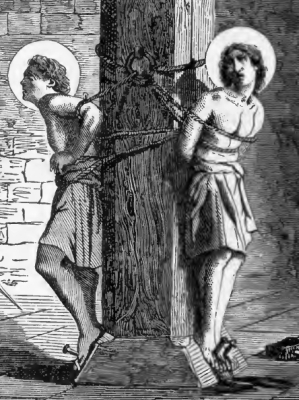
The little we know about these martyrs comes to us from Saint Damasus I, who served as pope from 366–384. As a child, Damasus heard the story of the martyrdom of Saints Marcellinus and Peter from the mouth of one of the executioners who later became a Christian. After their arrest, Marcellinus and Peter were likely given a sham trial, found guilty, and then offered the chance to gain their freedom by burning incense to the Roman gods. They refused. While in prison, the two men preached the Gospel to other prisoners and jailers. To put an end to their evangelization, orders were given to take them to a secret location in a nearby forest, where they were ordered to dig their graves. They did so joyfully, and were then beheaded and buried in that secret location to prevent other Christians from venerating their tombs.

After Marcellinus’ and Peter’s deaths, their stories became well known. Some time later, through divine providence, two holy women named Lucilla and Firmina were directed to the burial site. They took the saints’ bodies and buried them in what is today called the Catacombs of Marcellinus and Peter. These catacombs hold thousands of graves, primarily of Christians, and once also served as a secret place of Christian worship.

In 313, Emperor Constantine the Great issued the Edict of Milan, legalizing Christianity and calling for benevolent treatment of Christians. As part of his efforts to help Christianity grow, Constantine sent his mother, Saint Helena, on a journey to the Holy Land to bring back relics of Christ’s Passion. Constantine also built many churches in various holy places. One of those churches is the Basilica of Saints Marcellinus and Peter, built over their catacombs. When Saint Helena died, Constantine built a mausoleum for her next to the basilica, which became her resting place for centuries. As a result, devotion to Saints Marcillinus and Peter became widespread.

At the start of the ninth century, a German monk named Eginhard, who had previously been a secretary to Emperor Charlemagne, requested relics of martyrs from Pope Gregory IV. In response, Pope Gregory sent the relics of Saints Marcellinus and Peter, and a monastery was constructed in their honor in Seligenstadt. After they were buried there, many miracles were said to have taken place.

Although we know little about the details of their lives, the veneration of these early saints has been widespread, and their names continue to be invoked today every time the Roman Canon is used in the Mass. What is certain is that the courage of these saints in the face of death has inspired countless Christians for many centuries. As Jesus said, “No one has greater love than this, to lay down one’s life for one’s friends” (John 15:13). In many ways, everyone who has been inspired by the martyrdom of Saints Marcellinus and Peter can be considered their friends. Though they died long ago, the “friendship” of their witness endures.

As we honor these martyrs, ponder your own call to lay down your life selflessly for others. Dying to yourself—living sacrificially and selflessly—is no easy task. But when the grace of God is alive in your life, you will discover that you are given the courage you need to be a witness to Christ. Pray for the same courage that Marcellinus and Peter had, so that your sacrificial love will make you friends to others who need your witness.

Source: https://mycatholic.life/saints/saints-of-the-liturgical-year/june-3—saints-marcellinus-and-peter-martyrs/

Saints Marcellinus and Peter, Martyrs Read More »

Mark 12:13–14

The Path to True Unity

Some Pharisees and Herodians were sent to Jesus to ensnare him in his speech. They came and said to him, “Teacher, we know that you are a truthful man and that you are not concerned with anyone’s opinion. You do not regard a person’s status but teach the way of God in accordance with the truth. Is it lawful to pay the census tax to Caesar or not? Should we pay or should we not pay?”

Reflection:

Just prior to today’s Gospel, the chief priests, scribes, and elders confronted Jesus in the Temple area while He taught, challenging His authority to drive out the moneychangers and merchants. Though they withdrew out of fear of opposition from the crowds, they sent the Pharisees and Herodians to trap Him (cf. Mark 11:27–33). The alliance of these five groups, who were often opposed to one another—especially the Pharisees and the Herodians—well illustrates the old adage: “The enemy of my enemy is my friend.”

The Pharisees were known for their strict adherence to oral traditions derived from the Mosaic Law. They frequently clashed with the chief priests and elders, who focused on Temple worship and ceremonial rites.

The Herodians were despised by both the Pharisees and the other leaders for their support of Herod and Roman occupation. Their allegiance to Rome enabled them to maintain political influence under Herod’s rule. Despite their usual animosity, these groups united in their shared opposition to Jesus. His ongoing influence among the people, His teachings that exposed their hypocrisy, and His actions in the Temple all threatened their authority and control.

Though all five of these groups are less than inspirational, we can learn from them. They depict fallen human tendencies—such as pride, fear, and self-interest—that we all struggle with. First, true unity only comes from aligning ourselves with God and His Truth, which fosters humility, charity, and a desire to seek God’s will above our own interests. By contrast, the “unity” shared by this coalition of factions was grounded in malice. Hatred can so blind us that we turn from our core values and seek ways to fuel our resentment. This is precisely what these normally divided groups did: Their mutual hatred for Jesus and fear of losing influence over the community drove them to unite in a shared mission of opposition—something we, too, can fall into if we let malice guide us.

In today’s Gospel, we can also learn from the questioning of the Pharisees and Herodians. They begin with flattery, which is always deceptive and manipulative. Their insincere praise was not meant to honor Jesus but to disarm Him and lure Him into their trap. Perhaps they failed to recall the wisdom found in Proverbs: “Those who speak flattery to their neighbor cast a net at their feet” (29:5) or “Charm is deceptive…” (31:30). Flattery not only deceives others but often ensnares those who use it, leading them into sin, as seen in today’s Gospel.

Second, the question they ask is a carefully constructed trap. If Jesus said, “Yes, it is lawful to pay the census tax to Caesar,” the Pharisees could accuse Him of disregarding Jewish law and collaborating with Roman oppressors. If He said, “No,” the Herodians could report Him to Herod as a revolutionary opposing Roman authority. Their malice was cunning, but Jesus’ wisdom transcends theirs, and He escapes their trap. His response not only avoids their deceit but also exposes their hypocrisy, turning their malicious scheme into an opportunity to teach eternal truths.

Reflect today on these fallen human tendencies vividly illustrated by these five groups who were aligned in their opposition to our Lord. When you look at your own “alliances,” what is it that unites you? Shared hate and resentment? A common fear or opposition to something? Bonds formed over shared negativity or resentment are fleeting and destructive. True and lasting unity is found only in aligning ourselves with the Truth of the Word of God, striving together for holiness, and building relationships grounded in Christ. Reflect on whether your relationships draw you closer to Christ or distract you from Him, and seek to realign them with His Truth.

Source: https://catholic-daily-reflections.com/2026/06/01/the-path-to-true-unity/

Mark 12:13–14 Read More »

Saint Justin Martyr

c. 100–c. 165; Patron Saint of philosophers, lecturers, and apologists; Pre-Congregation canonization

“Justin, the son of Priscos, son of Baccheios, of Flavia Neapolis, in Palestinian Syria” is the way today’s saint describes himself in his Apologies, or “defenses,” of the faith. His hometown was in Samaritan territory, near Mount Gerizim, where the Samaritans continue to offer sacrifice today. It is also the location of Jacob’s well, where the Gospel story of the Woman at the Well took place. The city was largely populated by Roman pagans, and Justin was most likely raised as a pagan himself, being of Roman descent. He was well educated in Greek philosophy, in which he greatly excelled.

As a student of Greek philosophy, Justin moved from one teacher to another, trying to absorb all the wisdom he could. He took a special interest in Plato’s philosophy.  Plato focused on immaterial “forms” as the basis of reality. Of this philosophy, he stated, “The perception of immaterial things quite overpowered me, and the contemplation of ideas furnished my mind with wings, so that in a little while I supposed that I had become wise; and such was my stupidity, I expected forthwith to look upon God, for this is the end of Plato’s philosophy.” Though he referred to philosophy as “the greatest possession, and most honorable before God,” he also discovered that philosophy alone—without revelation—was insufficient to arrive at the fullness of truth. 

Justin’s conversion to Christianity began one day when he took a long walk to reflect on all he had learned from his philosophical studies. As he walked, an old man came up from behind and surprised him. The two began to converse, and the old man asked him what philosophy and happiness were. Justin responded, “Philosophy, then, is the knowledge of that which really exists, and a clear perception of the truth; and happiness is the reward of such knowledge and wisdom.” The old man then asked about Justin’s understanding of God. Justin replied that God was “That which always maintains the same nature, and in the same manner, and is the cause of all other things…” But the old man pressed him further, asking how philosophers can know God if they have never seen Him. After a lengthy conversation, the old man convinced Justin that his philosophy was insufficient to know God if it did not include revelation. This revelation began with the Old Testament prophets and was fulfilled in the Son of God made flesh. The old man concluded his conversation with Justin by saying, “But pray that, above all things, the gates of light may be opened to you; for these things cannot be perceived or understood by all, but only by the man to whom God and His Christ have imparted wisdom.” The conversation with the old man kindled a flame in Justin’s soul. He resolved to study the prophets and felt as though he had discovered the true reason for philosophy. Philosophy, used in conjunction with the revelation of the prophets and the Christ of God, would help people arrive at truth and come to know God Himself, Who is Truth. In that way, they could achieve eternal salvation, the only true happiness.

After his conversion, Justin used his keen mind to defend Christians against persecution by the Roman authorities. He founded a school of philosophy in Rome and regularly debated with the pagan Roman philosophers in public. Several of his writings still exist and are among the most articulate and valuable theological writings of the early Church.

Justin wrote his “First Apology” directly to Emperor Antoninus Pius. Although Antoninus Pius was relatively tolerant of Christians, persecutions continued on a local level throughout the empire. Since the emperor was the son of a philosopher and a philosopher himself, Justin used his philosophical knowledge to persuade the emperor to put an end to Christian persecution. Justin refuted the accusation that Christians were atheists because they refused to sacrifice to the Roman gods, and he presented Christianity as a noble and true religion with morally upright followers. Additionally, he provided a beautiful description of Christ and why Christians worship Him as God, as well as one of the earliest descriptions of Christian worship. This description is of great importance to the theology of the Mass, as it highlights the unbroken tradition and correlation of liturgical celebration from the early Church to today.

Justin addressed his “Second Apology” to the Roman Senate and continued to defend Christians against false accusations, such as claims of cannibalism and sexual immorality. He attributes those lies to demons. After giving a strong defense, he goes on to proclaim Christianity as the true faith, the practice of worship of the true God, and the way to Heaven.

Several other of Justin’s works have survived, such as his “Dialogue with Trypho.“ Trypho was a Jewish rabbi whom Justin tried to convince to convert to Christianity. He explained that Jesus was the Messiah and the fulfillment of the prophecies in the Hebrew Scriptures. The conversation becomes quite animated, and Justin’s philosophical approach is grounded in sound reasoning and articulate explanations. In all of his writings,  Justin clearly loves the pursuit of truth, finding the fullness of Truth in the Person of Jesus Christ.

Justin’s strong, clear, and bold defense of the Christian faith caused such a commotion that he was arrested and put on trial during the reign of Emperor Marcus Aurelius. Marcus Aurelius had appointed his revered teacher, Junius Rusticus, as prefect of the city of Rome. As prefect, Rusticus fiercely persecuted Christians. Around the year 165, Justin engaged in a public debate with a Greek philosopher named Crescens. Crescens was so outraged by their debate that he reported Justin and six of his companions to Rusticus, who had Justin and his companions arrested and put on trial. An eyewitness beautifully preserved the discourse between Rusticus and Justin. After being interrogated by Rusticus and threatened with torture and death, Justin responded, “We hope to suffer torment for the sake of our Lord Jesus Christ and so be saved. For this will bring us salvation and confidence as we stand before the more terrible and universal judgment-seat of our Lord and Savior.” At that, Rusticus pronounced the sentence on Justin and his companions, “Let those who have refused to sacrifice to the gods and to obey the command of the emperor be scourged and led away to suffer capital punishment according to the ruling of the laws.” With that, Justin and his companions were beheaded.

Saint Justin Martyr heroically defended the Christian faith, using his natural intellectual gifts in conjunction with revealed theological truths. He was bold, articulate, determined, and evangelistic. He did not fear death; he only feared the continuance of ignorance. His burning desire was that everyone would come to the full knowledge of Jesus Christ, his Lord, and God. As we ponder this great saint, let us consider our own depth of commitment to proclaiming the Gospel in a confused world. Let us pray that we will also have the wisdom and courage that Saint Justin had, so that through us, others will know and love the saving message of the Gospel.

Source: https://mycatholic.life/saints/saints-of-the-liturgical-year/june-1—saint-justin-martyr–memorial/

Saint Justin Martyr Read More »

Mark 12:10–12

Rejection Transformed

Jesus began to speak to the chief priests, the scribes, and the elders in parables. “A man planted a vineyard, put a hedge around it, dug a wine press, and built a tower. Then he leased it to tenant farmers and left on a journey. At the proper time he sent a servant to the tenants to obtain from them some of the produce of the vineyard.”

Reflection:

Today’s Gospel takes place during the Passover at the Temple in Jerusalem, just days before Jesus’ Passion and Death. The chief priests, scribes, and elders of the people were outraged and wanted to put Jesus to death, but they feared the people who were hanging on His every word.

In today’s parable, the “vineyard” is a biblical metaphor for Israel. The Prophet Isaiah chastised the people of Israel for being like a fruitless vineyard, and Jesus’ parable would have been immediately understood by His audience as a reference to that prophecy (cf. Isaiah 5:1–7). Fearlessly yet mercifully, Jesus brings this metaphor to life, applying it directly to Israel and the religious leaders who were present and plotting His death.

Jesus’ parable teaches that God is the owner of the vineyard and has provided everything necessary for it to flourish: the hedge for protection, the wine press for fruitfulness, and the tower for vigilance. These symbolize God’s providence, blessings, and the spiritual resources given to His chosen people to bear fruit. The tenant farmers, to whom the vineyard is leased, represent Israel’s leaders, who were entrusted with shepherding God’s people.

The servants sent by the owner symbolize the Old Testament prophets, whom God sent to call the people of Israel to repentance and fidelity. These prophets were often rejected, mistreated, or killed by Israel’s leaders—a sobering reminder of humanity’s resistance to God’s call throughout history, and our resistance to His grace today.

The beloved son represents Jesus Himself, sent by the Father in a final appeal for repentance. However, the tenants of Israel—now referring to the chief priests, scribes, and elders before Him—plot to kill the son, mistakenly believing they can maintain their control over the Jewish people. Their envy and pride blind them to their God-given responsibilities within the community and their duty to accept Jesus as the Messiah.

Though tensions were high and anger filled the hearts of the religious leaders, Jesus spoke boldly. While the people were amazed at His authority and teaching, they were likely uncertain and fearful of what might happen next.

Most people in Jesus’ position, risking their lives as our Lord was, would quickly become worried for their own safety. Jesus was not. He knew the Father’s will and the eternal value that would come from His Passion and Death. For that reason, He quotes Psalm 118:22–23: “The stone the builders rejected has become the cornerstone. By the LORD has this been done; it is wonderful in our eyes.”

Jesus knew that He was about to be rejected: betrayed, falsely accused, arrested, tortured, and killed. Yet He also knew that He was the fulfillment of Psalm 118. He was the “stone” that, once rejected, would become the “cornerstone” of the Church and the New Covenant of grace. With this divine hope and mission in mind, Jesus didn’t run and hide; He confronted rejection directly. He knew that His rejection would transform the worst—the murder of the Son of God—into the best—salvation for all who believe in Him and repent.

Reflect today on Jesus’ courage during that sermon as He foresaw all that would unfold that week. While we might expect such courage from the Son of God, He invites us to imitate Him. Every evil that befalls us has the potential, through grace, to become part of that cornerstone. As members of Christ’s Body, the Church, we are called to courageously allow grace to transform our own rejections and sufferings in Christ. In doing so, the foundation of Christ’s Church continues to be made manifest in our world today through us.

Source: https://catholic-daily-reflections.com/2026/05/31/rejection-transformed-3/

Mark 12:10–12 Read More »