November 2025

Luke 21:14-15

Responding with Grace

“Remember, you are not to prepare your defense beforehand, for I myself shall give you a wisdom in speaking that all your adversaries will be powerless to resist or refute.”

Reflection:

This line is embedded in today’s Gospel in which Jesus makes it clear that His followers will be persecuted. Many of them will be seized, sent to prison, hated and even be put to death. For some, this will even happen at the hands of their own family. But Jesus tells them this to prepare them and to let them know that these persecutions will enable them to give testimony to Jesus. The Gospel passage above explains how they are to do this.

First of all, giving “testimony” especially means they are to be a witness to Christ. And one of the best ways such a witness is fulfilled is through the various forms of martyrdom. To be a martyr is to be a witness. And those who suffer persecution for the sake of Christ, and then respond to that persecution in accord with the wisdom and inspiration of Jesus, are true martyrs. It’s helpful to note that if one is persecuted and responds with anger or returns the violence in accord with their own irrational will, then they are no martyr. They simply become what they have received. They become angry and bitter people. Being a martyr requires both unjust treatment and a response to that mistreatment in accord with God’s will. For that reason, though persecution is never initiated by God, it does offer the Christian an opportunity to deeply conform themself to Christ by responding as He dictates.

Jesus says that responding to persecution requires that we not prepare a defense beforehand. In part, this is because there is great temptation one experiences when persecuted by another. It is very understandable that when a person experiences persecution in any way, they will encounter anger and be tempted to fight back in a way that is uncharitable and only furthers the disorder. Responding to persecution in accord with the will of God requires great attentiveness to the promptings of the Holy Spirit, great humility, and unwavering charity directed at the one doing the persecution. Therefore, Jesus makes the promise that He will be with you in such situations and will give you “a wisdom in speaking that all your adversaries will be powerless to resist or refute.” What a grace! But this grace is only available to those who rely completely upon Christ, and not upon their own disordered passions and emotions.

Reflect, today, upon this promise from Jesus. Some will encounter little persecution in their lives at various times. But others will encounter severe persecution in various ways, even from their family. Reflect upon any ways that you have experienced the unjust treatment of another and then reflect upon your response. Were you able to immediately forgive? Were you able to set aside your anger, wounded pride and desire for revenge? Were you able to keep your eyes on Christ and rejoice that you have been found worthy to share in the ridicule, persecutions and sufferings that Jesus endured? Pray that you will always be open to the grace of this promise of Jesus so that you will always respond to everyone in accord with the wisdom of God.

Source: https://catholic-daily-reflections.com/2025/11/25/responding-with-grace-4/

Luke 21:14-15 Read More »

Saint Catherine of Alexandria, Virgin and Martyr

c. 287–c. 305; Patron Saint of apologists, apprentice milliners and seamstresses, archivists, attorneys, barbers, potters, spinners, the dying, educators, girls, jurists, knife sharpeners, librarians, maidens, mechanics, millers, nurses, old maids, philosophers, preachers, scholars, schoolchildren, scribes, secretaries, tanners, teachers, theologians, and unmarried girls; Pre-Congregation canonization

 In 331 BC, the Macedonian king, Alexander the Great, founded what would become one of the most important cities in North Africa—Alexandria, Egypt. By the time that Alexandria came under the control of the newly formed Roman Empire in 30 BC, it was a flourishing city of great culture, learning, religious diversity, trade, and influence. In the third century, Alexandria emerged as one of five major patriarchates in early Christendom. The others were Rome, Antioch, Constantinople, and Jerusalem. Alexandria was a center for Christian scholarship, liturgical development, and theological discourse. It was in this important city that an extraordinary noble girl was born, Saint Catherine of Alexandria. Saint Catherine’s life comes to us from legendary sources, of which the historicity is questionable. Because legends about her have inspired the faithful for many centuries, we will ponder those stories.

As a member of a noble family, Catherine received an excellent education and became well versed in literature, poetry, rhetoric, philosophy, music, mathematics, and medicine. Catherine was also of exceptional physical beauty and high moral virtue. Her beauty—coupled with her virtues, noble status, and intelligence—made her an ideal bride. Though many noblemen proposed to her, she rejected them all, since none of them surpassed her moral virtues and intelligence. Unable to find a suitable mate, she sensed within her soul that she was called to something greater.

One day, Catherine’s mother, who was secretly a Christian, introduced her to a holy Christian monk. This monk, in turn, introduced her to her future husband, her Lord Jesus Christ, the future Bridegroom of her soul. In Him, she discovered a man of the greatest wisdom and beauty, whose moral character was unmatched and whose nobility was above all. After speaking about Jesus in detail, the monk gave Catherine an icon of the Blessed Virgin Mary holding her young Son.

That night, Catherine had a dream in which she beheld the Blessed Mother holding her Son. Catherine tried to see the face of the Child, but He kept turning away. She realized that it was because she was not yet baptized that the Christ Child could not bear to look upon her. Her beauty, intelligence, and nobility meant nothing to Him if she were not cleansed by the waters of that holy sacrament. Soon after, she returned to the monk who had catechized her, and she received baptism.

After Catherine’s baptism, the holy monk encouraged her to beseech the Blessed Virgin Mary. She spent all night doing so and fell asleep while praying. In her dream, the Blessed Mother appeared to her with her Child who took great delight in Catherine and chose her as His bride, giving her a ring, and calling her to embrace earthly virginity. When she awoke, the ring was still on her finger.

A few years later, when Catherine was in her late teens, Emperor Maximinus decreed that all citizens had to offer sacrifice to the Roman gods in the temple. Catherine showed up during the sacrifices and was immediately noticed for her beauty and disposition. She sent word to the emperor that she had vital information for him. Once in the emperor’s presence, Catherine chastised him for his heathen practices and for his decree requiring worship of the false gods. The emperor was not only stunned at her beauty and character, he was also struck by the depth of her wisdom and elegant speech.

The emperor was so impressed that he knew her wisdom needed a response in order to justify his continued persecution of Christians. He then gathered fifty of the wisest men from across the empire to debate Catherine and prove her error. Just the opposite happened. Catherine’s wisdom was so great that she prevailed and won over many of the wise men. She cited the best Greek philosophers to prove her points and to support the truth that Jesus was the Savior and that the Trinity was the One God. Many of the wise men converted, and, as a result, the emperor had them killed.

The emperor then took another approach. He tried to seduce Catherine, offering her half of his kingdom and a place within the royal palace. She refused. The emperor then had her scourged until her blood covered the ground, and he imprisoned her.

While Catherine was in prison, the emperor’s wife became intrigued with her. When the emperor was gone, the empress and the captain of the guard went to Catherine’s cell and listened to her. They were both so impressed that they converted and were baptized.

While in prison, a dove brought food to Catherine, keeping her healthy and strong. The emperor decided to try one more time to convince her to give up her Christian faith and worship the gods. This time, he threatened her with torture on a large wheel meant to stretch her entire body and spin her to the point of death. Before Catherine was tied to the wheel, an angel made it spin out of control and shatter before everyone’s eyes. The empress then came out and chastised her husband, revealing that she had become a Christian after listening to the wisdom of Catherine. The emperor was so enraged that he had his wife beheaded on the spot.

The following day, Catherine was brought before the emperor again, and this time he ordered her execution by beheading. Within an hour of her execution, angels came and took her body away, laying it on the heights of Mount Sinai where it remained undisturbed and undefiled. A few centuries later, a holy monk in the monastery at the base of Mount Sinai, which was built around the burning bush, had a dream that led him to discover Catherine’s relics. He took her body and buried it in the monastery chapel where she lies today.

Whether these are legends or facts, Saint Catherine’s story reveals to us deep truths we must all embrace. True wisdom comes not only from study but from union with God. True beauty is only attained by reflecting the Source of all beauty. Nobility is measured only by the judgment of God, who bestows grace and eternal rank according to the merit of one’s life. The perfection of human virtue is only obtained by those who are infused with the divine virtues of faith, hope, and love. True courage is only possible when it is Christ Who strengthens us.

As we honor Saint Catherine and ponder these truths her life reflects, consider them in the light of your own life. Seek the spiritual gifts her life and legends represent, and seek to imitate those human qualities that can only be enhanced by entering more fully into the divine life of our Bridegroom.

Source: https://mycatholic.life/saints/saints-of-the-liturgical-year/november-25—saint-catherine-of-alexandria–optional-memorial/

Saint Catherine of Alexandria, Virgin and Martyr Read More »

Luke 21:5-6

Remain At Peace in All Things

While some people were speaking about how the temple was adorned with costly stones and votive offerings, Jesus said, “All that you see here—the days will come when there will not be left a stone upon another stone that will not be thrown down.”

Reflection:

In a literal way, this prophecy of our Lord came true. In 70 A.D., the Temple upon which they were commenting was destroyed. After prophesying this, Jesus then goes on to warn the disciples that there will be many confusions that will come. There will be false prophets, wars and insurrections, powerful earthquakes, famines, plagues, “and awesome sights and mighty signs will come from the sky.” Why does Jesus prophesy all of these things?

The answer was simple. He was not trying to scare them. He was not simply trying to satisfy their curiosity. Instead, He was warning them and preparing us all so that we do not become misled or terrified when they come. He says, “See that you not be deceived” and “do not be terrified.”

As the old saying goes, “Life is not a bowl of cherries.” While we live in this fallen world, chaos, confusion, deception, abuse, scandal, conflict and the like will be all around us. And when we do come face-to-face with any such difficulty, there is a temptation to fear, anger and despair. Be it family conflicts, civil unrest or even divisions within the Church itself, God wants us to remain at peace and to trust Him always.

Take Jesus’ own life as an example. He was arrested, falsely accused, sentenced to death and crucified. And through it all, He remained at peace, knowing that His suffering would become the very source of new life. God can use all things for good for those who love and serve Him.

Reflect, today, upon the undeniable fact that your life will involve difficulty. Sometimes that difficulty is self-imposed as a result of your sin, and sometimes it is unjustly imposed on account of the sin of another. Truth be told, we should only be concerned about our own sin. If other challenges come your way that are out of your control, then use those challenges as opportunities to trust. Entrust all things to God, every suffering, every persecution, every tragedy, every struggle, everything. If God the Father could bring about the greatest good ever known through the brutal murder of His own divine Son, then He can certainly do the same with all that you offer to Him in trust. Trust at all times and in all circumstances, and our all-powerful Lord will bring good from everything.

Source: https://catholic-daily-reflections.com/2025/11/24/remain-at-peace-in-all-things-4/

Luke 21:5-6 Read More »

Saint Andrew Dung-Lac, Priest and his Companions, Martyrs

Seventeenth–Nineteenth Centuries; Patron Saints of Vietnam; Canonized by Pope John Paul II June 19, 1988

From the seventeenth to nineteenth centuries, an estimated 130,000 to 300,000 men, women, and children; bishops, priests, and religious suffered martyrdom in Vietnam because they refused to renounce their Catholic faith. They were arrested, brutally tortured, and killed. Their torture was methodical, diabolical, and orchestrated to impose the maximum pain over the longest period of time possible. To escape that fate, all those arrested had to do was renounce their faith, step on a crucifix, or blaspheme Christ. If they did, they were granted kindnesses by the imperial courts. If they didn’t, their suffering grew more intense until they died.

In March of 1533, some records show that a European missionary named I-nê-khu (Ignatius—possibly a priest) began to preach the Gospel in Nam Định, northern Vietnam. In 1550, a Dominican priest is believed to have arrived in southern Vietnam, and between 1615 and 1627, Jesuits arrived. Among these early Jesuits, Fathers Alexander de Rhodes and Antoine Marquez, from Avignon, France, made the biggest impact by initiating the first formal program of evangelization. They arrived in 1627, and by 1630 they reported 6,000 converts. Though they were expelled from Vietnam twice, they completed a Romanized version of the Vietnamese alphabet and published a catechism and other liturgical books in Vietnam that enabled them and subsequent missionaries to communicate the faith in the local language. By 1660, there were an estimated 100,000 converts to Catholicism. Their success was attributed to their method of forming lay catechists who, in turn, spread the faith to their fellow citizens.

As the faith grew rapidly, suspicion arose among the feudal lords and others in the governing party. Christianity challenged practices in Buddhism, Confucianism, and ancestor worship, which were all central parts of Vietnamese culture. As the missionaries grew in popularity, there were also growing concerns that the Europeans might seek to colonize Vietnam. As fear and anger within the feudal lords and their ruling party began to reach critical levels, persecutions began. Actual records of all martyrs are lost to history. Andrew of Phú Yên, a nineteen-year-old Vietnamese catechist, is believed to have been the first martyr. In 1644, the local Mandarin ruler received orders from the feudal lord that he should expel the Jesuits and do what was necessary to stop the spread of “foolish opinions” of the Catholic faith. Andrew of Phú Yên was arrested at the home of Father de Rhodes and told to renounce his faith. He wouldn’t do so. He was beaten but exuded joy. He was then sentenced to death by hanging. Though his name was not included in the 1988 canonization, Andrew of Phú Yên was beatified in March 2000 and honored as the protomartyr of Vietnam.

Between 1659–1802, the Church in Vietnam began to be organized. In 1658, the Paris Foreign Missions Society was established, and two bishops were sent to form two dioceses. Shortly afterward, seven Vietnamese catechists were ordained priests, a women’s religious order was established, parishes were built, and the first Synod in Vietnam was held in 1670. Over the next seventy years, the Church in Vietnam continued to flourish with only minor persecutions and martyrdoms.

In 1742, Pope Benedict XIV issued an apostolic constitution which banned the ancestral worship and Confucian rites within the newly budding Asian churches of China, Japan, and Vietnam. This new restriction brought with it a serious wave of persecution in Vietnam. The imperial court saw this as an attack upon Vietnamese culture and society as a whole, since these Confucian rites were such an integral part of their national identity. Over the next sixty years, at least 30,000 Vietnamese Catholics were martyred as a way of trying to stop Catholicism’s growth. By 1802, there were three dioceses in Vietnam and approximately 320,000 Catholics.

In 1802, Emperor Gia Long unified north and south Vietnam and granted religious freedom to Christians. This was due, in large part, because Bishop Pigneau de Béhaine supported him in his ascension to the throne. However, his successor, Minh Mạng resumed the persecution of Christians in 1825. Though he sent a delegation to France to resolve the dispute and force the withdrawal of the missionaries, the French authorities ignored him. The next two emperors, Thiệu Trị and Tự Đức, increased persecutions. In 1868, Emperor Tự Đức issued a severe decree in which he divided his population into “good citizens—those who embraced traditional Vietnamese practices and religions” and “bad citizens—those who follow Christianity.” From 1820–1883, at least 100,000 Vietnamese Christians were martyred.

Within this period of persecution, a boy named Trần An Dũng was born into a poor non-Christian family. When he was twelve, his family moved to Hanoi to find work. In Hanoi, Trần met a Vietnamese catechist from whom he received shelter, food, and an education in the Catholic faith. Within a few years he was baptized, took the Christian name Andrew, and became a catechist. He was then chosen to study theology and was ordained a priest on March 18, 1823, at the age of twenty-eight. His priestly ministry led many to Christ. He fasted and lived a simple and morally upright life.

In 1835, Father Andrew was arrested but was ransomed by his parishioners using donations from the French Missionary Society. He then changed his last name to Lạc and moved to another territory to escape persecution. In 1839, however, he was arrested again, along with Fr. Peter Thi, whom Father Andrew was visiting so he could go to confession. They were both ransomed but arrested shortly afterward. This third time, they were brutally tortured, refused to renounce their faith, and so were beheaded in Hanoi on December 21, 1839. Father Andrew Trần Dũng-Lạc’s name is uniquely attached to this memorial as a representative of all Vietnamese martyrs, the 117 that are named, and the countless others who are unnamed and unknown.

In 1874, the French entered into the Treaty of Saigon, giving them control over southern Vietnam. In 1884, the Treaty of Huế was signed, which effectively reduced the Vietnamese emperor to a ceremonial role in the nation, with France taking control of the internal administration, military, and foreign policy. Though many citizens in Vietnam revolted against these treaties, French rule provided a safer environment for Catholics and missionaries, putting an end to the edicts of the previous century and the state-sponsored persecutions. Though some persecutions continued, they were more localized, rather than the result of imperial acts. Often, the Catholics were associated with the French colonizers, given that some of the missionaries were French, so rebellion against colonialism was sometimes taken out upon Catholics.

In addition to the 130,000 to 300,000 who suffered martyrdom between 1630–1886, countless others suffered as “confessors,” meaning, they suffered for the faith in ways that did not result in martyrdom. Many had to flee from their homes and villages, hide in the forests and mountains, or suffer exile to other countries, living in constant fear for their lives. Others had the words “ta dao,” meaning, “false religion,” written on their faces. Homes and property were confiscated, and whole villages were destroyed.

The French left Vietnam in 1954 after the defeat of French forces at Dien Bien Phu. A communist regime took control of the north, while a republic was formed in the south. As a result, there were mass migrations of Catholics to the south to avoid communist persecutions. After the Vietnam War ended in 1975 with the fall of Saigon, communism encompassed both north and south. Properties were confiscated, religious activity was restricted, priests and religious were imprisoned, and the government discriminated against lay Catholics.

Today’s memorial honors 117 martyrs who were initially beatified in separate groups: sixty-four in 1900, eight in 1906, twenty in 1909, and twenty-five in 1951. In 1988, Pope John Paul II canonized all these martyrs together, symbolizing the countless unnamed individuals who also gave their lives for their faith. Though the communist government of Vietnam failed to send delegates to the canonization of these holy martyrs, many thousands of exiled Vietnamese showed up in Saint Peter’s Square, and the very act of canonization resounded through the hearts and minds of the faithful within Vietnam. The group of 117 was made up of ninety-six Vietnamese, eleven Spaniards, and ten French. It includes eight bishops, fifty priests, and fifty-nine laypeople. Among the laypeople was a nine-year-old child, Saint Agnese Le Thi Thành.

As we honor this huge cloud of witnesses who gave their lives for their faith in a harsh and cruel environment, enduring some of the worst tortures ever committed in the history of the world, we are reminded that no matter how difficult life is, no matter how much we must endure, it is all worth it in the end. One of the martyrs who died in these persecutions was Father Jean-Théophane Vénard. He first became known through the writings of Saint Thérèse of Lisieux who had a deep devotion to him and was greatly inspired by his letters which were circulating at the time she was in the convent. Let’s conclude with a quote from Saint Théophane that Saint Thérèse copied and treasured: “I can find nothing on earth that can make me truly happy; the desires of my heart are too vast, and nothing of what the world calls happiness can satisfy it. Time for me will soon be no more, my thoughts are fixed on Eternity. My heart is full of peace, like a tranquil lake or a cloudless sky. I do not regret this life on earth. I thirst for the waters of Life Eternal.”

Source: https://mycatholic.life/saints/saints-of-the-liturgical-year/november-24—saint-andrew-dung-lac-and-his-companions-martyrs–memorial/
Saint Andrew Dung-Lac, Priest and his Companions, Martyrs Read More »

Luke 21:3-4

A Total Offering to God

“I tell you truly, this poor widow put in more than all the rest; for those others have all made offerings from their surplus wealth, but she, from her poverty, has offered her whole livelihood.”

Reflection:

We must all see ourselves as this poor widow by offering our “whole livelihood” to Christ. Everything we have is a gift from God, and it must be offered back to God, sacrificially, as our gift to Him. The material offering made by this poor widow was two small coins worth very little. The truth is that even if you were the richest person in the world and donated all that you had to God, it would greatly pale in comparison to the gift given to us by our Lord. We are all poor in the big picture of God’s grace and His Kingdom. The most any one of us can offer is symbolized by these two small coins.

As you look at your own life, how willing are you to give everything you have to our Lord for His glory and service? The only appropriate “offering” we are called to give to our Lord is the “sacrifice” of our entire life. This spiritual truth is something very difficult for those who are very wealthy in the things of this world. Material wealth offers an easy way to live in comfort. Money can provide every modern convenience, entertainment, fun, worldly security and much of what this world has to offer. But money cannot buy fulfillment. It cannot satisfy us in the truest sense. This is why many people who live very luxurious lives are not truly happy.

Happiness is found in sacrifice. Specifically, it is found in sacrificial love by which we dedicate everything we are and all that we have to the sole purpose of the glory of God and the furtherment of His Kingdom. Sadly, when one is rich in the things of this world, it is easy to think that offering a portion of their wealth, such as a tithe, means that they can keep and use the rest any way they want. But that’s not true. Giving of ourselves completely to God and to His service does not necessarily mean that we donate all of our money to the Church. But it does mean that we offer everything to God. For many, when this complete offering is done every day, God will lead them to use their material resources for the raising of their family, to take care of their basic needs, and, at times, to even enjoy various comforts in life. But the real question is whether or not you truly live as though all you have and all you are is God’s and is to be used for His glory and the furtherment of His will.

Reflect, today, upon this poor widow. She was greatly blessed to have very little. This made it easier for her to remain detached from money and other forms of material wealth. And in that detachment, she gave all to God. She entrusted all to Him, and Jesus noticed and praised her. Reflect upon our Lord’s reaction to you and to the offering of your life to Him. If you are holding back from our Lord, then use the witness of this poor widow to inspire you to daily dedicate everything to the service of God in accord with His holy will.

Source: https://catholic-daily-reflections.com/2025/11/23/a-total-offering-to-god-4/

Luke 21:3-4 Read More »

Our Lord Jesus Christ, King of the Universe

Last Sunday in Ordinary Time

Our liturgical year is ordered in such a way as to lead us through the entire mystery of salvation won for us in Christ. Each liturgical year begins with Advent, when we ponder the Incarnation that leads us to the celebration of Jesus’ birth at Christmas. Following Christmas we enter into the public ministry of Christ during Ordinary Time, which begins with the feast of His Baptism. In the midst of Ordinary Time, we enter the deepest paschal mystery of Lent and Easter, culminating with the Triduum of Holy Thursday, Good Friday, and Easter Sunday. The Easter Season concludes with Christ’s Ascension and Pentecost, the beginning of the Church. Finally, after the rest of Ordinary Time, we come to the great Solemnity of Our Lord Jesus Christ, King of the Universe, commonly referred to as the Feast of Christ the King.

The liturgical feast of Christ the King was added to the Church calendar in 1925, when Pope Pius XI instituted it with his encyclical Quas Primas. The eschatological event it celebrates has been in the mind and heart of the Blessed Trinity from before the beginning of time and was clearly proclaimed by Jesus in His public ministry. At the time Pope Pius XI instituted it, the world was in political and social chaos. After World War I ended in 1918, secularism began to grow worldwide, and communist and fascist ideologies emerged, leading many to question and even abandon their faith. The unity of faith and civil governance, which had been part of the make-up of Europe since the fourth century, slowly crumbled, and God’s sovereignty over the world was readily dismissed. Though the concept of the separation of the Church and State can be helpful to both the Church and the State, if God’s authority and laws are excluded from human governance, man is left to his own designs and inevitably goes astray.

Upon seeing the social and political culture of the 1920s devolve, Pope Pius XI felt that he needed to remind the Church and the world that there is only one King, and that King is not only the King of Catholics, He is the King of humanity, of the entire Universe. In his encyclical letter, Pope Pius quotes Pope Leo XIII who said in his encyclical on the Sacred Heart, Annum Sacrum, “[Christ’s] empire includes not only Catholic nations, not only baptized persons…but also all those who are outside the Christian faith; so that truly the whole of mankind is subject to the power of Jesus Christ.” Pope Pius XI goes on to say, “Nor is there any difference in this matter between the individual and the family or the State; for all men, whether collectively or individually, are under the dominion of Christ. In him is the salvation of the individual, in him is the salvation of society” (Quas Primas #18).

When Jesus walked the earth, He chose not to forcibly impose His divine authority and rule upon nations, even though many of His followers wanted Him to do so. Instead, He instituted the Kingdom of God as a spiritual reality in which we are all called to voluntarily participate, for now. Those who do participate are called to work to establish Christ’s Kingdom on earth, here and now, by governing according to the mind and will of God. The modern-day concept of the separation of Church and State is helpful insofar as the Church must be free from political interference and control. However, this separation should never lead to an exclusion of the King of the Universe from human governance. Rather, human beings must give themselves over to the control and dominion of the Great King, and then govern according to His mind and will. Pope Pius XI goes on to say, “When once men recognize, both in private and in public life, that Christ is King, society will at last receive the great blessings of real liberty, well-ordered discipline, peace and harmony. Our Lord’s regal office invests the human authority of princes and rulers with a religious significance; it ennobles the citizen’s duty of obedience” (#19).

Moving beyond the role Christ has in the governance of the Universe and humanity, this feast also reminds us that in order for Christ to truly reign as King, He must first govern each and every soul. Jesus is not only the Savior of mankind, He is also the model of Christian living. He Himself said, “I came down from heaven not to do my own will but the will of the one who sent me” (John 6:38). Just as the Son of God did His Father’s will while on the earth, so must we. Christ will reign as King of our lives only when we say those words with Him, by the power of grace that He infused into human nature. We cannot do our own will, but the will of the Father in Heaven. God’s governance of our lives requires complete obedience to His commands because His commands are perfect, true, and lead us to the fulfillment of human life. Only in Christ do we find peace, unity, harmony, and true purpose.

Furthermore, the ideal society will only become a reality if every individual is governed by the will of God. The more that happens, the more society as a whole will share in the Kingdom of God. The individual’s or society’s refusal to obey God will lead only to a participation in the kingdom of satan. Hence, we should see the institution of this feast in 1925 as both an invitation to share in God’s Kingdom on earth and as a warning that the secular, communist, and fascist ideologies that were emerging were leading the world toward satan’s kingdom. The same is true of our day and age in another way, especially as we see secularism growing.

The final and most glorious aspect of today’s feast points us to the end of time when Jesus, the great King, will return in all His splendor and glory to establish His unending Kingdom on earth, when He unites Heaven and earth into the new and resurrected Kingdom yet to come. On that day, Christ “will come again in glory to judge the living and the dead and his kingdom will have no end,” and we will all share in “the resurrection of the dead and the life of the world to come” (Nicene Creed). Sadly, this new and eternal Kingdom of Christ is often ignored.

As we celebrate this glorious solemnity, the last Sunday of the Church’s liturgical year, deepen your faith in the mystery it celebrates, and strengthen your resolve to embrace the Kingship of Christ in your life, so that through you, His Kingdom will become all the more present in the world all around you.

Source: https://mycatholic.life/saints/saints-of-the-liturgical-year/our-lord-jesus-christ-king-of-the-universe–solemnity/

Our Lord Jesus Christ, King of the Universe Read More »

The Solemnity of Our Lord Jesus Christ, King of the Universe

First Reading 2 Samuel 5:1-3

In those days, all the tribes of Israel came to David in Hebron and said:
“Here we are, your bone and your flesh.
In days past, when Saul was our king,
it was you who led the Israelites out and brought them back.
And the LORD said to you,
‘You shall shepherd my people Israel
and shall be commander of Israel.'”
When all the elders of Israel came to David in Hebron,
King David made an agreement with them there before the LORD,
and they anointed him king of Israel.

Responsorial Psalm Psalms 122:1-2, 3-4, 4-5

R. (cf. 1) Let us go rejoicing to the house of the Lord.
I rejoiced because they said to me,
“We will go up to the house of the LORD.”
And now we have set foot
within your gates, O Jerusalem.
R. Let us go rejoicing to the house of the Lord.
Jerusalem, built as a city
with compact unity.
To it the tribes go up,
the tribes of the LORD.
R. Let us go rejoicing to the house of the Lord.
According to the decree for Israel,
to give thanks to the name of the LORD.
In it are set up judgment seats,
seats for the house of David.
R. Let us go rejoicing to the house of the Lord.

Second Reading Colossians 1:12-20

Brothers and sisters:
Let us give thanks to the Father,
who has made you fit to share
in the inheritance of the holy ones in light.
He delivered us from the power of darkness
and transferred us to the kingdom of his beloved Son,
in whom we have redemption, the forgiveness of sins.

He is the image of the invisible God,
the firstborn of all creation.
For in him were created all things in heaven and on earth,
the visible and the invisible,
whether thrones or dominions or principalities or powers;
all things were created through him and for him.
He is before all things,
and in him all things hold together.
He is the head of the body, the church.
He is the beginning, the firstborn from the dead,
that in all things he himself might be preeminent.
For in him all the fullness was pleased to dwell,
and through him to reconcile all things for him,
making peace by the blood of his cross
through him, whether those on earth or those in heaven.

Alleluia Mark 11:9, 10

R. Alleluia, alleluia.
Blessed is he who comes in the name of the Lord!
Blessed is the kingdom of our father David that is to come!
R. Alleluia, alleluia.

Gospel Luke 23:35-43

The rulers sneered at Jesus and said,
“He saved others, let him save himself
if he is the chosen one, the Christ of God.”
Even the soldiers jeered at him.
As they approached to offer him wine they called out,
“If you are King of the Jews, save yourself.”
Above him there was an inscription that read,
“This is the King of the Jews.”

Now one of the criminals hanging there reviled Jesus, saying,
“Are you not the Christ?
Save yourself and us.”
The other, however, rebuking him, said in reply,
“Have you no fear of God,
for you are subject to the same condemnation?
And indeed, we have been condemned justly,
for the sentence we received corresponds to our crimes,
but this man has done nothing criminal.”
Then he said,
“Jesus, remember me when you come into your kingdom.”
He replied to him,
“Amen, I say to you,
today you will be with me in Paradise.”

Source: https://bible.usccb.org/bible/readings/112325.cfm

The Solemnity of Our Lord Jesus Christ, King of the Universe Read More »

Luke 23:42-43

Remember Me, My God and King

“Jesus, remember me when you come into your kingdom.” He replied to him, “Amen, I say to you, today you will be with me in Paradise.” 

Reflection:

What powerful words these were. As Jesus hung dying on the Cross for the salvation of the world, He hung between two thieves. These thieves represent all of us. One of them wanted Jesus to save His earthly life by coming down from the Cross and saving him at the same time. The other thief made a prayer for eternal life, asking Jesus to remember him when Jesus entered His Kingdom. To the latter, Jesus granted his request.

Oftentimes we pray for earthly goods and pay little attention to eternal ones. Today, as we celebrate the last Sunday of the liturgical year, we celebrate the Solemnity of Jesus Christ, King of the Universe. On this day, we are invited to pray this prayer with the good thief, acknowledging that we are sinners deserving death, but hoping and praying for mercy and a share in the Eternal Kingdom of God.

Nothing makes the soul of our Lord more joyful than saving His children. He endured suffering and death out of love. He knew that His death would destroy our death if we cling to Him in hope. On the Cross, Jesus’ gaze was on eternal, not earthly, redemption. He beheld the glorious throne that He mounted. It began with a cross but would end with glory, power and splendor beyond imagination.

As we honor Jesus as the great and glorious King of the Universe, we are encouraged to invite Him to establish His kingship in our lives more fully. Though Jesus’ permanent, lasting and visible Kingdom will be established only in the future when He returns at the end of time, His Kingdom must begin now.

The Kingdom of God is established here and now every time you allow Him to exercise His kingship in your life. As a King, Jesus desires to order your life. He demands perfect submission of your will to Him. He demands complete obedience. And He demands that you embrace this kingship of His freely, of your own choosing. These are demands of perfect love that bring about a sharing in His eternal Kingdom. How well do you do this?

Throughout our world, there are many forms of governments. Democracies are thought by many to be the best form of government because no one person is capable of being the perfect king. Therefore a democracy is more of a safeguard against tyranny and abusive leadership. But when it comes to the end of time, the governance of humanity will take place by a King—the King of Kings and Lord of Lords. He is the only one Who is capable of governing humanity with justice and love. He is the only one under Whose leadership we will all flourish. He is the only one Who will be able to establish universal peace and harmony.

Reflect, today, upon the glorious end of the world when our Lord Jesus Christ, the King of the Universe, will return in splendor and majesty to judge the living and the dead and to establish His permanent and unending Kingdom. Though we are not able to comprehend what this Kingdom will be at this time, we must believe in it with faith and have supernatural hope that we will share in it. Reflect, especially, upon your mission to allow that Kingdom of grace and mercy to begin now, within the depths of your own soul. Surrender all to Him. Invite Him to reign over your thoughts, will, body and soul. Do not hesitate. Trust in this one and only glorious King Who is worthy of our total obedience.

Source: https://catholic-daily-reflections.com/2025/11/22/remember-me-my-god-and-king/

Luke 23:42-43 Read More »

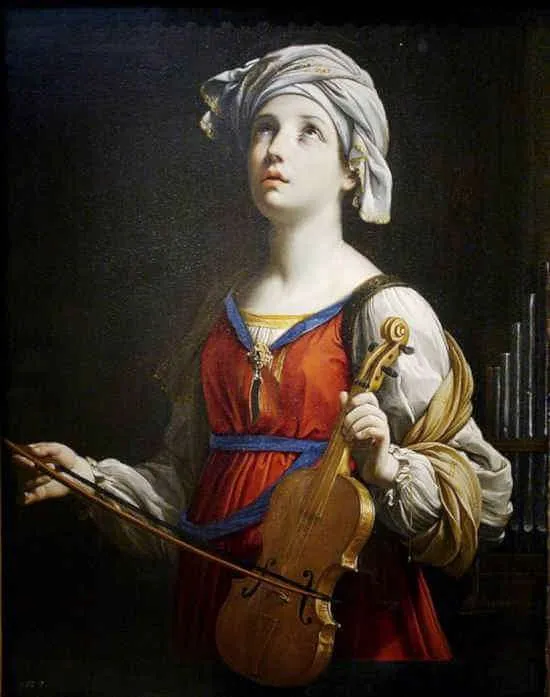
Saint Cecilia, Virgin and Martyr

Late Second or Early Third Century; Patron Saint of bodily purity, composers, luthiers, martyrs, music, musicians, musical instrument makers, poets, and singers; Pre-Congregation canonization

An ancient tradition holds that Pope Urban I, who served as the Holy Father from about 222–230, built a church in Rome over the house of a virgin martyr named Cecilia. By the fifth century, the church of Santa Cecilia in Trastevere had been either rebuilt or expanded, as it was also in the ninth and sixteenth centuries. The fact that today’s martyr had a church built in her honor, over the house in which she lived and died, helps explain how she has become so revered and honored throughout the many centuries since her death, despite the fact that little is known about her.

All we know for certain about Saint Cecilia is that she lived, was a follower of Christ, and died a martyr. Even the year of her death is disputed. Some place it as early as during the rule of Emperor Marcus Aurelius (176–180); others place it later, during the rule of Emperor Alexander Severus (222–235); still others place it somewhere in between. Though we do not have historical facts, we have an inspiring legend that was written down around the fifth century in a book called The Passion of Saint Cecilia. It is from that legend that this reflection on the life of this holy martyr is based.

Cecelia was born into a wealthy and noble family in the city of Rome during a time when Roman emperors and local prefects often persecuted Christians. Cecilia was not only a Christian with a very deep faith, she fasted, performed other penitential acts, and pledged her life to Christ and Him alone as His bride.

As a young woman, Cecilia’s father gave her in marriage to a nobleman named Valerian against her wishes. Young women at that time did not have the final say about whom they would marry. Like most Romans at that time, Valerian adhered to the Roman pagan religious practices. During their wedding, as the music played, Cecilia sang her own hymn in her heart. It was a hymn of praise to God, a beautiful prayer to her true Spouse in Heaven, which is why she later became the patron saint of musicians. After their wedding, before Valerian attempted to sleep with her, Cecilia revealed to her new husband that she was a Christian and that she had made a vow of virginity to her true heavenly Spouse. What’s more, Cecilia told Valerian that an angel of God was sent to her to guard her virginity, and the angel would deal fiercely with anyone who tried to violate it. Valerian asked to see the angel and Cecilia informed him that there was only one way. He had to go see Pope Urban I, receive catechetical instruction, and be baptized. Pope Urban had been in seclusion, living within the catacombs to avoid persecution and death from the Roman prefect. Valerian found him, was instructed in the faith, and baptized. When he returned to Cecilia, Valerian not only saw the angel who guarded her, he also saw her angel place on her head a dual crown of white lilies, symbolizing her purity, and red roses, symbolizing her martyrdom.

As a new Christian, Valerian shared his faith with his brother, Tiburtius, who also converted and was baptized. Valerian and Tiburtius then became very active with the underground Christian community, devoting themselves to good works, such as burying those who were martyred for their faith. Eventually, they came to the attention of the Prefect Almachius who ordered them to offer sacrifice to the Roman god Jupiter. When they refused, a Roman officer named Maximus was commanded to behead them. When Maximus attempted to carry out the command, he had a heavenly vision that led to his instant conversion. Once he professed his faith, he, too, was martyred with Valerian and Tiburtius by beheading, and Cecilia buried them.

Shortly afterward, Cecilia was arrested. The Prefect Almachius tried to convince her to save her life by offering sacrifice to the Roman gods, but she refused. Almachius was afraid that there might be backlash if he killed her publicly, since she was a beloved member of the community, so he ordered the guards to take her to her home, lock her in her bathroom, and boil water so that the steam would suffocate her, and her death could be blamed on an accident of her own making. The plot backfired and Cecilia survived. Outraged, Almachius ordered her beheading in her home. The soldier was dispatched and struck her neck once, twice, and a third time, but she remained alive, though badly injured. Roman law did not permit a fourth attempt at beheading, so the soldiers left her alone to die. 

Cecilia remained alive for the next three days, during which time the Christian community flocked to her home. She distributed all of her money and property to the poor, and donated her house to the pope so he could transform it into a place of Christian worship. Toward the end, she was in such great suffering that she could no longer speak. So, to honor God, she held up her thumb and two fingers to represent the Most Holy Trinity, and her index finger on the other hand to represent the one divine nature they shared.

When she died, she was buried in the Catacomb of Saint Callistus, and Pope Urban transformed her house into a church. Centuries later, in 821, Pope Paschal I moved her mortal remains from the catacomb to the church built by Pope Urban and later expanded. In 1599, in preparation for the jubilee year, Cardinal Paolo Emilio Sfrondati had her body exhumed, and she was found miraculously preserved. Her tomb is now under the main altar with a marble sarcophagus on top, made by the artist Stefano Maderno, who is said to have seen her miraculously preserved body in 1599. The sarcophagus depicts what he saw. She is clothed in a silk and gold dress; her face is turned to the ground. On one hand her three fingers honor the Trinity; on the other, her one finger honors Their shared divinity.

Despite the legendary nature of her story, God has used Saint Cecilia to inspire many through the centuries, and there is little doubt that the details of her life were passed down from generation to generation by word of mouth, until they were finally put in writing. Her name was inserted into the Roman Canon (Eucharistic Prayer I), along with other saints and Roman martyrs. The Basilica of Santa Cecilia in Trastevere remains a revered church in Rome to this day, where many enter to pray and beseech her intercession and are inspired as they kneel before the marble sarcophagus depicting her young martyred body awaiting her final resurrection with Christ, her divine Spouse.

Source: https://mycatholic.life/saints/saints-of-the-liturgical-year/november-22—saint-cecilia–memorial/

Saint Cecilia, Virgin and Martyr Read More »

Luke 20:37-38

Preparing for Eternity

“That the dead will rise even Moses made known in the passage about the bush, when he called  ‘Lord’ the God of Abraham, the God of Isaac, and the God of Jacob; and he is not God of the dead, but of the living, for to him all are alive.”

Reflection:

Jesus gives this response to some of the Sadducees who question Him about the resurrection of the dead. The Sadducees did not believe in the resurrection of the body, whereas the Pharisees did. Thus, the Sadducees asked Jesus about the resurrection of the body using an almost unheard of example. They refer to the levirate law found in Deuteronomy 25:5ff which states that if a married man dies before having children, the brother of that man must marry his wife and provide descendants for his brother. Thus, the Sadducees present the scenario where seven brothers die, each one subsequently taking the same wife. The question they posed was, “Now at the resurrection whose wife will that woman be? For all seven had been married to her.” Jesus answers by explaining that marriage is for this life, not the life to come at the resurrection. Therefore, none of the brothers will be married to her when they rise.

Some spouses have a hard time with this teaching, in that they love their spouse and desire to remain married in Heaven and at the time of the final resurrection. For those who feel this way, rest assured that the bonds of love we form on earth will remain and even be strengthened in Heaven. And when the end of the world comes and all of our bodies rise and are reunited with our souls, those bonds of love will remain stronger than ever. However, marriage, in the earthly sense, will be no more. It will be replaced by the pure love of the new life to come.

This teaching gives us reason to ponder further the beautiful teaching of our Lord about His return in glory and, as we say in the Creed, “the resurrection of the dead and the life of the world to come.” We profess this belief every Sunday at Mass. But for many, it can be hard to understand. So what do we actually believe? 

Simply put, we believe that when we die, our body is “laid to rest,” but our soul enters a moment of particular judgment. Those who remain in mortal sin are eternally separated from God. But those who die in a state of grace will eternally live with God. Most people who die will most likely die with some lasting venial sins on their soul. Thus, Purgatory is the grace of final purification that the person’s soul encounters upon death. Purgatory is simply the purifying love of God which has the effect of eliminating every last sin and imperfection, and every attachment to sin, so that the purified soul can see God face-to-face in Heaven. But it doesn’t stop there. We also believe that at some definitive time in world history, Jesus will return to earth and transform it. This is His Final Judgment. At that time, every body will rise, and we will live eternally as we were intended to live: body and soul united as one. Those souls who are in mortal sin will also be reunited with their bodies, but their body and soul will live separated from God forever. Thankfully, those who are in a state of grace and have endured their final purification will be resurrected and share in the new Heavens and new Earth forever, body and soul as God intended.

Reflect, today, upon this glorious teaching of our Lord that you profess faith in every time you pray the Creed. Keeping your eyes on Heaven and, especially, on the final and glorious resurrected state in which you will live in the new Heaven and Earth must become your daily practice. The more we live with this holy expectation, the more we will live here and now as a time of preparation for this final existence. Build treasure now in anticipation of this glorious day and believe that it is the eternity to which you are called.

Source: https://catholic-daily-reflections.com/2025/11/21/preparing-for-eternity-4/

Luke 20:37-38 Read More »