November 2025

John 6:40

Commemorating All Souls

“For this is the will of my Father, that everyone who sees the Son and believes in him may have eternal life, and I shall raise him on the last day.”

Reflection:

Yesterday’s Solemnity of All Saints gave us an opportunity to celebrate and rejoice in the fact that there are countless people who have gone before us who are now enjoying the glories of Heaven. These faithful souls lived lives that were grounded in God’s grace and have been fully purified of all sin. They now gaze at our good God face-to-face.

Today, we commemorate the fact that many who die in a state of grace are not immediately ready to stand before the glorious throne of God and see Him face-to-face. The only way this is possible is if every sin and every attachment to sin is purged from our souls. We must have nothing but pure charity alive within us if we are to enter the eternal glories of Heaven. But how many people die in such a state?

The Church, in her wisdom and holiness, has taught clearly through the centuries that when a person passes from this world to the next while still attached to less serious sin, they need to be fully purified in order to enter Heaven. This is Purgatory. The Catechism of the Catholic Church states: “All who die in God’s grace and friendship, but still imperfectly purified, are indeed assured of their eternal salvation; but after death they undergo purification, so as to achieve the holiness necessary to enter the joy of heaven. The Church gives the name Purgatory to this final purification of the elect, which is entirely different from the punishment of the damned” (#1030–31a).

For some, Purgatory can be a frightening and even confusing thought. Why doesn’t God, in His infinite mercy, simply take all our loved ones who followed Him straight to Heaven? The answer is simple. He does! And the path for them to Heaven is this incredible mercy of their final purification.

Purification of all attachment to sin within our soul is a mercy beyond what we can imagine. Through this final purification, God prepares the holy souls who have died for an eternity of joy. But this purification is necessary because God, in His love, does not want any soul to live eternally with even a minor attachment to sin. God wants us all free. The truth is that every sin on our soul, even the smallest one, is reason enough for us to be excluded from Heaven. So Purgatory must be seen as a final mercy from God by which He lifts every last burden that keeps us from perfect love, so that our eternity will be one of utmost freedom and ecstasy. God wants us to be filled only with the purity of love forever. Thus, upon our death, we are graced to enter into a final and intense purification of every minor sin, so that when we see God in all His glory, we will see Him with the perfection to which we are called. Purgatory is a gift, a grace, a mercy. It will be painful to go through in the same way that overcoming any sin is painful. But the good fruit of freedom from sin makes every final purification we must endure worth it a hundredfold and more.

Reflect, today, upon the spiritual truth that God wants you to be a saint. If you are among those few who die in a state in which you are purified from every sin, then be assured that you have already completed your purgatory on earth. But if you or your loved ones are among the many who still hold some minor attachment to sin at the time of death, then rejoice that God is not done with you yet. Anticipate with much gratitude the final purification that awaits and look forward to the freedom that ultimately comes from that purification.

Source: https://catholic-daily-reflections.com/2025/11/01/commemorating-all-souls-4/
John 6:40 Read More »

All Saints’ Day

Holy Day of Obligation

Today, we celebrate the Solemnity of All Saints, a celebration honoring all men and women who have entered Heaven. While this includes every soul in Heaven, the focus is particularly on those who led extraordinarily holy lives on earth and that the Church has canonized as saints. These individuals honored God in a variety of ways: through deep prayer and mystical union, through enduring martyrdom or other forms of religious persecution, and through acts of service, such as caring for the needy or teaching the faith. Some saints were powerful preachers or miracle workers. Others were leaders, some lived in obscurity, and still others experienced exile or made significant personal sacrifices for their faith. In various ways, these saints glorified God during their lifetimes.

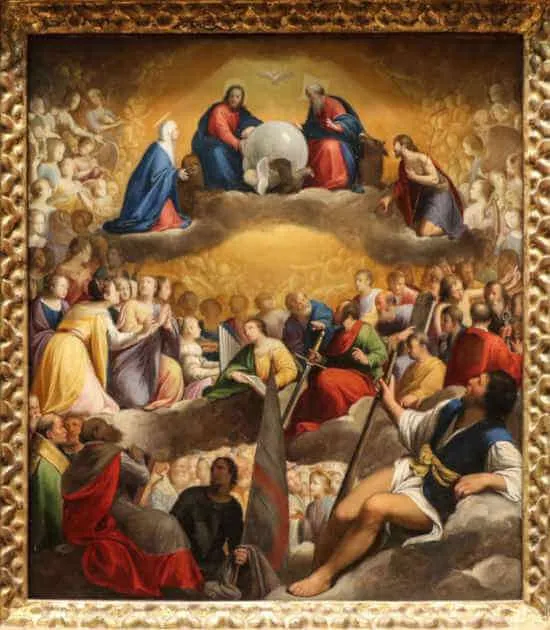
By honoring this host of saintly witnesses, we honor and glorify God through their lives. By honoring them, we honor Him Who made them holy. This liturgical solemnity is but a foretaste of the eternal Solemnity of Heaven. Heaven will be the eternal glory of God through the lives of all His saints. In Heaven, the virtues, sacrifices, prayers, and selfless service of all the saints will radiate as beacons that eternally manifest the great mercy and goodness of God. The life of every saint in Heaven will become a continuous chorus of praise and worship of God, intertwined with the nine choirs of angelic hosts. With the Seraphim, Cherubim, and Thrones, the saints will cry “Holy, Holy, Holy…” With the Dominions, Virtues, and Powers, the saints will participate in God’s providential care of the New Heavens and Earth. With the Principalities, Archangels, and Guardian Angels, the saints will celebrate God’s protection and continuous communication with all of His sons and daughters. Heaven today, as well as the New Heavens and Earth at the end of time, will be nothing other than a continuous solemn celebration of all that God is in His essence and all that God has done in the lives of those who responded to His grace.

Honoring the saints also becomes an invitation to each one of us on earth to strive after the holiness the saints attained. The saints give us an example; their lives are a “how to” book in holiness. The lives of the “super saints”—such as the Blessed Virgin Mary and Saints Francis of Assisi, Catherine of Siena, Teresa of Ávila, Thérèse of Lisieux, Augustine of Hippo, and Thomas Aquinas—should be studied and pondered so that we can learn from their example.

We must also remember that, from Heaven, the saints become powerful intercessors for us on earth. It is true that God could deal directly with us without using the mediation of angels and saints. He chooses to use secondary causes, while He always remains the First Cause and Source of all grace. The saints and angels are among those secondary causes God chooses to mediate His grace. For that reason, we should rely upon their intercession. Doing so is an act of faith by which we profess our belief in God, using the saints and angels as His instruments.

Today’s solemnity has its roots in the earliest days of the Church. Even in the New Testament times, martyrs were honored by the community of believers, beginning with the deacon Saint Stephen, the first martyr. As the first century of the Church unfolded, others began to suffer persecution and death at the hands of Roman emperors, and the Church honored their deaths. In 64, Emperor Nero was the first to organize a persecution of Christians in Rome, taking the lives of Saints Peter and Paul, and many others. After this first persecution in Rome, other Roman emperors systematized various persecutions throughout the entire empire. The worst persecution took place under Emperor Diocletian from 303–311. During that persecution, churches and sacred texts were destroyed; Christians lost their property, legal rights, and lives; and those who were not killed were imprisoned and tortured. Some estimate that during the Diocletian persecutions, there were as many as 3,500 martyrs. Although there is no way to confirm the exact number, there were many.

In the fourth century, after Christianity was legalized in 313 by Emperor Constantine I, who became a Christian himself and began building churches and monuments to the martyrs, public devotion to the martyrs began to flourish. Their graves became churches and places of pilgrimage and prayer. On May 13, 609, Pope Boniface IV transformed the Pantheon in Rome, a former pagan temple, into a church dedicated to the Blessed Virgin Mary and all martyrs. The annual celebration of its dedication also honored the Blessed Virgin Mary and all martyrs. On November 1, 731, Pope Gregory III dedicated an oratory within Saint Peter’s Basilica to “all saints” that included the Apostles, martyrs, confessors, and all holy men and women throughout the world. This broadened the commemoration of the saints beyond the martyrs to all who lived saintly lives. In 844, Pope Gregory IV extended the November 1 celebration to the entire Church. In 1484, Pope Sixtus IV made November 1 a holy day of obligation for the entire Church and added a vigil day and octave to follow, making the celebration nine days in all. The vigil celebration for All Hallows’ Day was called All Hallows’ Eve, or Halloween. Unfortunately, in many places, Halloween has lost its Christian and saintly focus and has become a secular, and even pagan, celebration.

As we honor all the saints in Heaven today, ponder the fact that you are called to be among their company. The extent to which you become holy while on earth is the extent to which your life will be an eternal glorification of God. Seek a profound depth of holiness. Don’t just try to remain in a state of grace. Seek an abundance of grace. Strive to grow in virtue. Purge all sin, even small sins, from your life. Pray as often as you can. Read about the saints. Ponder the Scripture. Act with generosity and charity. Forgive everyone. And do everything you can to become the super saint God wants you to become.

Source: https://mycatholic.life/saints/saints-of-the-liturgical-year/november-1–all-saints/

All Saints’ Day Read More »

Matthew 5:1-3

Honoring All Saints

When Jesus saw the crowds, he went up the mountain, and after he had sat down, his disciples came to him. He began to teach them, saying: “Blessed are the poor in spirit, for theirs is the Kingdom of heaven.”

Reflection:

Today we celebrate one of the most glorious solemnities within our Church! Every saint, canonized or not, is honored today. Our Gospel passage lays out the path by which these saints entered Heaven. While on earth, these great men and women lived lives that were poor in spirit, filled with a holy mourning, meekness, a hunger and thirst for righteousness, mercy, peace, purity of heart and even persecution. Each one of these Beatitudes concludes by stating the reward that those who lived these qualities obtains: Heaven, comfort, satisfaction, mercy, seeing God, being children of God and rewards beyond what we can imagine in God’s Kingdom.

The Beatitudes invite us to the heights of holiness. They are not for the faint of heart or for those living a lukewarm spiritual life. These Beatitudes present us with the pinnacle of holy living and challenge us to the core. But every effort put into living these Beatitudes are worth it here on earth and ultimately in Heaven. Let’s look briefly at two of these Beatitudes.

The second Beatitude states that those “who mourn…will be comforted.” This is an interesting Beatitude. Why is it holy to mourn? Simply put, this form of holy mourning means that you not only have a holy sorrow for your own sins but that you have this holy sorrow as you see the many evils within our world. This is crucial today. First, it should be quite obvious that we must have holy sorrow for our own sins. Doing so means your conscience is working. And when your conscience is working, you will be compelled, by this holy sorrow, to acknowledge your offenses against God and work diligently to change. But we must also have a holy sorrow as we see the many evils within our world. Too often today there is a tendency to undermine this Beatitude by presenting universal acceptance of all things as a good. We are told we must not judge, and though that is true when it comes to judging another’s heart, a worldly presentation of this secular “virtue” attempts to lead us to downplay the objective nature of sin. Our secular world tempts us to ignore many objective moral truths by which God guides us into all truth. But as Christians, our first approach must be to despise all that our Lord taught was objectively morally evil. And when we do come face-to-face with immoral lifestyles, the appropriate response must be holy sorrow, not acceptance of grave sin. To mourn over another’s poor choices is a true act of charity toward them.

The fourth Beatitude calls us to “hunger and thirst for righteousness.” This means that we not only have a holy sorrow over our sins and the objective evils of our world, but that we also allow ourselves to be filled with a hunger and thirst for truth and holy living. This drive must become a burning motivation within us to do all we can to further the Kingdom of God everywhere. This Beatitude enables us to overcome indifference, inspiring us to bring about change in the face of all opposition. And this drive is fueled by charity and every other accompanying virtue.

Reflect, today, upon the beautiful truth that you are called to become a saint. And the surest path to sainthood is the Beatitudes. Read them carefully. Meditate upon them and know that they reveal to you how God is calling you to live. If one of these Beatitudes stands out to you, then spend time focusing upon it. Work to internalize these graces, and God will work wonders in your life, one day making this solemnity within our Church a true celebration of your life well lived.

Source: https://catholic-daily-reflections.com/2025/10/31/honoring-all-saints-4/

Matthew 5:1-3 Read More »