2024

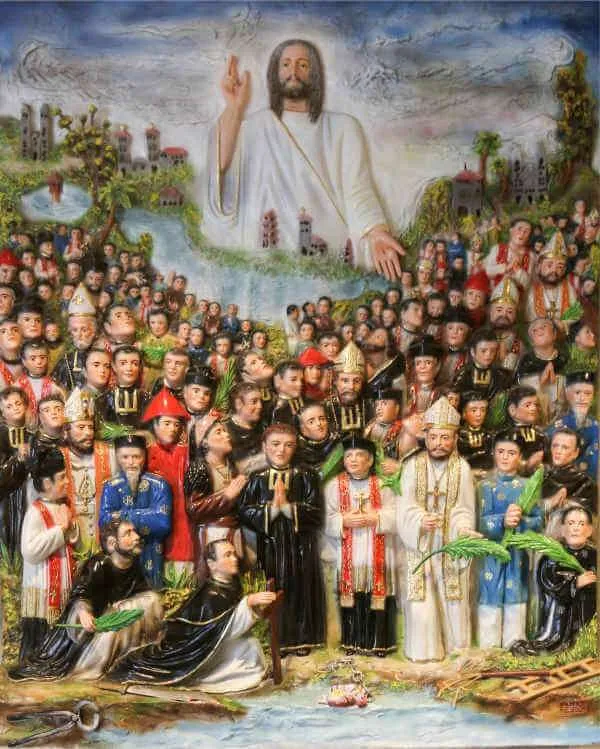
Saint Andrew Dung-Lac, Priest and his Companions, Martyrs

Seventeenth–Nineteenth Centuries; Patron Saints of Vietnam; Canonized by Pope John Paul II June 19, 1988

From the seventeenth to nineteenth centuries, an estimated 130,000 to 300,000 men, women, and children; bishops, priests, and religious suffered martyrdom in Vietnam because they refused to renounce their Catholic faith. They were arrested, brutally tortured, and killed. Their torture was methodical, diabolical, and orchestrated to impose the maximum pain over the longest period of time possible. To escape that fate, all those arrested had to do was renounce their faith, step on a crucifix, or blaspheme Christ. If they did, they were granted kindnesses by the imperial courts. If they didn’t, their suffering grew more intense until they died.

In March of 1533, some records show that a European missionary named I-nê-khu (Ignatius—possibly a priest) began to preach the Gospel in Nam Định, northern Vietnam. In 1550, a Dominican priest is believed to have arrived in southern Vietnam, and between 1615 and 1627, Jesuits arrived. Among these early Jesuits, Fathers Alexander de Rhodes and Antoine Marquez, from Avignon, France, made the biggest impact by initiating the first formal program of evangelization. They arrived in 1627, and by 1630 they reported 6,000 converts. Though they were expelled from Vietnam twice, they completed a Romanized version of the Vietnamese alphabet and published a catechism and other liturgical books in Vietnam that enabled them and subsequent missionaries to communicate the faith in the local language. By 1660, there were an estimated 100,000 converts to Catholicism. Their success was attributed to their method of forming lay catechists who, in turn, spread the faith to their fellow citizens.

As the faith grew rapidly, suspicion arose among the feudal lords and others in the governing party. Christianity challenged practices in Buddhism, Confucianism, and ancestor worship, which were all central parts of Vietnamese culture. As the missionaries grew in popularity, there were also growing concerns that the Europeans might seek to colonize Vietnam. As fear and anger within the feudal lords and their ruling party began to reach critical levels, persecutions began. Actual records of all martyrs are lost to history. Andrew of Phú Yên, a nineteen-year-old Vietnamese catechist, is believed to have been the first martyr. In 1644, the local Mandarin ruler received orders from the feudal lord that he should expel the Jesuits and do what was necessary to stop the spread of “foolish opinions” of the Catholic faith. Andrew of Phú Yên was arrested at the home of Father de Rhodes and told to renounce his faith. He wouldn’t do so. He was beaten but exuded joy. He was then sentenced to death by hanging. Though his name was not included in the 1988 canonization, Andrew of Phú Yên was beatified in March 2000 and honored as the protomartyr of Vietnam.

Between 1659–1802, the Church in Vietnam began to be organized. In 1658, the Paris Foreign Missions Society was established, and two bishops were sent to form two dioceses. Shortly afterward, seven Vietnamese catechists were ordained priests, a women’s religious order was established, parishes were built, and the first Synod in Vietnam was held in 1670. Over the next seventy years, the Church in Vietnam continued to flourish with only minor persecutions and martyrdoms.

In 1742, Pope Benedict XIV issued an apostolic constitution which banned the ancestral worship and Confucian rites within the newly budding Asian churches of China, Japan, and Vietnam. This new restriction brought with it a serious wave of persecution in Vietnam. The imperial court saw this as an attack upon Vietnamese culture and society as a whole, since these Confucian rites were such an integral part of their national identity. Over the next sixty years, at least 30,000 Vietnamese Catholics were martyred as a way of trying to stop Catholicism’s growth. By 1802, there were three dioceses in Vietnam and approximately 320,000 Catholics.

In 1802, Emperor Gia Long unified north and south Vietnam and granted religious freedom to Christians. This was due, in large part, because Bishop Pigneau de Béhaine supported him in his ascension to the throne. However, his successor, Minh Mạng resumed the persecution of Christians in 1825. Though he sent a delegation to France to resolve the dispute and force the withdrawal of the missionaries, the French authorities ignored him. The next two emperors, Thiệu Trị and Tự Đức, increased persecutions. In 1868, Emperor Tự Đức issued a severe decree in which he divided his population into “good citizens—those who embraced traditional Vietnamese practices and religions” and “bad citizens—those who follow Christianity.” From 1820–1883, at least 100,000 Vietnamese Christians were martyred.

Within this period of persecution, a boy named Trần An Dũng was born into a poor non-Christian family. When he was twelve, his family moved to Hanoi to find work. In Hanoi, Trần met a Vietnamese catechist from whom he received shelter, food, and an education in the Catholic faith. Within a few years he was baptized, took the Christian name Andrew, and became a catechist. He was then chosen to study theology and was ordained a priest on March 18, 1823, at the age of twenty-eight. His priestly ministry led many to Christ. He fasted and lived a simple and morally upright life.

In 1835, Father Andrew was arrested but was ransomed by his parishioners using donations from the French Missionary Society. He then changed his last name to Lạc and moved to another territory to escape persecution. In 1839, however, he was arrested again, along with Fr. Peter Thi, whom Father Andrew was visiting so he could go to confession. They were both ransomed but arrested shortly afterward. This third time, they were brutally tortured, refused to renounce their faith, and so were beheaded in Hanoi on December 21, 1839. Father Andrew Trần Dũng-Lạc’s name is uniquely attached to this memorial as a representative of all Vietnamese martyrs, the 117 that are named, and the countless others who are unnamed and unknown.

In 1874, the French entered into the Treaty of Saigon, giving them control over southern Vietnam. In 1884, the Treaty of Huế was signed, which effectively reduced the Vietnamese emperor to a ceremonial role in the nation, with France taking control of the internal administration, military, and foreign policy. Though many citizens in Vietnam revolted against these treaties, French rule provided a safer environment for Catholics and missionaries, putting an end to the edicts of the previous century and the state-sponsored persecutions. Though some persecutions continued, they were more localized, rather than the result of imperial acts. Often, the Catholics were associated with the French colonizers, given that some of the missionaries were French, so rebellion against colonialism was sometimes taken out upon Catholics.

In addition to the 130,000 to 300,000 who suffered martyrdom between 1630–1886, countless others suffered as “confessors,” meaning, they suffered for the faith in ways that did not result in martyrdom. Many had to flee from their homes and villages, hide in the forests and mountains, or suffer exile to other countries, living in constant fear for their lives. Others had the words “ta dao,” meaning, “false religion,” written on their faces. Homes and property were confiscated, and whole villages were destroyed.

The French left Vietnam in 1954 after the defeat of French forces at Dien Bien Phu. A communist regime took control of the north, while a republic was formed in the south. As a result, there were mass migrations of Catholics to the south to avoid communist persecutions. After the Vietnam War ended in 1975 with the fall of Saigon, communism encompassed both north and south. Properties were confiscated, religious activity was restricted, priests and religious were imprisoned, and the government discriminated against lay Catholics.

Today’s memorial honors 117 martyrs who were initially beatified in separate groups: sixty-four in 1900, eight in 1906, twenty in 1909, and twenty-five in 1951. In 1988, Pope John Paul II canonized all these martyrs together, symbolizing the countless unnamed individuals who also gave their lives for their faith. Though the communist government of Vietnam failed to send delegates to the canonization of these holy martyrs, many thousands of exiled Vietnamese showed up in Saint Peter’s Square, and the very act of canonization resounded through the hearts and minds of the faithful within Vietnam. The group of 117 was made up of ninety-six Vietnamese, eleven Spaniards, and ten French. It includes eight bishops, fifty priests, and fifty-nine laypeople. Among the laypeople was a nine-year-old child, Saint Agnese Le Thi Thành.

As we honor this huge cloud of witnesses who gave their lives for their faith in a harsh and cruel environment, enduring some of the worst tortures ever committed in the history of the world, we are reminded that no matter how difficult life is, no matter how much we must endure, it is all worth it in the end. One of the martyrs who died in these persecutions was Father Jean-Théophane Vénard. He first became known through the writings of Saint Thérèse of Lisieux who had a deep devotion to him and was greatly inspired by his letters which were circulating at the time she was in the convent. Let’s conclude with a quote from Saint Théophane that Saint Thérèse copied and treasured: “I can find nothing on earth that can make me truly happy; the desires of my heart are too vast, and nothing of what the world calls happiness can satisfy it. Time for me will soon be no more, my thoughts are fixed on Eternity. My heart is full of peace, like a tranquil lake or a cloudless sky. I do not regret this life on earth. I thirst for the waters of Life Eternal.”

Source: https://mycatholic.life/saints/saints-of-the-liturgical-year/november-24—saint-andrew-dung-lac-and-his-companions-martyrs–memorial/

Saint Andrew Dung-Lac, Priest and his Companions, Martyrs Read More »
Luke 21:32-33

Relying Upon the Word of God

Amen, I say to you, this generation will not pass away until all these things have taken place. Heaven and earth will pass away, but my words will not pass away.

Reflection:

As we approach the final days of this liturgical year, we continue to read about the end of the world. Today we read that both Heaven and earth, as they currently are, will pass away. This is worth pondering.

We know that life is full of change. It has been said that the one thing that never changes is change itself. Everything else changes. But when it comes to earth, it is hard to believe that it will one day “pass away.” Some scientists believe that the earth has existed for over four and a half billion years. That’s a long time! Now consider the fact that Jesus prophesied the end of this earth as we know it today. When will it happen? Only God knows.

Heaven, as it exists today, is also prophesied by our Lord to pass away. Heaven, as it is right now, is a pure spiritual reality in which the only corporeal bodies present are those of Jesus and our Blessed Mother. The rest of Heaven consists of the Divine Essence, the souls of those who have been redeemed and the angels of God. But if Heaven even passes away, what awaits?

First of all, the only reason that these two realities, Heaven and earth, will pass away in their current form is because, at the Final Judgment, there will be a “New Heavens and a New Earth,” as spoken of in the Book of Revelation. At that time, Heaven and earth will be united as one, and this new creation will exist for eternity.

But is there anything that is currently eternal? Anything that will never experience change? We humans will be changed at the resurrection of the dead, the angels will encounter a new home, so to speak, and God will establish a new and permanent Kingship. But, according to Jesus’ teaching today, the one thing that will remain are His words: “…my words will not pass away.” Again, this is worth pondering.

In a world filled with change and uncertainty, we need some form of stability. And that stability is the Truth found in the Word of God. The Word of God, as revealed to us through the Scriptures, must become our rock foundation upon which our whole lives are built and exist. Pondering, praying with, meditating on, and believing the Word of God enables us to stand on firm and unchanging spiritual ground as we go through the change of this life and even the changes that will come at the end of time. Though this may seem somewhat mysterious in nature, it is a helpful truth to understand and believe. Everything will pass away except Jesus’ words. Thus, the most secure thing we can do in life is to cling to His words and never let go.

Reflect, today, upon the importance of truly immersing yourself in the Word of God. How much time do you spend each week reading it, praying with it and allowing it to become your daily food? The Word of God is not simply a book of teachings meant to inspire you or guide you. The Word of God is a Living Word. It is God in His unchangeable form. God, in His essence, will never change, and engaging Him through the revelation of His written Word is one essential way by which you will be able to experience true stability in life and prepare for each and every change to come until the final order of life is permanently established.

Source: https://catholic-daily-reflections.com/2024/11/28/relying-upon-the-word-of-god-3/

Luke 21:32-33 Read More »

Thanksgiving Day

Fourth Thursday in November

Thanksgiving is not only an American holiday, it is also celebrated as an optional liturgical memorial within the Catholic Church in the United States. Similar Church celebrations take place in many countries at different times according to local history and customs. Thanksgiving Day in the United States takes its roots from a feast of thanksgiving for the harvest that the English Pilgrims and the Wampanoag tribe shared at Plymouth in 1621. The governor appointed a day for public praise and prayer after the first harvest; legend holds that about ninety members of the Wampanoag tribe arrived unannounced and joined the fifty or so English settlers in a meal that lasted days and included provisions from both sides, such as fowl, fish, shellfish, stews, and vegetables. This first Thanksgiving led to a peace for more than fifty years.

In 1789 (the first year of the government under the Constitution), at the request of President Washington, Congress established a national thanksgiving observance on Thursday, November 26, “as a day of public thanksgiving and prayer to be observed by acknowledging with grateful hearts the many and signal favors of Almighty God.” The Congressional exhortation encouraged the people to “beseech Him to pardon our national and other transgressions, to promote the knowledge and practice of true religion and virtue, and to grant unto all mankind such a degree of temporal prosperity as He alone knows to be best.”

In 1817, New York State officially initiated an annual Thanksgiving holiday, and, in 1863, President Abraham Lincoln—soon after he had dedicated the cemetery at Gettysburg—issued a Thanksgiving proclamation in which he urged all citizens:

…to set apart and observe the last Thursday of November next, as a day of Thanksgiving… And I recommend to them that while offering up the ascriptions justly due to Him …, they do also, with humble penitence for our national perverseness and disobedience, commend to His tender care all those who have become widows, orphans, mourners or sufferers in the lamentable civil strife in which we are unavoidably engaged, and fervently implore the interposition of the Almighty Hand to heal the wounds of the nation and to restore it as soon as may be consistent with Divine purposes to the full enjoyment of peace, harmony, tranquility and Union.

Prior to this national institution of Thanksgiving, there is an earlier Catholic history of an “established” thanksgiving that took place in what is today Saint Augustine, Florida, with its seeds planted by the earliest Catholic explorers.

Exploration of what is today the United States of America began in 1492 with the arrival of Christopher Columbus, a Catholic. Columbus, however, never stepped foot on the mainland of what is today the United States. Instead, he discovered the Caribbean islands. In subsequent voyages, he discovered more Caribbean islands, Trinidad, and South and Central America.

In 1508, Juan Ponce de León established a settlement in what is today Puerto Rico. In 1513, de León and a small crew became the first recorded Catholics to step foot on what is today mainland United States. They landed near the modern-day city of Saint Augustine and then sailed by the Florida Keys before returning to Puerto Rico. He named the land Florida after the Spanish term “pascua florida,” meaning, “flowery festival,” because of the luscious and blooming flowers. With permission from the Spanish crown to colonize Florida, de León returned in 1521, but that trip was brief, possibly only a few weeks, because the natives attacked his party and fatally shot de León with an arrow.

In 1526 and 1539, other Spanish Catholic explorers arrived by sea and attempted to settle in what is now the mainland United States, without lasting success. In 1540, Francisco Vázquez de Coronado led an expedition from Mexico to the American Southwest and the Great Plains, including parts of modern-day Arizona, New Mexico, Texas, Oklahoma, and Kansas. He was searching for a fabled city of gold, which he did not find. Spanish Franciscan Father Juan de Padilla traveled with him and became the first martyr in North America from the arrows of the Kansas tribe.

In 1565, Spanish explorer Don Pedro Menéndez de Avilés arrived in Florida and founded the first European settlement that remains today. On that ship was Father Francisco López de Mendoza Grajales, the chaplain of the Spanish expedition. According to Father Francisco’s memoirs, they arrived at the coast of Florida on August 28, 1565, the feast of Saint Augustine of Hippo. Don Pedro named the landing spot after Saint Augustine in thanksgiving.

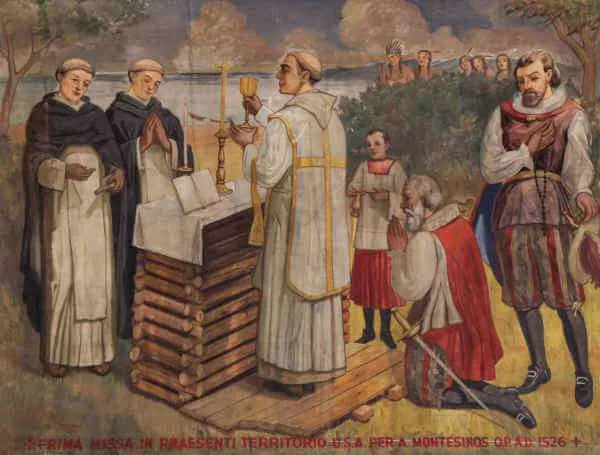
On September 8, 1565, the settlers—led by Don Pedro—disembarked and erected a cross, formally claiming the territory for both Spain and the Catholic Church. Following this, Father Francisco celebrated the first documented Mass on what is now U.S. soil. This Mass was on the Memorial of the Nativity of the Blessed Virgin Mary and expressed gratitude to God for the safe journey of the 800 sailors, soldiers, and settlers. The congregation also prayed for divine guidance for their future endeavors. 

Although previous explorers likely celebrated Mass privately among themselves, this particular Mass stood out because it attracted the local indigenous people. A celebratory meal followed the Mass, featuring salted pork, Spanish red wine, garbanzo beans, bread, Caribbean yucca, and other available foods. The native Timucua tribe joined the explorers for this inaugural Thanksgiving feast, making it the first known shared meal between Europeans and native people, more than fifty years before the Plymouth feast. Shortly afterward, Father Francisco founded the first Catholic mission in the mainland United States—Mission Nombre de Dios.

This story presents Catholics with the ideal way to celebrate Thanksgiving Day. The word “Eucharist” means “thanksgiving.” The Mass is, first and foremost, an act of thanksgiving on our part because the gift contained within the Mass, the one and eternal Sacrifice of Christ for the salvation of souls, must evoke within us nothing but gratitude for this unmerited gift. Our gratitude to God for the gift of His Body, Blood, Soul, and Divinity must then lead us to unity and fraternal charity and celebration. These first Catholics not only celebrated together, they also invited the natives whom they encountered. In truth, it might have been the grace of that first Mass that God used to draw the natives to a peaceful encounter with the settlers. The Mass must unite us and must be the source of all we do and all we are, both individually and collectively.

As we celebrate Thanksgiving Day, try to attend Mass as the first act of your day. If you are unable to do so, take time for prayerful reflection as an opportunity to give thanks to God for His countless blessings, and then invite Him to walk with you in life to all that lies ahead, so that your life becomes an invitation to others to feast at the table of our Lord.

Source: https://mycatholic.life/saints/saints-of-the-liturgical-year/thanksgiving—usa-optional-memorial/

Thanksgiving Day Read More »

Luke 17:17-19

Gratitude for Immeasurable Blessings – Being Ready, Always

“Ten were cleansed, were they not? Where are the other nine? Has none but this foreigner returned to give thanks to God?” Then he said to him, “Stand up and go; your faith has saved you.”

Reflection:

He was saved by faith through the expression of gratitude! What a wonderful story to ponder today as we celebrate the national holiday of Thanksgiving!

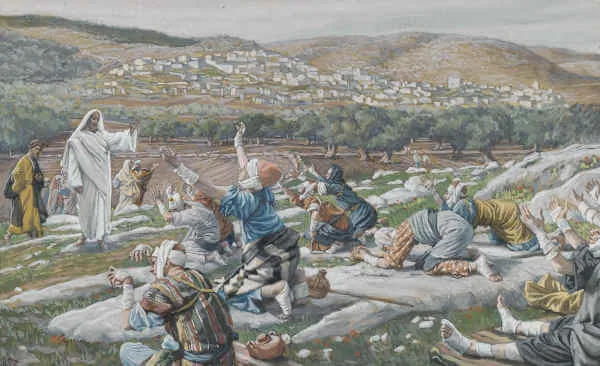
Though Thanksgiving Day is not specifically a Church holy day, gratitude is certainly central to our Christian faith, as is illustrated by today’s Gospel in which ten lepers were healed by Jesus. And their communal reaction is something of which to take note. Nine of them were healed and went about their business, not returning to the source of their healing to thank Him. But one did. This one leper, who was suddenly no longer a leper, returned to Jesus, glorified Him, fell at His feet and thanked Him. This one leper was a foreigner, a Samaritan, but he manifested a faith that we must all strive to imitate. The faith of this Samaritan was evident by the fact that he knew he needed to not only be grateful for the grace of healing but that he also needed to express it.

As we celebrate Thanksgiving Day, we are reminded that of all the things for which we must be grateful, nothing is more important than our gratitude to God for the immeasurable graces He has given us. But as the story goes, it is clearly very easy to overlook the importance of our response to God’s blessings. Only ten percent of the lepers responded with such an expression. Therefore, it is helpful today to examine the many reasons we should be thankful and should work to express that gratitude to God.

First, God created us out of love. This is no small gift. It is the first gift He has given us and one we often take for granted. God did not need to create us. He did not need to create you. But He did. And the gift of life, the gift of an immortal soul, is something that we must never overlook and always rejoice in.

Second, God entered our fallen state through the Incarnation within the womb of the Blessed Virgin Mary. Doing so elevated our fallen human nature to a height never known before. Humanity and divinity were united in the Person of the Incarnate Son of God and Son of Man, and we must be grateful for this unmerited and awe-inspiring gift.

Third, we know the rest of the story. God, in the Person of the Incarnate Son, suffered, died and rose again. In so doing, He made it possible for every sin of ours to be wiped away. As we die with Him, we are invited to rise with Him. And as we rise with Him, we are invited to share in His glory in Heaven.

Lastly, in each and every life, there are countless graces given to us every day. But as spoiled children, we often overlook these blessings and take them for granted. Examples here do not suffice. It is essential that if you want to have a grateful heart that you learn to see these blessings in your own life. Too often we focus on our struggles and pain. But the blessings are abundant, and the more we turn to our Lord in total surrender, the more the blessings flow.

Reflect, today, upon the attitude that you have toward the many blessings God has bestowed upon you. Begin by considering the central blessings of God’s creation and His saving acts of love. From there, try to ponder the many small ways that God has been with you, guided you, strengthened you, and blessed you abundantly. If you do not see these clearly, then use this day to consciously listen so that God can reveal them to you. As you see your blessings, respond as this one leper. Turn to Jesus, glorify Him, fall at His feet in prayer and thank Him. Doing so will fill you with the same saving faith granted to this one leper.

Source: https://catholic-daily-reflections.com/2024/11/27/being-ready-always-2/

Luke 17:17-19 Read More »

Saint Columban (Columbanus), Abbot

543–615; Patron Saint of motorcyclists; Invoked against floods; Pre-Congregation canonization

Columban (commonly called Columbanus in Latin) was born in the Kingdom of Leinster, on the southeast coast of Ireland, a century after Saint Patrick brought the Catholic faith to the island. Writing shortly after Columban’s death, his first biographer and fellow monk, Jonas, states that when Columban’s mother was pregnant with him, she had a dream of the sun rising from her womb. She later interpreted her dream to mean that her child would be a man of incredible genius, shining the light of faith upon the people of God whom he would serve. Because of this dream, Columban’s mother took great care in raising her son, protecting him from every evil influence. He was tutored at home, studying the liberal arts and excelling in his pursuit of knowledge.

As Columban grew, he became acutely aware of worldly temptations, especially those of the flesh, and guarded himself carefully from all sin through his prayer and Scripture study. After being counseled in this area by an old and wise woman, Columban decided to heed her warnings and enter a monastery. His mother was deeply distressed by his decision and tried to stop him, even lying across the threshold of their home. Columban courageously stepped over her, exhorted her to trust in God, and informed her that though she would never see him again in this life, he would obey the will of God and go wherever God led him.

He first traveled north to Cleenish Island (Cluain Inis, in modern-day Northern Ireland) where he studied Scripture under the saintly Abbot Sinell. Around the age of twenty, Columban traveled about 100 miles east to the coast of Ireland and entered the monastery in Bangor, becoming a monk under Abbot Comgall, another saintly man. In Bangor, Columban embraced a life of study, deep prayer, and severe asceticism, in accord with the ideals of Irish monasticism at that time. He was ordained a priest and spent thirty years at the monastery, preparing himself for what would become his second vocation.

At the age of fifty, Father Columban sensed God calling him to leave his homeland and become a pilgrim and missionary for Christ, a peregrinatio pro Christo. After the fall of the Roman Empire in the late fifth century and the subsequent invasion of those lands by pagan barbarian tribes from the north and east, the Church in what would become modern-day Europe was struggling. Monasteries and the clergy were in need of reform, political instability was common as new rulers vied for power, theological disputes from heretics lingered, and pagan practices were reintroduced as invaders moved in. Since the Church in Ireland had been isolated from the rest of the Roman Church, it instead enjoyed relative stability. Father Columban desired to extend that stability to the people of Europe.

After Abbot Comgall reluctantly agreed to Father Columban’s request, Father Columban and twelve other monks set sail for Gaul, modern-day France. They first crossed the Irish Sea to England, and from Cromwell crossed the English Channel, landing in Saint-Malo, France. The king of that region was Good King Gontrand, as Saint Gregory of Tours called him. King Gontrand had lived a sinful life of fleshly indulgence as a young man, but remorse led him to a radical conversion. Afterward, he was known as a holy man who cared for all of his subjects as a father. His penitential life drew him into deep union with God, and miracles were attributed to him during and after his life. After death, by popular acclaim, he was declared a saint.

The arrival of Father Columban and his companions delighted King Gontrand, as he found in them a depth of fervor that was lacking within his kingdom. He gifted them an ancient Roman fortress in Annegray for their first monastery, near the border of modern-day northern Switzerland and southern Germany. Though the fortress was in ruins, the monks restored it and turned it into a school. The school grew so rapidly that the monks had to expand to a nearby property in Luxeuil. Soon after, they expanded to another location in Fontaine, about an hour’s walk to the north.

Given the fact that the Frankish Church in which he established his first monasteries was struggling, the people were immediately drawn to Father Columban and his fellow monks. In them, they discovered men who were faith-filled, ascetical, wise, and pastoral. Lives were changing, and this caught the attention of the local bishops. The envious bishops began to find fault with these Irish monks, criticizing them for introducing Irish traditions that were contrary to the Roman ones. The Irish monks celebrated Easter on a different day, following the Eastern tradition. They also used the Celtic tonsure, in which the front half of the monk’s hair was shaved, in opposition to the Roman tonsure, in which the head was shaved in a circle on top of the head, representing the crown of thorns. The bishops deposed Father Columban, demanding that he appear before them at a local council. Instead, Father Columban wrote them a letter, encouraging them to focus on more important issues facing the local church. Father Columban wrote to Pope Gregory the Great, asking him to intervene, but the Holy Father died about the time his letter was received. He attempted the same with Pope Boniface IV, but it is unclear if he received a response. Eventually, it appears the monks embraced the local culture.

During the remainder of his years in Luxeuil, Father Columban wrote a foundational monastic rule called the Regula Monachorum. This “Rule for the Monk” was an important document that articulated the daily life of monasticism, including the monk’s prayer, communal life, obedience, manual labor, and strict austerity and asceticism, which was far stricter than the Rule of Saint Benedict that eventually won out as the normative rule for monks in the West. Father Columban also wrote a supplement to the rule, a guide for Confession which emphasized the importance of imposing a penance that was proportional to the sin, and a collection of instructions that gave practical advice on morality, humility, charity, and love of God. He also left behind a number of sermons, letters, poetry and hymns.

Being a man of great faith and courage, Father Columban openly chastised King Theuderic II, a successor to Good King Gontrand, who was living in an adulterous relationship. This led to Father Columban’s exile, along with the remainder of the Irish monks, leaving only those from Gaul (France) who had joined them after their arrival. After being forced onto a boat that was to sail to Ireland, the boat was driven off course by a storm and returned to the French mainland. The captain saw it as a sign from Heaven and parted ways. Father Columban then spent the next few years traveling with his monks across France, Switzerland, and southern Germany, eventually settling in northern Italy where they built the famous Bobbio Abbey, where Father Columban died a few years later.

Saint Columban spent the first half of his life being formed in Irish monasticism. When the appointed time came, God sent him and his fellow monks to help restore the faith to the troubled parts of Europe. After his death, the few monasteries he founded expanded to over 200 new foundations. He is remembered for his zeal, his miracles, his authority over animals who listened to his commands, his rigorous monastic rule, and his pastoral guide on the celebration of the Sacrament of Confession and the imposition of appropriate penances. Though his courage and boldness led to persecution and discord, that discord resulted in changes within a broken Church.

As we honor this holy monk, ponder the fact that it is never too late to do great things for God. Saint Columban began his missionary journey at the age of fifty and continued to forge new paths for the Gospel until the time of his death in his early seventies. In imitation of him, renew your commitment to the proclamation of the Gospel and the apostolate to which God is calling you. Age, wisdom, and experience are all tools God can use, just as He did with Saint Columban.

Source: https://mycatholic.life/saints/saints-of-the-liturgical-year/november-23—saint-columban-religious–optional-memorial/

Saint Columban (Columbanus), Abbot Read More »

Luke 21:14-15

Responding with Grace

Remember, you are not to prepare your defense beforehand, for I myself shall give you a wisdom in speaking that all your adversaries will be powerless to resist or refute.”

Reflection:

This line is embedded in today’s Gospel in which Jesus makes it clear that His followers will be persecuted. Many of them will be seized, sent to prison, hated and even be put to death. For some, this will even happen at the hands of their own family. But Jesus tells them this to prepare them and to let them know that these persecutions will enable them to give testimony to Jesus. The Gospel passage above explains how they are to do this.

First of all, giving “testimony” especially means they are to be a witness to Christ. And one of the best ways such a witness is fulfilled is through the various forms of martyrdom. To be a martyr is to be a witness. And those who suffer persecution for the sake of Christ, and then respond to that persecution in accord with the wisdom and inspiration of Jesus, are true martyrs. It’s helpful to note that if one is persecuted and responds with anger or returns the violence in accord with their own irrational will, then they are no martyr. They simply become what they have received. They become angry and bitter people. Being a martyr requires both unjust treatment and a response to that mistreatment in accord with God’s will. For that reason, though persecution is never initiated by God, it does offer the Christian an opportunity to deeply conform themself to Christ by responding as He dictates.

Jesus says that responding to persecution requires that we not prepare a defense beforehand. In part, this is because there is great temptation one experiences when persecuted by another. It is very understandable that when a person experiences persecution in any way, they will encounter anger and be tempted to fight back in a way that is uncharitable and only furthers the disorder. Responding to persecution in accord with the will of God requires great attentiveness to the promptings of the Holy Spirit, great humility, and unwavering charity directed at the one doing the persecution. Therefore, Jesus makes the promise that He will be with you in such situations and will give you “a wisdom in speaking that all your adversaries will be powerless to resist or refute.” What a grace! But this grace is only available to those who rely completely upon Christ, and not upon their own disordered passions and emotions.

Reflect, today, upon this promise from Jesus. Some will encounter little persecution in their lives at various times. But others will encounter severe persecution in various ways, even from their family. Reflect upon any ways that you have experienced the unjust treatment of another and then reflect upon your response. Were you able to immediately forgive? Were you able to set aside your anger, wounded pride and desire for revenge? Were you able to keep your eyes on Christ and rejoice that you have been found worthy to share in the ridicule, persecutions and sufferings that Jesus endured? Pray that you will always be open to the grace of this promise of Jesus so that you will always respond to everyone in accord with the wisdom of God.

Source: https://catholic-daily-reflections.com/2024/11/26/responding-with-grace-3/

Luke 21:14-15 Read More »

Saint Clement I, Pope and Martyr

c. 35–c. 99; Patron Saint of sailors, mariners, sick children, and stonecutters; Pre-Congregation canonization

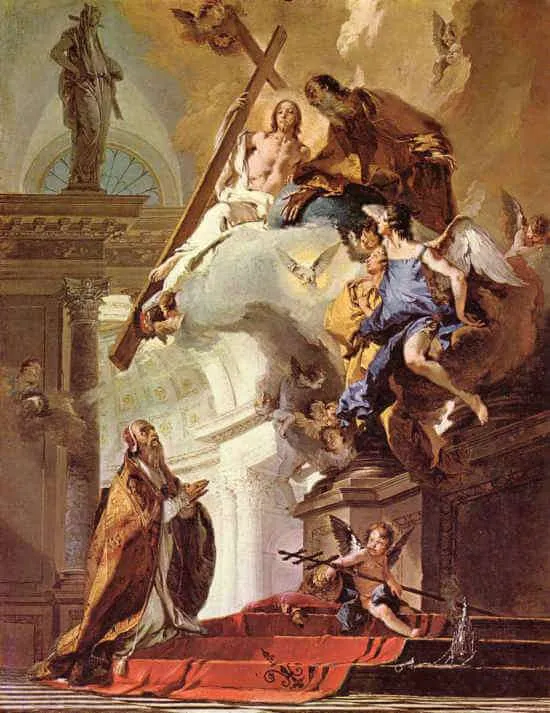
Saint Peter, the first pope, was martyred around the year 64. After him, Saint Linus became pope and died around 76. He was succeeded by Saint Cletus (Anacletus), who was martyred around 88 or 92. Today’s saint, Pope Saint Clement I, succeeded Saint Cletus, making him the fourth pope. This early papal succession is clearly presented in the Roman Canon (Eucharistic Prayer I), in which the saints are listed. The first listing of the saints begins with “…the glorious ever-Virgin Mary, Mother of our God and Lord, Jesus Christ, and blessed Joseph, her Spouse, your blessed Apostles and Martyrs…” Then, the Apostles are listed, including Saint Paul, followed by the first three popes who succeeded Saint Peter: “Linus, Cletus, Clement…”

Saint Peter arrived in Rome following a persecution, leading to the establishment of the papacy in the city of Rome. Around 44, James the Apostle, son of Zebedee, was beheaded by Herod Agrippa in Jerusalem. Shortly afterward, Saint Peter was arrested but was miraculously released from prison with the assistance of an angel. After Peter gained his freedom, the Acts of the Apostles states, “…he left and went to another place” (Acts 12:17). Although Peter might have traveled to various places, Saint Paul writes that he met Peter in Antioch (Galatians 2:11). Thus, it is believed that Peter first established himself as the Bishop of Antioch before traveling to Rome. After appointing a successor in Antioch, and possibly Corinth, Peter is generally believed to have traveled to Rome around the year 54 or 55. While in Rome, he led the Church and wrote two letters. The early Church theologian Tertullian (c. 155–c. 220) wrote about the importance of apostolic succession and stated that Saint Clement, whom we honor today, was “ordained in like manner by Peter.” Therefore, Clement not only knew Saint Peter but was also ordained by him, either as a priest or a bishop.

Little is known about Pope Saint Clement’s early years. However, his pontificate greatly enriched the Church, not only through his martyrdom but also through a letter he left behind, addressed to the nascent Church in Corinth. Saint Clement is one of three early Church Fathers who hold the title “Apostolic Father,” alongside Saint Ignatius of Antioch and Saint Polycarp of Smyrna. The Apostolic Fathers are those who personally knew the Apostles and received the Gospel from them, becoming the first heirs and successors to the Apostles. Regarding Pope Saint Clement, Saint Irenaeus (c. 130–c. 202) wrote, “This man, as he had seen the blessed apostles and had been conversant with them, might be said to have the preaching of the apostles still echoing [in his ears], and their traditions before his eyes.”

Pope Saint Clement’s lengthy and heartfelt letter to the Church in Corinth addressed the community’s internal conflict and division. The Corinthians sought guidance from Pope Clement, who was delayed in responding, likely due to the persecution in Rome under the policies of Emperor Domitian. In his letter, Pope Clement begins by saying, “Owing, dear brethren, to the sudden and successive calamitous events which have happened to ourselves, we feel that we have been somewhat tardy in turning our attention to the points respecting which you consulted us…” With the death of Emperor Domitian in 96 and a temporary pause in persecution, Pope Clement was able to address the issues facing the Church in Corinth.

Pope Clement’s letter from Rome to the Corinthians serves as one of the earliest indications that the young Church recognized the authority residing in the See of Rome, initially occupied by Peter. His letter is both doctrinal and pastoral, and it was often read and revered in the early Church alongside the canonical Gospels and letters in the New Testament, although it is not included in the New Testament. To continue quoting Saint Irenaeus concerning Clement’s letter to the Corinthians, he wrote, “In the time of this Clement, no small dissension having occurred among the brethren at Corinth, the Church in Rome dispatched a most powerful letter to the Corinthians, exhorting them to peace, renewing their faith, and declaring the tradition it had recently received from the apostles…”

In addition to addressing the divisions, Pope Clement articulates the hierarchical structure of the Church, noting that the Father sent the Son, the Son sent the Apostles, and the Apostles sent their successors, and so forth. This sacramental structure proceeds from the Father in Heaven in an ordered manner through ordination.

At the beginning of the year 98, Trajan became emperor and was mostly mild in his approach to Christians, although he was not hesitant to execute or exile them if they refused to renounce their faith and honor the Roman gods. According to a fourth-century legend, Pope Clement was arrested by Emperor Trajan and exiled to the Tauric Chersonese (modern-day Crimea), where he was forced to work in a stone quarry. There, his co-prisoners, some of whom were also Christians, were starving and dehydrated. Pope Clement saw a lamb appear and, believing it a sign from Heaven, struck the ground with his ax, causing a spring of water to gush forth. This led to the conversion of many other prisoners. When this news reached the emperor, he was outraged at Pope Clement’s popularity and ordered his execution. An anchor was tied around Clement’s neck, and he was thrown into the Black Sea. The legend continues that in the mid- to late-ninth century, the brothers Saints Cyril and Methodius miraculously found his body and brought it to Rome, where it is now buried in the Church of Saint Clement.

Pope Saint Clement is among the many men and women who helped the early Church to grow and prosper. His unique role as a successor made him one of the few who became that “rock” upon which Jesus built His Church. The Church continues to grow and prosper today, thanks to the unique role of the pope and his ongoing authority to hold the “keys to the Kingdom of Heaven” to bind and loose in accord with God’s wisdom and will. Though a successor to Saint Peter might err in his personal life or in prudential decisions, when speaking definitively from the Chair of Peter, the pope will never mislead the Church, and the rock foundation will never crumble.

As we honor this early pope, pray for our current pope. Pray for his wisdom, openness to the Holy Spirit, and holiness of life. The Church throughout the world prays for the pope every day for a reason. The pope needs our prayers and the guidance of the Holy Spirit. Add your prayers to the many so that our Holy Father, the successor of Saints Peter, Linus, Cletus, and Clement, will shepherd the Church with both the mind and heart of Christ Himself.

Source: https://mycatholic.life/saints/saints-of-the-liturgical-year/november-23—saint-clement-i-pope-and-martyr—optional-memorial/

Saint Clement I, Pope and Martyr Read More »

Luke 21:5-6

Remain At Peace in All Things

While some people were speaking about how the temple was adorned with costly stones and votive offerings, Jesus said, “All that you see here—the days will come when there will not be left a stone upon another stone that will not be thrown down.”

Reflection:

In a literal way, this prophecy of our Lord came true. In 70 A.D., the Temple upon which they were commenting was destroyed. After prophesying this, Jesus then goes on to warn the disciples that there will be many confusions that will come. There will be false prophets, wars and insurrections, powerful earthquakes, famines, plagues, “and awesome sights and mighty signs will come from the sky.” Why does Jesus prophesy all of these things?

The answer was simple. He was not trying to scare them. He was not simply trying to satisfy their curiosity. Instead, He was warning them and preparing us all so that we do not become misled or terrified when they come. He says, “See that you not be deceived” and “do not be terrified.”

As the old saying goes, “Life is not a bowl of cherries.” While we live in this fallen world, chaos, confusion, deception, abuse, scandal, conflict and the like will be all around us. And when we do come face-to-face with any such difficulty, there is a temptation to fear, anger and despair. Be it family conflicts, civil unrest or even divisions within the Church itself, God wants us to remain at peace and to trust Him always.

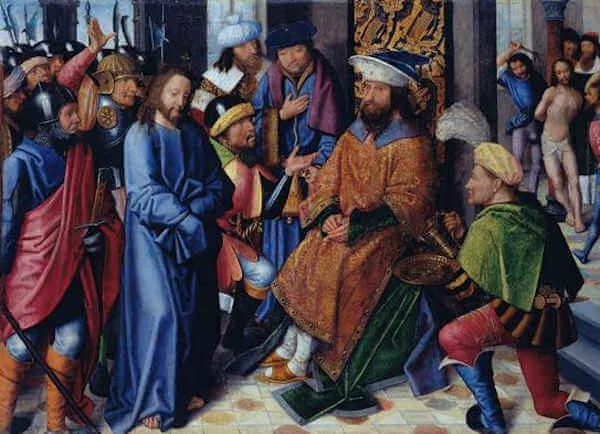
Take Jesus’ own life as an example. He was arrested, falsely accused, sentenced to death and crucified. And through it all, He remained at peace, knowing that His suffering would become the very source of new life. God can use all things for good for those who love and serve Him.

Reflect, today, upon the undeniable fact that your life will involve difficulty. Sometimes that difficulty is self-imposed as a result of your sin, and sometimes it is unjustly imposed on account of the sin of another. Truth be told, we should only be concerned about our own sin. If other challenges come your way that are out of your control, then use those challenges as opportunities to trust. Entrust all things to God, every suffering, every persecution, every tragedy, every struggle, everything. If God the Father could bring about the greatest good ever known through the brutal murder of His own divine Son, then He can certainly do the same with all that you offer to Him in trust. Trust at all times and in all circumstances, and our all-powerful Lord will bring good from everything.

Source: https://catholic-daily-reflections.com/2024/11/25/remain-at-peace-in-all-things-3/

Luke 21:5-6 Read More »

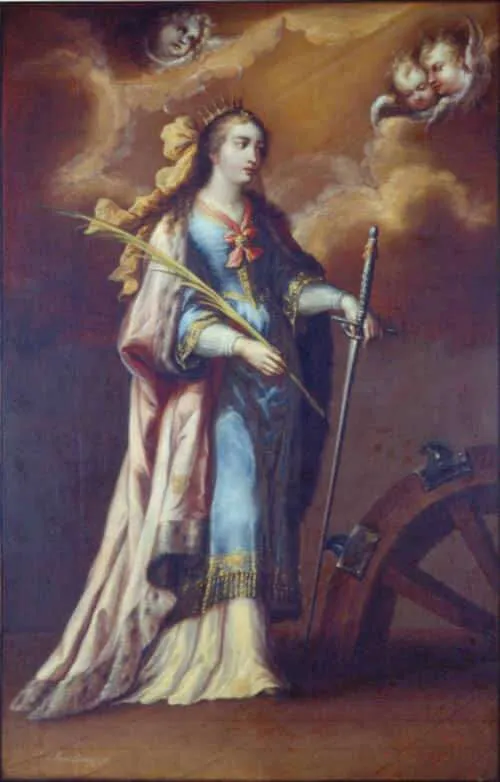
Saint Catherine of Alexandria, Virgin and Martyr

c. 287–c. 305; Patron Saint of apologists, apprentice milliners and seamstresses, archivists, attorneys, barbers, potters, spinners, the dying, educators, girls, jurists, knife sharpeners, librarians, maidens, mechanics, millers, nurses, old maids, philosophers, preachers, scholars, schoolchildren, scribes, secretaries, tanners, teachers, theologians, and unmarried girls; Pre-Congregation canonization

In 331 BC, the Macedonian king, Alexander the Great, founded what would become one of the most important cities in North Africa—Alexandria, Egypt. By the time that Alexandria came under the control of the newly formed Roman Empire in 30 BC, it was a flourishing city of great culture, learning, religious diversity, trade, and influence. In the third century, Alexandria emerged as one of five major patriarchates in early Christendom. The others were Rome, Antioch, Constantinople, and Jerusalem. Alexandria was a center for Christian scholarship, liturgical development, and theological discourse. It was in this important city that an extraordinary noble girl was born, Saint Catherine of Alexandria. Saint Catherine’s life comes to us from legendary sources, of which the historicity is questionable. Because legends about her have inspired the faithful for many centuries, we will ponder those stories.

As a member of a noble family, Catherine received an excellent education and became well versed in literature, poetry, rhetoric, philosophy, music, mathematics, and medicine. Catherine was also of exceptional physical beauty and high moral virtue. Her beauty—coupled with her virtues, noble status, and intelligence—made her an ideal bride. Though many noblemen proposed to her, she rejected them all, since none of them surpassed her moral virtues and intelligence. Unable to find a suitable mate, she sensed within her soul that she was called to something greater.

One day, Catherine’s mother, who was secretly a Christian, introduced her to a holy Christian monk. This monk, in turn, introduced her to her future husband, her Lord Jesus Christ, the future Bridegroom of her soul. In Him, she discovered a man of the greatest wisdom and beauty, whose moral character was unmatched and whose nobility was above all. After speaking about Jesus in detail, the monk gave Catherine an icon of the Blessed Virgin Mary holding her young Son.

That night, Catherine had a dream in which she beheld the Blessed Mother holding her Son. Catherine tried to see the face of the Child, but He kept turning away. She realized that it was because she was not yet baptized that the Christ Child could not bear to look upon her. Her beauty, intelligence, and nobility meant nothing to Him if she were not cleansed by the waters of that holy sacrament. Soon after, she returned to the monk who had catechized her, and she received baptism.

After Catherine’s baptism, the holy monk encouraged her to beseech the Blessed Virgin Mary. She spent all night doing so and fell asleep while praying. In her dream, the Blessed Mother appeared to her with her Child who took great delight in Catherine and chose her as His bride, giving her a ring, and calling her to embrace earthly virginity. When she awoke, the ring was still on her finger.

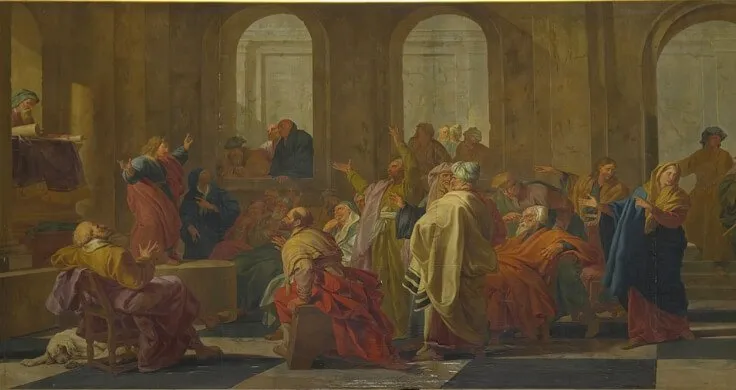
A few years later, when Catherine was in her late teens, Emperor Maximinus decreed that all citizens had to offer sacrifice to the Roman gods in the temple. Catherine showed up during the sacrifices and was immediately noticed for her beauty and disposition. She sent word to the emperor that she had vital information for him. Once in the emperor’s presence, Catherine chastised him for his heathen practices and for his decree requiring worship of the false gods. The emperor was not only stunned at her beauty and character, he was also struck by the depth of her wisdom and elegant speech.

The emperor was so impressed that he knew her wisdom needed a response in order to justify his continued persecution of Christians. He then gathered fifty of the wisest men from across the empire to debate Catherine and prove her error. Just the opposite happened. Catherine’s wisdom was so great that she prevailed and won over many of the wise men. She cited the best Greek philosophers to prove her points and to support the truth that Jesus was the Savior and that the Trinity was the One God. Many of the wise men converted, and, as a result, the emperor had them killed.

The emperor then took another approach. He tried to seduce Catherine, offering her half of his kingdom and a place within the royal palace. She refused. The emperor then had her scourged until her blood covered the ground, and he imprisoned her.

While Catherine was in prison, the emperor’s wife became intrigued with her. When the emperor was gone, the empress and the captain of the guard went to Catherine’s cell and listened to her. They were both so impressed that they converted and were baptized.

While in prison, a dove brought food to Catherine, keeping her healthy and strong. The emperor decided to try one more time to convince her to give up her Christian faith and worship the gods. This time, he threatened her with torture on a large wheel meant to stretch her entire body and spin her to the point of death. Before Catherine was tied to the wheel, an angel made it spin out of control and shatter before everyone’s eyes. The empress then came out and chastised her husband, revealing that she had become a Christian after listening to the wisdom of Catherine. The emperor was so enraged that he had his wife beheaded on the spot.

The following day, Catherine was brought before the emperor again, and this time he ordered her execution by beheading. Within an hour of her execution, angels came and took her body away, laying it on the heights of Mount Sinai where it remained undisturbed and undefiled. A few centuries later, a holy monk in the monastery at the base of Mount Sinai, which was built around the burning bush, had a dream that led him to discover Catherine’s relics. He took her body and buried it in the monastery chapel where she lies today.

Whether these are legends or facts, Saint Catherine’s story reveals to us deep truths we must all embrace. True wisdom comes not only from study but from union with God. True beauty is only attained by reflecting the Source of all beauty. Nobility is measured only by the judgment of God, who bestows grace and eternal rank according to the merit of one’s life. The perfection of human virtue is only obtained by those who are infused with the divine virtues of faith, hope, and love. True courage is only possible when it is Christ Who strengthens us.

As we honor Saint Catherine and ponder these truths her life reflects, consider them in the light of your own life. Seek the spiritual gifts her life and legends represent, and seek to imitate those human qualities that can only be enhanced by entering more fully into the divine life of our Bridegroom.

Source: https://mycatholic.life/saints/saints-of-the-liturgical-year/november-25—saint-catherine-of-alexandria–optional-memorial/

Saint Catherine of Alexandria, Virgin and Martyr Read More »

Luke 21:3-4

A Total of Offering to God

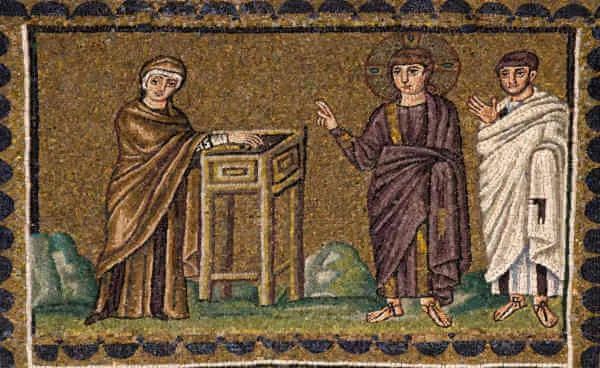
“I tell you truly, this poor widow put in more than all the rest; for those others have all made offerings from their surplus wealth, but she, from her poverty, has offered her whole livelihood.”

Reflection:

We must all see ourselves as this poor widow by offering our “whole livelihood” to Christ. Everything we have is a gift from God, and it must be offered back to God, sacrificially, as our gift to Him. The material offering made by this poor widow was two small coins worth very little. The truth is that even if you were the richest person in the world and donated all that you had to God, it would greatly pale in comparison to the gift given to us by our Lord. We are all poor in the big picture of God’s grace and His Kingdom. The most any one of us can offer is symbolized by these two small coins.

As you look at your own life, how willing are you to give everything you have to our Lord for His glory and service? The only appropriate “offering” we are called to give to our Lord is the “sacrifice” of our entire life. This spiritual truth is something very difficult for those who are very wealthy in the things of this world. Material wealth offers an easy way to live in comfort. Money can provide every modern convenience, entertainment, fun, worldly security and much of what this world has to offer. But money cannot buy fulfillment. It cannot satisfy us in the truest sense. This is why many people who live very luxurious lives are not truly happy.

Happiness is found in sacrifice. Specifically, it is found in sacrificial love by which we dedicate everything we are and all that we have to the sole purpose of the glory of God and the furtherment of His Kingdom. Sadly, when one is rich in the things of this world, it is easy to think that offering a portion of their wealth, such as a tithe, means that they can keep and use the rest any way they want. But that’s not true. Giving of ourselves completely to God and to His service does not necessarily mean that we donate all of our money to the Church. But it does mean that we offer everything to God. For many, when this complete offering is done every day, God will lead them to use their material resources for the raising of their family, to take care of their basic needs, and, at times, to even enjoy various comforts in life. But the real question is whether or not you truly live as though all you have and all you are is God’s and is to be used for His glory and the furtherment of His will.

Reflect, today, upon this poor widow. She was greatly blessed to have very little. This made it easier for her to remain detached from money and other forms of material wealth. And in that detachment, she gave all to God. She entrusted all to Him, and Jesus noticed and praised her. Reflect upon our Lord’s reaction to you and to the offering of your life to Him. If you are holding back from our Lord, then use the witness of this poor widow to inspire you to daily dedicate everything to the service of God in accord with His holy will.

Source: https://catholic-daily-reflections.com/2024/11/24/a-total-offering-to-god-3/

Luke 21:3-4 Read More »