2023

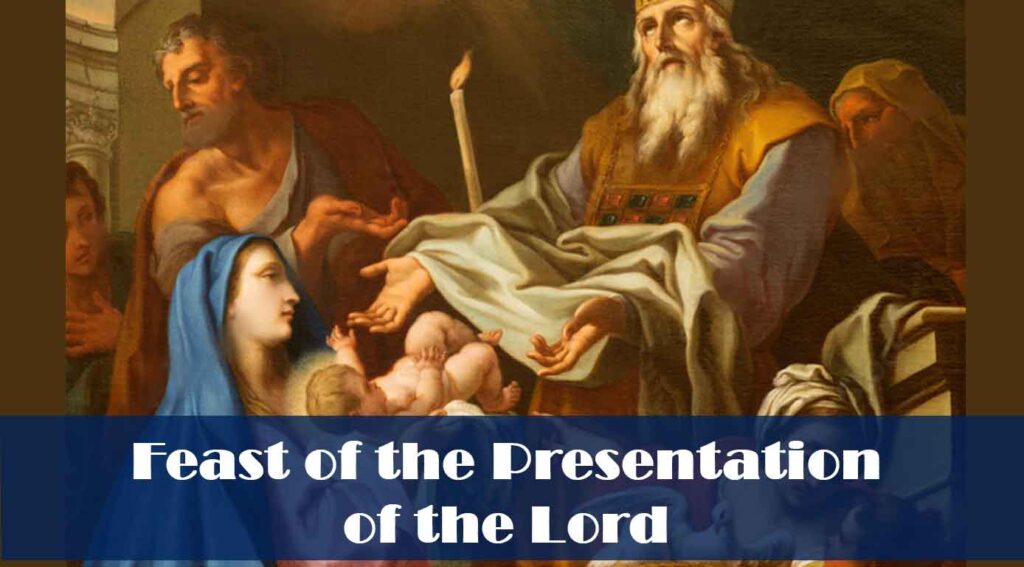
Feast of the Presentation of the Lord

Also known as, Candlemas or Presentation of Christ in the Temple, the Feast of the Presentation of the Lord is a Christian celebration. It commemorates the occasion when the Blessed Virgin Mary went to the Temple to be purified 40 days after the birth of Jesus, and to present him to God.

At the end of the fourth century, a woman named Etheria made a pilgrimage to Jerusalem. Her journal, discovered in 1887, gives an unprecedented glimpse of liturgical life there. Among the celebrations she describes is the Epiphany, the observance of Christ’s birth, and the gala procession in honor of his Presentation in the Temple 40 days later. Under the Mosaic Law, a woman was ritually “unclean” for 40 days after childbirth, when she was to present herself to the priests and offer sacrifice—her “purification.” Contact with anyone who had brushed against mystery—birth or death—excluded a person from Jewish worship. This feast emphasizes Jesus’ first appearance in the Temple more than Mary’s purification.

The observance spread throughout the Western Church in the fifth and sixth centuries. Because the Church in the West celebrated Jesus’ birth on December 25, the Presentation was moved to February 2, 40 days after Christmas.

At the beginning of the eighth century, Pope Sergius inaugurated a candlelight procession; at the end of the same century the blessing and distribution of candles which continues to this day became part of the celebration, giving the feast its popular name: Candlemas.

Feast of the Presentation of the Lord Read More »
Proverbs 10:22

Verse:

“The blessing of the Lord brings wealth, without painful toil for it.” - Proverbs 10:22

Prayer for a Sick Person

Almighty and Eternal God,
You are the everlasting health of those who believe in You.
Hear us for Your sick servant (N...)
for whom we implore the aid of Your tender mercy,
that being restored to bodily health,
he (she) may give thanks to You in Your Church.
Through Christ our Lord.

Proverbs 10:22 Read More »

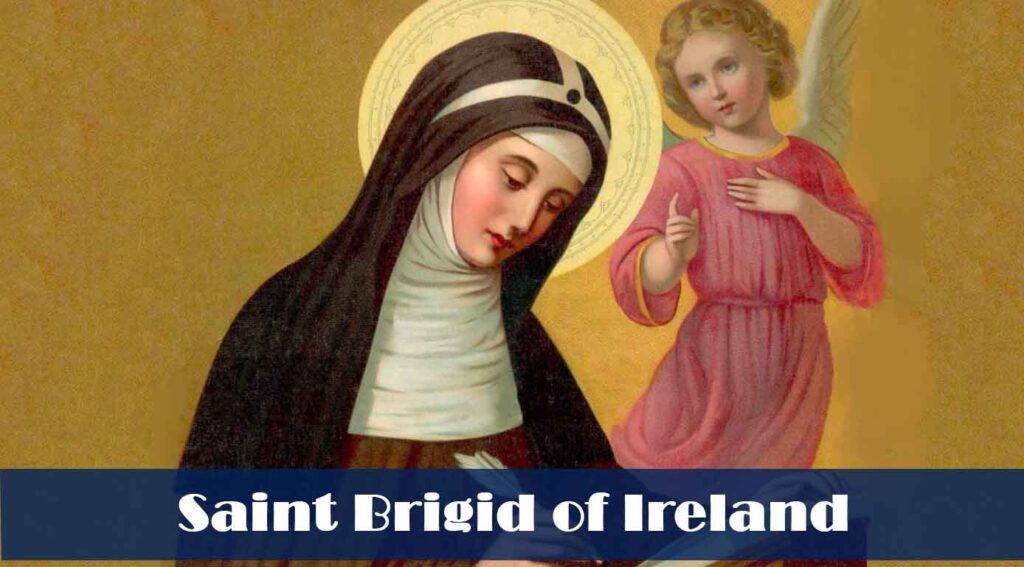
Saint Brigid of Ireland

Saint Brigid is also known as Saint Brigid of Kildare. She is patroness saint of Ireland, and one of its three national saints along with Patrick and Columba. She is patroness of many things, including poetry, learning, healing, protection, blacksmithing, livestock and dairy production. The saint shares her name with a Celtic goddess.

There are few historical facts about her, and early hagiographies are mainly anecdotes and miracle tales, some of which are rooted in pagan folklore. She was an abbess who founded several convents of nuns, most notably that of Kildare, which was one of the most important in Ireland.

Brigid was said to have worked miracles, including healing and feeding the poor. According to one tale, as a child, she once gave away her mother’s entire store of butter. The butter was then replenished in answer to Brigid’s prayers. Around the age of ten, she was returned as a household servant to her father, where her charity led her to donate his belongings to anyone who asked.

Brigid, with an initial group of seven companions, is credited with organising communal consecrated religious life for women in Ireland.She founded two monasteries; one for men, the other for women.

Sources:

https://en.wikipedia.org/wiki/Brigid_of_Kildare
St. Brigid's GNS, Glasnevin.
Farmer, David. The Oxford Dictionary of Saints (Fifth Edition, Revised). Oxford University Press, 2011. pp.66–67, 467–470
Jestice, Phyllis G. (2004). Holy People of the World: A Cross-Cultural Encyclopedia. ABC-CLIO. pp. 140–. ISBN 9781576073551.

Saint Brigid of Ireland Read More »

1 Peter 5:10

Verse:

 “And the God of all grace, who called you to his eternal glory in Christ, after you have suffered a little while, will himself restore you and make you strong, firm and steadfast.” - 1 Peter 5:10

Prayer to Saint John Bosco

O glorious Saint John Bosco, who in order to lead young people to the feet of the divine Master and to mould them in the light of faith and Christian morality didst heroically sacrifice thyself to the very end of thy life and didst set up a proper religious Institute destined to endure and to bring to the farthest boundaries of the earth thy glorious work, obtain also for us from Our Lord a holy love for young people who are exposed to so many seductions in order that we may generously spend ourselves in supporting them against the snares of the devil, in keeping them safe from the dangers of the world, and in guiding them, pure and holy, in the path that leads to God. Amen.

Sources:

1 Peter 5:10 Read More »

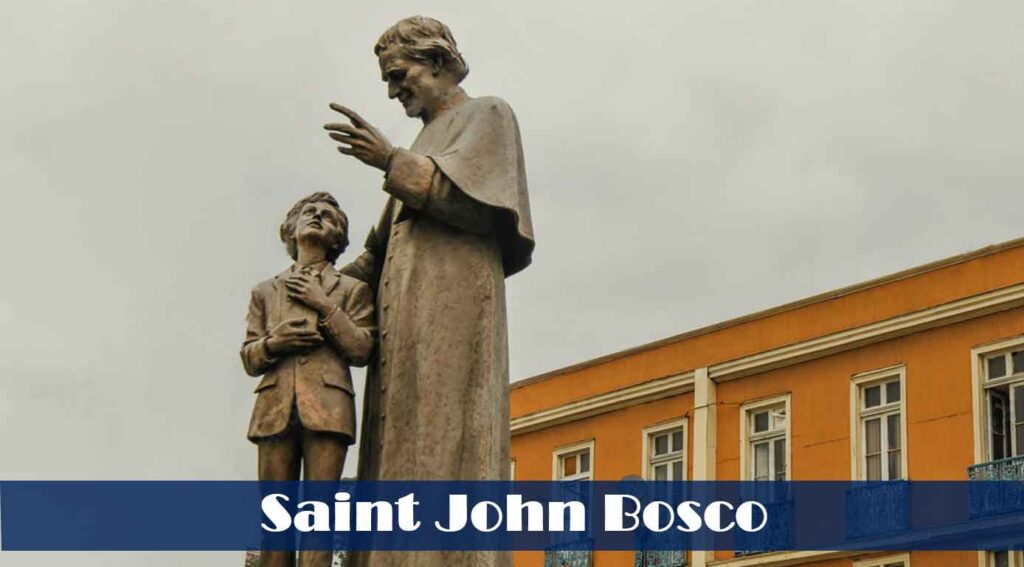
Saint John Bosco

Saint John Bosco’s theory of education could well be used in today’s schools. It was a preventive system, rejecting corporal punishment and placing students in surroundings removed from the likelihood of committing sin. He advocated frequent reception of the sacraments of Penance and Holy Communion. He combined catechetical training and fatherly guidance, seeking to unite the spiritual life with one’s work, study and play.

Encouraged during his youth in Turin to become a priest so he could work with young boys, John was ordained in 1841. His service to young people started when he met a poor orphan in Turin, and instructed him in preparation for receiving Holy Communion. He then gathered young apprentices and taught them catechism.

After serving as chaplain in a hospice for working girls, Don Bosco opened the Oratory of St. Francis de Sales for boys. Several wealthy and powerful patrons contributed money, enabling him to provide two workshops for the boys, shoemaking and tailoring.

By 1856, the institution had grown to 150 boys and had added a printing press for publication of religious and catechetical pamphlets. John’s interest in vocational education and publishing justify him as patron of young apprentices and Catholic publishers.

John’s preaching fame spread and by 1850 he had trained his own helpers because of difficulties in retaining young priests. In 1854, he and his followers informally banded together, inspired by Saint Francis de Sales.

With Pope Pius IX’s encouragement, John gathered 17 men and founded the Salesians in 1859. Their activity concentrated on education and mission work. Later, he organized a group of Salesian Sisters to assist girls.

Saint John Bosco Read More »

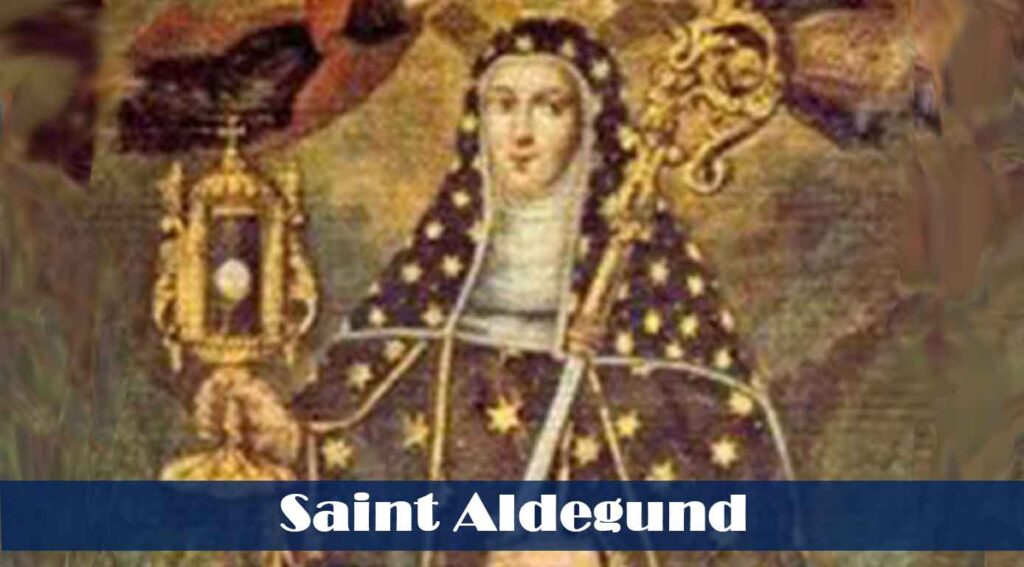
Saint Aldegund

Saint Aldegund, also known as Saint Aldegundis or Aldegonde, was closely related to the Merovingian royal family. Her parents, afterwards honored as St. Walbert, Count of Guînes, and St. Bertilla de Mareuil, lived in the County of Hainaut. She is the most famous of what Aline Hornaday calls the “Maubeuge Cycle” of Merovingian saints.

Saint Aldegund was urged to marry, but she chose the life of the cloister. Having allegedly walked across the waters of the Sambre, she had built on its banks a small hospital at Malbode, which later became, under the name Maubeuge Abbey, a famous abbey of Benedictine nuns, though at a later date these were replaced by canonesses.

She bore with fortitude the breast cancer that eventually killed her. She was a Frankish Benedictine abbess who is honored as a saint by the Roman Catholic Church in France and Orthodox Church.

Sources:

https://en.wikipedia.org/wiki/Aldegund
https://www.catholic.org/saints/saint.php?saint_id=1220
Aline Hornaday, "Toward a Prosopography of the "Maubeuge Cycle" Saints", Prosopon Newsletter, 1996
Thurston, Herbert. "St. Aldegundis." The Catholic Encyclopedia Vol. 1. New York: Robert Appleton Company, 1907. 30 May 2016
article in Archéologie (March 2003), n° 398, p. 7
Saint of the Day, January 30: Aldegundis of Maubeuge Archived 2020-02-25 at the Wayback Machine SaintPatrickDC.org


Saint Aldegund Read More »

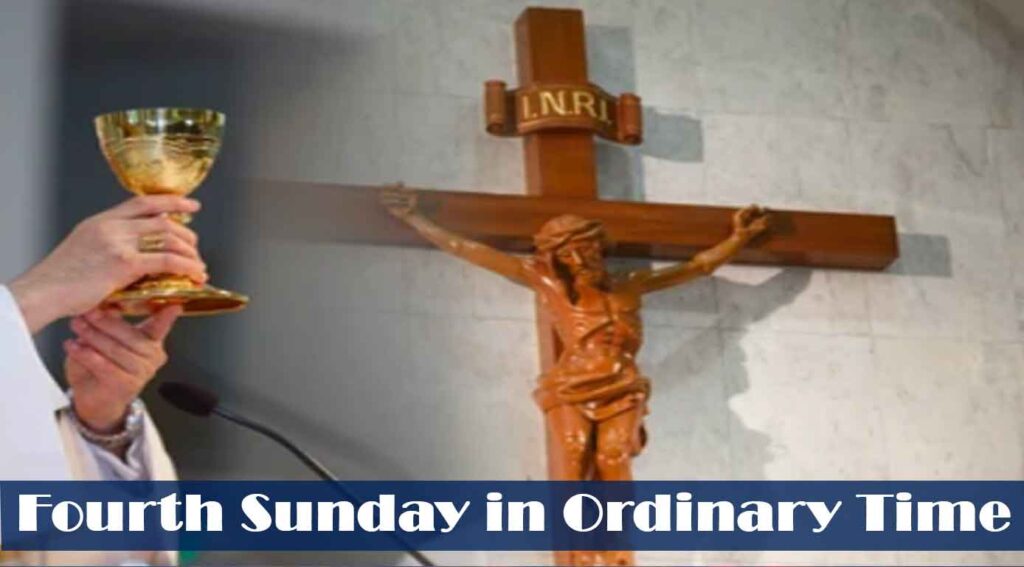
Fourth Sunday in Ordinary Time

Liturgy of the Word

First Reading: Zep 2:3; 3:12-13

Seek the LORD, all you humble of the earth,
who have observed his law;
seek justice, seek humility;
perhaps you may be sheltered
on the day of the LORD's anger.

But I will leave as a remnant in your midst
a people humble and lowly,
who shall take refuge in the name of the LORD:
the remnant of Israel.
They shall do no wrong
and speak no lies;
nor shall there be found in their mouths
a deceitful tongue;
they shall pasture and couch their flocks
with none to disturb them.

Responsorial Psalm: Psalm 146:6-7, 8-9, 9-10

Response– Blessed are the poor in spirit; the kingdom of heaven is theirs!

The LORD keeps faith forever,
secures justice for the oppressed,
gives food to the hungry.
The LORD sets captives free.
R– Blessed are the poor in spirit; the kingdom of heaven is theirs!

The LORD gives sight to the blind;
the LORD raises up those who were bowed down.
The LORD loves the just;
the LORD protects strangers.
R– Blessed are the poor in spirit; the kingdom of heaven is theirs!

The fatherless and the widow the LORD sustains,
but the way of the wicked he thwarts.
The LORD shall reign forever;
your God, O Zion, through all generations. Alleluia.
R– Blessed are the poor in spirit; the kingdom of heaven is theirs!

Second Reading: 1 Cor 1:26-31

Consider your own calling, brothers and sisters.
Not many of you were wise by human standards,
not many were powerful,
not many were of noble birth.
Rather, God chose the foolish of the world to shame the wise,
and God chose the weak of the world to shame the strong,
and God chose the lowly and despised of the world,
those who count for nothing,
to reduce to nothing those who are something,
so that no human being might boast before God.
It is due to him that you are in Christ Jesus,
who became for us wisdom from God,
as well as righteousness, sanctification, and redemption,
so that, as it is written,
"Whoever boasts, should boast in the Lord."

Alleluia:

Alleluia, alleluia. Rejoice and beglad; your reward will be great in heaven. Alleluia, alleluia!

Gospel: Mt 5: 1-12a

GospelA reading from the holy Gospel according to Matthew

When Jesus saw the crowds, he went up the mountain,
and after he had sat down, his disciples came to him.
He began to teach them, saying:
"Blessed are the poor in spirit,
for theirs is the kingdom of heaven.
Blessed are they who mourn,
for they will be comforted.
Blessed are the meek,
for they will inherit the land.
Blessed are they who hunger and thirst for righteousness,
for they will be satisfied.
Blessed are the merciful,
for they will be shown mercy.
Blessed are the clean of heart,
for they will see God.
Blessed are the peacemakers,
for they will be called children of God.
Blessed are they who are persecuted for the sake of righteousness,
for theirs is the kingdom of heaven.
Blessed are you when they insult you and persecute you
and utter every kind of evil against you falsely because of me.
Rejoice and be glad,
for your reward will be great in heaven."
: Mt 5: 1-12a

The Readings and Gospel were sourced from:

Fourth Sunday in Ordinary Time Read More »

Micah 7:18

Verse:

“Who is a God like you, who pardons sin and forgives the transgression of the remnant of his inheritance? You do not stay angry forever but delight to show mercy.” - Micah 7:18

Prayer for the Sick

Omnipotent and eternal God, the everlasting Salvation of those who believe, hear us on behalf of Thy sick servant, N., for whom we beg the aid of Thy pitying mercy, that, with his bodily health restored, he may give thanks to Thee in Thy church. Through Christ our Lord. Amen.

Original Source of the Prayer:

Micah 7:18 Read More »

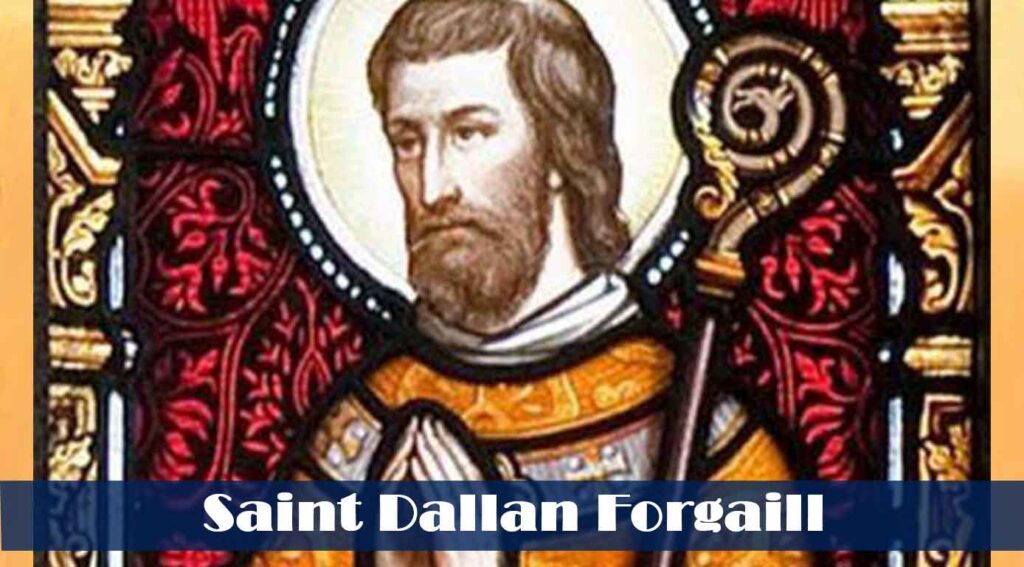
Saint Dallan Forgaill

Saint Dallan was born in Maigen (now Ballyconnell), at the eastern edge of the territory of the Masraige of Magh Slécht in the north-west of modern County Cavan. He was not a member of the Masraige but belonged to a branch of the Airgíalla called the Fir Lurg, who were in the process of spreading southwards into modern-day County Fermanagh and County Cavan.

The Amhra Coluim Cille, a panegyric on Columba, written shortly after Columba’s death in 597, is his best known work and considered “one of the most important poems we have from the early medieval Gaelic world”. It is reported that after completing the work, Dallan regained his sight. It was claimed that those who recited the praises of Columba from memory would receive the gift of a happy death, a custom that was widely abused by those who attempted to rely on their memory rather than a virtuous life. The “Amhra Coluim Cille” became a popular text for students in Irish monasteries.

In 640, Dallan was visiting his friend Saint Conall Cael at his monastery on Inishkeel when pirates raided the island monastery. Dallan was reportedly beheaded, and it is said that God reattached his head to his body after he was martyred. He was buried on Iniskeel; his friend Canall Cael was later laid to rest in the same grave.

Sources:

 https://en.wikipedia.org/wiki/Dall%C3%A1n_Forgaill
According to the Life of St Dallán in the Acta Sanctorum Hiberniae
Dictionary of the Irish Language, compact edition, Royal Irish Academy p. 178
T. M. Charles-Edwards, 'Dallán Forgaill (fl. 597)', Oxford Dictionary of National Biography, Oxford University Press, 2004,
"Dallàn's death and burial" on page 37 of 'The Bodleian Amra Choluimb Chille' in Revue Celtique. Vol. 21 (Paris 1900), pp. 133-136.
www.vanhamel.nl.

Saint Dallan Forgaill Read More »