2023

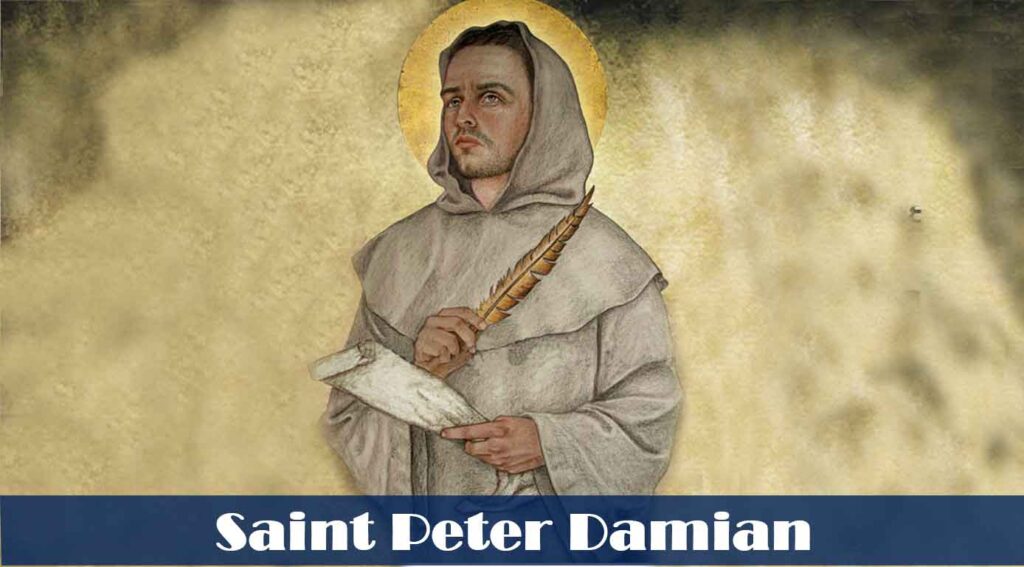
Saint Peter Damian

Maybe because he was orphaned and had been treated shabbily by one of his brothers, Peter Damian was very good to the poor. It was the ordinary thing for him to have a poor person or two with him at table and he liked to minister personally to their needs.
Peter escaped poverty and the neglect of his own brother when his other brother, who was archpriest of Ravenna, took him under his wing. His brother sent him to good schools and Peter became a professor.

Already in those days, Peter was very strict with himself. He wore a hair shirt under his clothes, fasted rigorously and spent many hours in prayer. Soon, he decided to leave his teaching and give himself completely to prayer with the Benedictines of the reform of Saint Romuald at Fonte Avellana. They lived two monks to a hermitage. Peter was so eager to pray and slept so little that he soon suffered from severe insomnia. He found he had to use some prudence in taking care of himself. When he was not praying, he studied the Bible.

The abbot commanded that when he died Peter should succeed him. Abbot Peter founded five other hermitages. He encouraged his brothers in a life of prayer and solitude and wanted nothing more for himself. The Holy See periodically called on him, however, to be a peacemaker or troubleshooter, between two abbeys in dispute or a cleric or government official in some disagreement with Rome.
Finally, Pope Stephen IX made Peter the cardinal-bishop of Ostia. He worked hard to wipe out simony—the buying of church offices–and encouraged his priests to observe celibacy and urged even the diocesan clergy to live together and maintain scheduled prayer and religious observance. He wished to restore primitive discipline among religious and priests, warning against needless travel, violations of poverty, and too comfortable living. He even wrote to the bishop of Besancon complaining that the canons there sat down when they were singing the psalms in the Divine Office.
He wrote many letters. Some 170 are extant. We also have 53 of his sermons and seven lives, or biographies, that he wrote. He preferred examples and stories rather than theory in his writings. The liturgical offices he wrote are evidence of his talent as a stylist in Latin.

He asked often to be allowed to retire as cardinal-bishop of Ostia, and finally Pope Alexander II consented. Peter was happy to become once again just a monk, but he was still called to serve as a papal legate. When returning from such an assignment in Ravenna, he was overcome by a fever. With the monks gathered around him saying the Divine Office, he died on February 22, 1072. In 1828, he was declared a Doctor of the Church.

Sources:

https://www.franciscanmedia.org/saint-of-the-day/saint-peter-damian/

Saint Peter Damian Read More »

2 Corinthians 3:18

Verse:

“And we all, who with unveiled faces contemplate the Lord’s glory, are being transformed into his image with ever-increasing glory, which comes from the Lord, who is the Spirit.” - 2 Corinthians 3:18

Act of Contrition

O my God, I am sorry for my sins because I have offended you. I know I should love you above all things. Help me to do penance, to do better, and to avoid anything that might lead me to sin. Amen.

2 Corinthians 3:18 Read More »

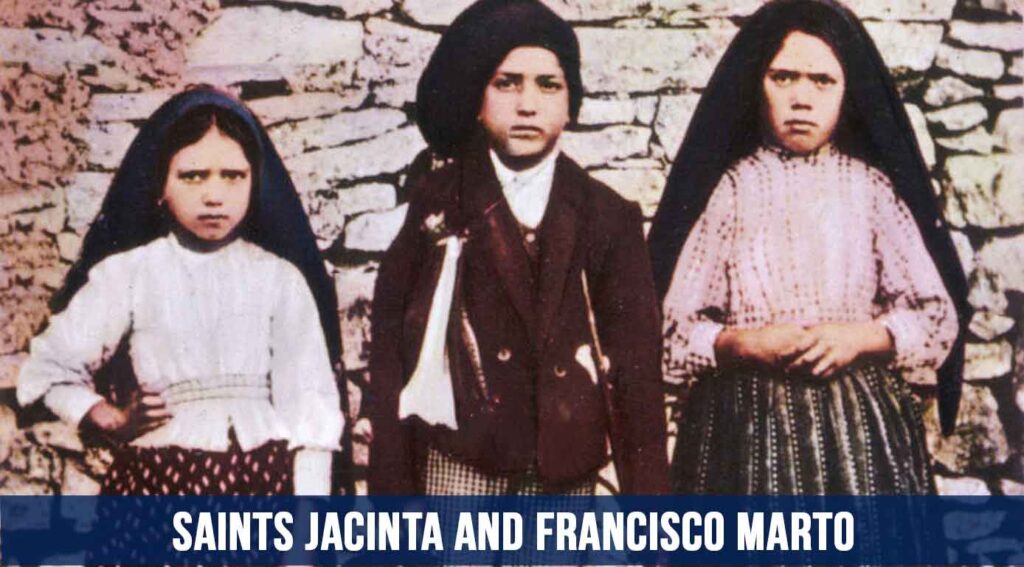
Saints Jacinta and Francisco Marto

Between May 13 and October 13, 1917, three Portuguese shepherd children from Aljustrel, received apparitions of Our Lady at Cova da Iria, near Fátima, a city 110 miles north of Lisbon. At that time, Europe was involved in an extremely bloody war. Portugal itself was in political turmoil, having overthrown its monarchy in 1910; the government disbanded religious organizations soon after.

At the first appearance, Mary asked the children to return to that spot on the thirteenth of each month for the next six months. She also asked them to learn to read and write and to pray the rosary “to obtain peace for the world and the end of the war.” They were to pray for sinners and for the conversion of Russia, which had recently overthrown Czar Nicholas II and was soon to fall under communism. Up to 90,000 people gathered for Mary’s final apparition on October 13, 1917.
Less than two years later, Francisco died of influenza in his family home. He was buried in the parish cemetery and then re-buried in the Fátima basilica in 1952. Jacinta died of influenza in Lisbon in 1920, offering her suffering for the conversion of sinners, peace in the world, and the Holy Father. She was re-buried in the Fátima basilica in 1951. Their cousin Lúcia dos Santos, became a Carmelite nun and was still living when Jacinta and Francisco were beatified in 2000; she died five years later. Pope Francis canonized the younger children on his visit to Fátima to commemorate the 100th anniversary of the first apparition–May 13, 2017. The shrine of Our Lady of Fátima is visited by up to 20 million people a year.

Sources:

https://www.franciscanmedia.org/saint-of-the-day/saints-jacinta-and-francisco-marto/

Saints Jacinta and Francisco Marto Read More »

Seventh Sunday in Ordinary Time

Liturgy of the Word

First Reading: Lv 19:1-2, 17-18

The LORD said to Moses,
"Speak to the whole Israelite community and tell them:
Be holy, for I, the LORD, your God, am holy.

"You shall not bear hatred for your brother or sister in your heart.
Though you may have to reprove your fellow citizen,
do not incur sin because of him.
Take no revenge and cherish no grudge against any of your people.
You shall love your neighbor as yourself.
I am the LORD."

Responsorial Psalm: Psalm 103:1-2, 3-4, 8, 10, 12-13

Response– The Lord is kind and merciful

Bless the LORD, O my soul;
and all my being, bless his holy name.
Bless the LORD, O my soul,
and forget not all his benefits.
R– The Lord is kind and merciful

He pardons all your iniquities,
heals all your ills.
He redeems your life from destruction,
crowns you with kindness and compassion.
R– The Lord is kind and merciful

Merciful and gracious is the LORD,
slow to anger and abounding in kindness.
Not according to our sins does he deal with us,
nor does he requite us according to our crimes.
R– The Lord is kind and merciful

As far as the east is from the west,
so far has he put our transgressions from us.
As a father has compassion on his children,
so the LORD has compassion on those who fear him.
R– The Lord is kind and merciful

Second Reading: 1 Cor 3:16-23

Brothers and sisters:
Do you not know that you are the temple of God,
and that the Spirit of God dwells in you?
If anyone destroys God's temple, God will destroy that person;
for the temple of God, which you are, is holy.

Let no one deceive himself.
If any one among you considers himself wise in this age,
let him become a fool, so as to become wise.
For the wisdom of this world is foolishness in the eyes of God,
for it is written:
God catches the wise in their own ruses,
and again:
The Lord knows the thoughts of the wise,
that they are vain.

So let no one boast about human beings, for everything belongs to you,
Paul or Apollos or Cephas,
or the world or life or death,
or the present or the future:
all belong to you, and you to Christ, and Christ to God.

Alleluia:

Alleluia, alleluia. Whoever keeps the word of Christ, the love of God is truly perfected in him. Alleluia, alleluia!

Gospel: Mt 5: 38-48

A reading from the holy Gospel according to Matthew

Jesus said to his disciples:
"You have heard that it was said,
An eye for an eye and a tooth for a tooth.
But I say to you, offer no resistance to one who is evil.
When someone strikes you on your right cheek,
turn the other one as well.
If anyone wants to go to law with you over your tunic,
hand over your cloak as well.
Should anyone press you into service for one mile,
go for two miles.
Give to the one who asks of you,
and do not turn your back on one who wants to borrow.

"You have heard that it was said,
You shall love your neighbor and hate your enemy.
But I say to you, love your enemies
and pray for those who persecute you,
that you may be children of your heavenly Father,
for he makes his sun rise on the bad and the good,
and causes rain to fall on the just and the unjust.
For if you love those who love you, what recompense will you have?
Do not the tax collectors do the same?
And if you greet your brothers only,
what is unusual about that?
Do not the pagans do the same?
So be perfect, just as your heavenly Father is perfect."

The Readings and Gospel were sourced from:

Seventh Sunday in Ordinary Time Read More »

Proverbs 23:4

Verse:

“Do not wear yourself out to get rich; do not trust your own cleverness.” - Proverbs 23:4

Prayer to Jesus Before the Blessed Sacrament

Jesus, each time I look at the sacred Host,
sancify my eyes,
that they may close more and more
to all that is merely earthly.

Jesus, each time I look at the sacred Host,
send a ray of divine light into my soul,
that I may better know you and myself.

Jesus, each time I look at the sacred Host,
send a flame of divine love into my heart
to consume everything in it
that is displeasing to You
and to set it all on fire with Your love.

Now and in eternity
may my only desire be to contemplate
the infinite beauty of Your divine countenance
which delights the angels.

Amen.

Proverbs 23:4 Read More »

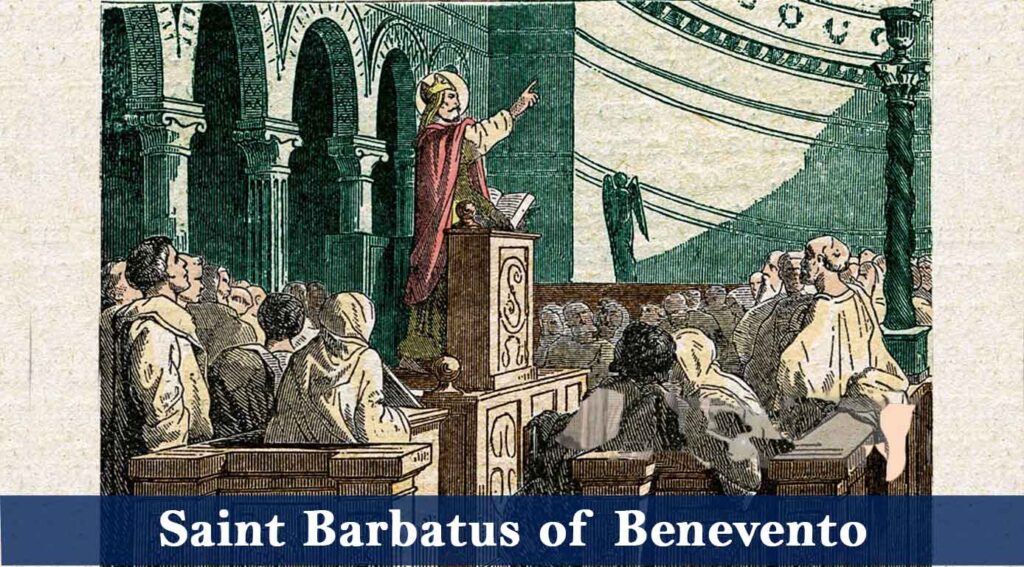
Saint Barbatus of Benevento

Saint Barbatus of Benevento was born in the village of Vandano, near Cerreto Sannita, then part of the Duchy of Benevento, toward the end of the papacy of Gregory the Great.

According to the ninth century vitae, he received a Christian education, and spent a good deal of time studying the Christian scriptures. He took holy orders as soon as allowed to do so, and was immediately employed by the local bishop as a preacher. Shortly thereafter, he was made the curate of St. Basil’s Church in nearby Morcone

He warned the people of the city of the great trials they would soon suffer at the hands of the East Roman Emperor Constans II and his army, who shortly thereafter landed in the area and laid siege to Benevento. The people, in their fear, renounced the practices Barbatus had criticized. He then cut down the tree the locals had worshipped, and melted the viper into a chalice for use in the church.
In 680, he assisted in a council held by Pope Agatho, and took part in the sixth general council held in Constantinople in 681 regarding the Monothelites. He died shortly after the end of the council, on 19 February 682, at about seventy years of age.

Sources:

https://en.wikipedia.org/wiki/Barbatus_of_Benevento#:~:text=Barbatus%20of%20Benevento%20
"Barbatus”. New Catholic Dictionary. CatholicSaints.Info. 18 August 2012
Staley, Tony. "Making a chalice from a gold snake", The Compass, Diocese of Green Bay, Wisconsin, 17 February 2012

Saint Barbatus of Benevento Read More »

Matthew 5:44

Verse:

“But I tell you, love your enemies and pray for those who persecute you.” - Matthew 5:44

Prayer for Government Leader

God of power and might, wisdom and justice,
through you authority is rightly administered,
laws are enacted, and judgment is decreed.
Assist with your spirit of counsel and fortitude
the President and other government leaders of these United
States.
May they always seek
the ways of righteousness, justice and mercy.
Grant that they may be enabled by your powerful protection
to lead our country with honesty and integrity.
We ask this through Christ our Lord.

Matthew 5:44 Read More »

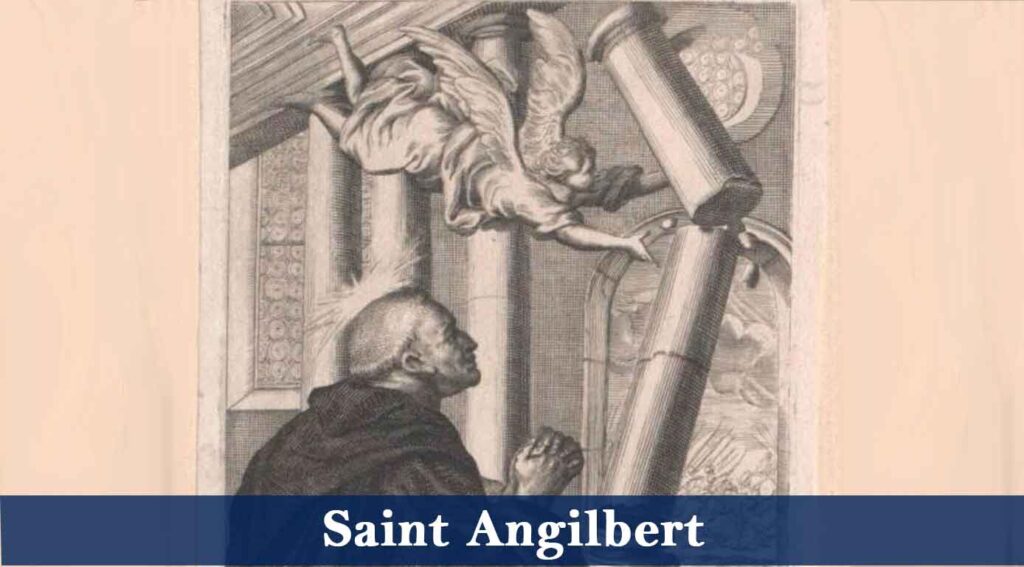
Saint Angilbert

Saint Angilbert was a noble Frankish poet who was educated under Alcuin and served Charlemagne as a secretary, diplomat, and son-in-law. He seems to have been brought up at the court of Charlemagne at the palace school in Aquae Grani. He was educated there as the pupil and then friend of the great English scholar Alcuin.

As the friend and adviser of Pepin, he assisted for a while in the government of Italy. At one time, he served an officer of the maritime provinces. He accompanied Charlemagne to Rome in 800 and was one of the witnesses to his will in 811.

In 790, Angilbert retired to the abbey of Centulum, the “Monastery of St Richarius” (Sancti Richarii monasterium) at present-day Saint-Riquier in Picardy. Elected abbot in 794, he rebuilt the monastery and endowed it with a library of 200 volumes. He spent a great deal rebuilding Saint-Riquier; when he completed it, Charlemagne spent Easter of the year 800 there. In keeping with Carolingian policies, Angilbert established a school at Saint-Riquier to educate the local boys.

Sources:

https://en.wikipedia.org/wiki/Angilbert
"St. Angilbert", Martyrology, Abiquiú, New Mexico: Monastery of Christ in the Desert, 1998, archived from the original on 11 June 2015.
Baynes, T. S., ed. (1878), "St Angilbert" , Encyclopædia Britannica, vol. 2 (9th ed.), New York: Charles Scribner's Sons, p. 29
Frassetto, Michael (2003), "St. Angilbert (c. 740–814)", Encyclopedia of Barbarian Europe, Santa Barbara, California: ABC-CLIO, p. 32, ISBN 978-1576072639

Saint Angilbert Read More »

Acts 1:8

Verse:

“But you will receive power when the Holy Spirit comes on you; and you will be my witnesses in Jerusalem, and in all Judea and Samaria, and to the ends of the earth.” - Acts 1:8

Prayer before Study or Instructions

Incomprehensible Creator, the true Fountain of light and only Author of all knowledge: deign, we beseech Thee, to enlighten our understanding, and to remove from us all darkness of sin and ignorance. Thou, who makest eloquent the tongues of those who lack utterance, direct our tongues, and pour on our lips the grace of thy blessing. Give us a diligent and obedient spirit, quickness of apprehension, capacity of retaining, and the powerful assistance of Thy holy grace; that what we hear or learn we may apply to Thy honor and the eternal salvation of our own souls. Amen.

Acts 1:8 Read More »

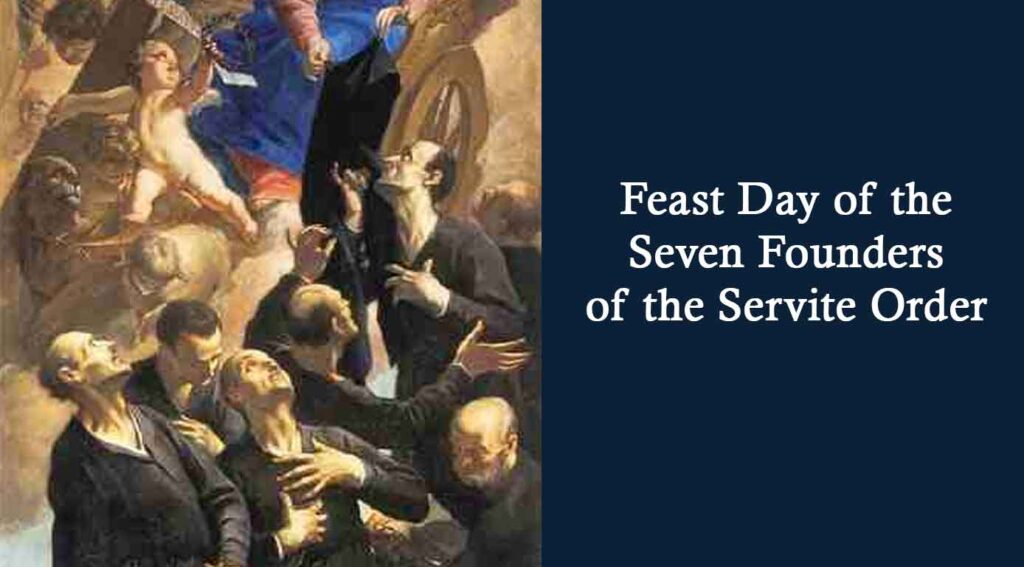
Feast Day of the Seven Founders
of the Servite Order

Can you imagine seven prominent men of Boston or Denver banding together, leaving their homes and professions, and going into solitude for a life directly given to God? That is what happened in the cultured and prosperous city of Florence in the middle of the 13th century. The city was torn with political strife as well as the heresy of the Cathari, who believed that physical reality was inherently evil. Morals were low and religion seemed meaningless.

In 1240, seven noblemen of Florence mutually decided to withdraw from the city to a solitary place for prayer and direct service of God. Their initial difficulty was providing for their dependents, since two were still married and two were widowers.
Their aim was to lead a life of penance and prayer, but they soon found themselves disturbed by constant visitors from Florence. They next withdrew to the deserted slopes of Monte Senario.

In 1244, under the direction of Saint Peter of Verona, O.P., this small group adopted a religious habit similar to the Dominican habit, choosing to live under the Rule of St. Augustine and adopting the name of the Servants of Mary. The new Order took a form more like that of the mendicant friars than that of the older monastic Orders.

Members of the community came to the United States from Austria in 1852 and settled in New York and later in Philadelphia. The two American provinces developed from the foundation made by Father Austin Morini in 1870 in Wisconsin.

Community members combined monastic life and active ministry. In the monastery, they led a life of prayer, work and silence while in the active apostolate they engaged in parochial work, teaching, preaching, and other ministerial activities.

Feast Day of the Seven Founders
of the Servite Order
Read More »