2023

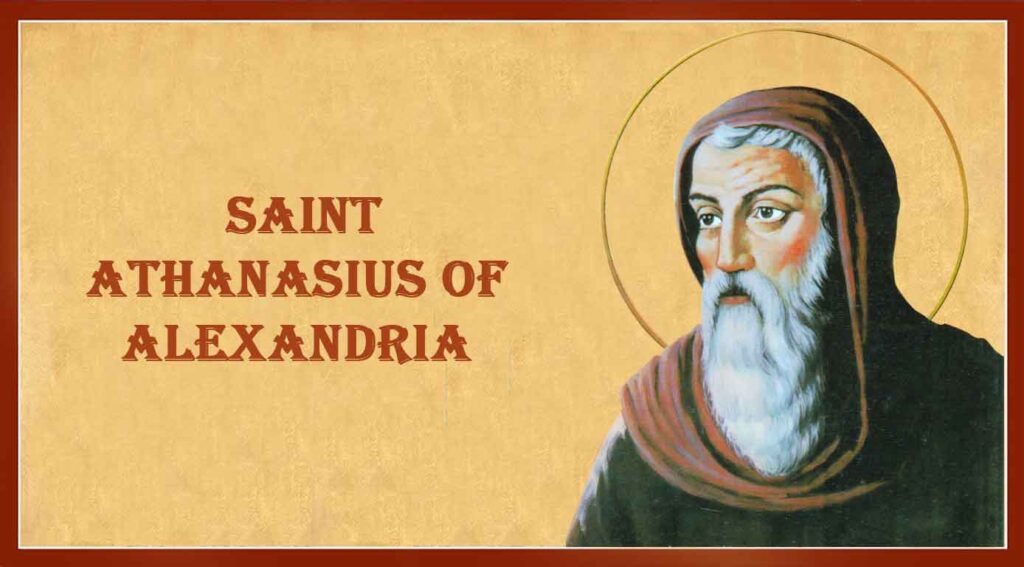
Saint Athanasius of Alexandria

Saint Athanasius I of Alexandria was also known as Athanasius the Great and Athanasius the Confessor. He was a Christian theologian, a Church Father, the chief defender of Trinitarianism against Arianism, and a noted Egyptian Christian leader of the fourth century.

In 325, at age 27, Saint Athanasius began his leading role against the Arians as a deacon and assistant to Bishop Alexander of Alexandria during the First Council of Nicaea. Roman Emperor Constantine the Great had convened the council to address the Arian position that the Son of God, Jesus of Nazareth, is of a distinct substance from the Father. Three years after that council, Athanasius succeeded his mentor as pope of Alexandria.

Athanasius’ episcopate began on 9 May 328 as the Alexandrian Council elected Athanasius to succeed after the death of Alexander. During his first years as bishop, Athanasius visited the churches of his territory, which at that time included all of Egypt and Libya. He established contacts with the hermits and monks of the desert, including Pachomius, which proved very valuable to him over the years. Patriarch Athanasius spent over 17 years in five exiles ordered by four different Roman Emperors, not counting approximately six more incidents in which Athanasius fled Alexandria to escape people seeking to take his life.

Athanasius’ “Letter Concerning the Decrees of the Council of Nicaea” (De Decretis), is an important historical as well as theological account of the proceedings of that council. His other important works include his Letters to Serapion, which defends the divinity of the Holy Spirit. In a letter to Epictetus of Corinth, Athanasius anticipates future controversies in his defence of the humanity of Christ. Athanasius also wrote several works of Biblical exegesis, primarily on Old Testament materials. The most important of these is his Epistle to Marcellinus on how to incorporate psalm-saying into one’s spiritual practice. Excerpts remain of his discussions concerning the Book of Genesis, the Song of Solomon, and Psalms.

Gregory of Nazianzus called Saint Athanasius as the “Pillar of the Church”. His writings were well regarded by subsequent Church fathers in the West and the East, who noted their devotion to the Word-become-man, pastoral concern and interest in monasticism. Athanasius is considered one of the four great Eastern Doctors of the Church in the Catholic Church.

Sources:

https://en.wikipedia.org/wiki/Athanasius_of_Alexandria

Saint Athanasius of Alexandria Read More »
Acts 2:3-4

Verse:

“They saw what seemed to be tongues of fire that separated and came to rest on each of them. All of them were filled with the Holy Spirit and began to speak in other tongues as the Spirit enabled them.” - Acts 2:3-4

Prayer To Be Led By The Holy Spirit

Heavenly Father, how I thank You for my salvation, which You have given to me as a free gift of grace by faith in the Lord Jesus. Thank You also, that Your Holy Spirit has made me alive in Him and placed me into the family of God and the body of Christ.

Amen.

Acts 2:3-4 Read More »

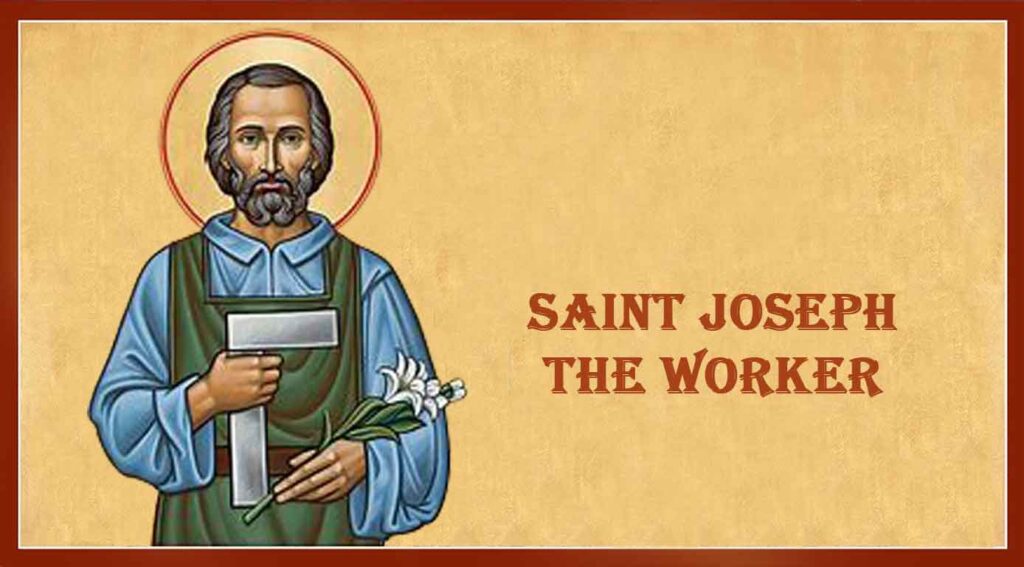
Saint Joseph the Worker

To foster deep devotion to Saint Joseph among Catholics, and in response to the “May Day” celebrations for workers sponsored by Communists, Pope Pius XII instituted the feast of Saint Joseph the Worker in 1955. This feast extends the long relationship between Joseph and the cause of workers in both Catholic faith and devotion. Beginning in the Book of Genesis, the dignity of human work has long been celebrated as a participation in the creative work of God. By work, humankind both fulfills the command found in Genesis to care for the earth (Gn 2:15) and to be productive in their labors. Saint Joseph, the carpenter and foster father of Jesus, is but one example of the holiness of human labor.

Jesus, too, was a carpenter. He learned the trade from Saint Joseph and spent his early adult years working side-by-side in Joseph’s carpentry shop before leaving to pursue his ministry as preacher and healer. In his encyclical Laborem Exercens, Pope John Paul II stated: “the Church considers it her task always to call attention to the dignity and rights of those who work, to condemn situations in which that dignity and those rights are violated, and to help to guide [social] changes so as to ensure authentic progress by man and society.”

Saint Joseph is held up as a model of such work. Pius XII emphasized this when he said, “The spirit flows to you and to all men from the heart of the God-man, Savior of the world, but certainly, no worker was ever more completely and profoundly penetrated by it than the foster father of Jesus, who lived with Him in closest intimacy and community of family life and work.”

Sources:

https://www.franciscanmedia.org/saint-of-the-day/saint-joseph-the-worker/

Saint Joseph the Worker Read More »

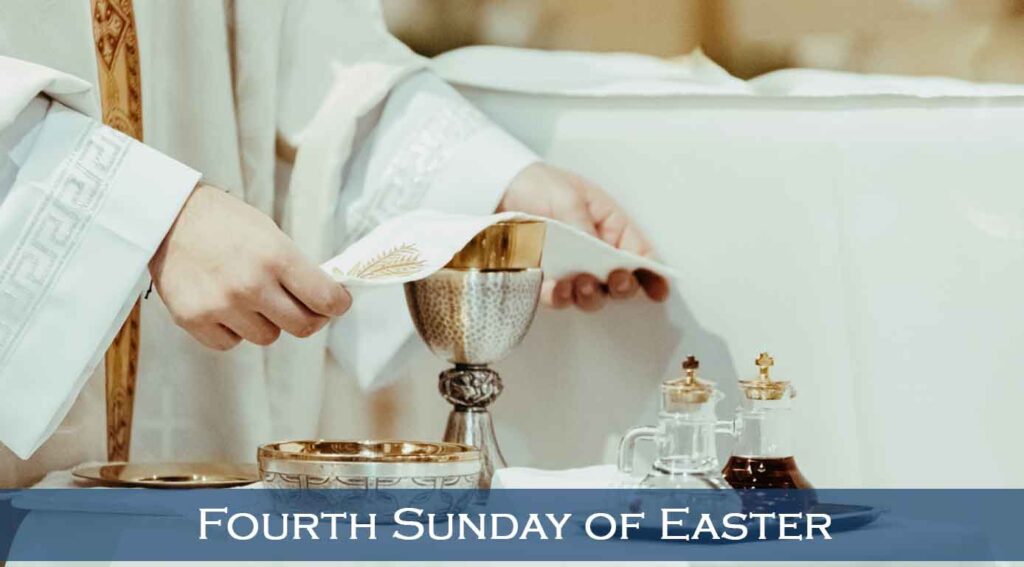
Fourth Sunday of Easter

Liturgy of the Word

First Reading: Acts 2:14a, 36-41

Then Peter stood up with the Eleven,
raised his voice, and proclaimed:
"Let the whole house of Israel know for certain
that God has made both Lord and Christ,
this Jesus whom you crucified."

Now when they heard this, they were cut to the heart,
and they asked Peter and the other apostles,
"What are we to do, my brothers?"
Peter said to them,
"Repent and be baptized, every one of you,
in the name of Jesus Christ for the forgiveness of your sins;
and you will receive the gift of the Holy Spirit.
For the promise is made to you and to your children
and to all those far off,
whomever the Lord our God will call."
He testified with many other arguments, and was exhorting them,
"Save yourselves from this corrupt generation."
Those who accepted his message were baptized,
and about three thousand persons were added that day.

Responsorial Psalm: Psalm 23:1-3a, 3b4, 5, 6

Response– The Lord is my shepherd; there is nothing I shall want

The LORD is my shepherd; I shall not want.
In verdant pastures he gives me repose;
beside restful waters he leads me;
he refreshes my soul.
R– The Lord is my shepherd; there is nothing I shall want

He guides me in right paths
for his name's sake.
Even though I walk in the dark valley
I fear no evil; for you are at my side.
With your rod and your staff
that give me courage.
R– The Lord is my shepherd; there is nothing I shall want

You spread the table before me
in the sight of my foes;
you anoint my head with oil;
my cup overflows.
R– The Lord is my shepherd; there is nothing I shall want

Only goodness and kindness follow me
all the days of my life;
and I shall dwell in the house of the LORD
for years to come.
R– The Lord is my shepherd; there is nothing I shall want

Second Reading: 1 Pt 2:20b-25

Beloved:
If you are patient when you suffer for doing what is good,
this is a grace before God.
For to this you have been called,
because Christ also suffered for you,
leaving you an example that you should follow in his footsteps.
He committed no sin, and no deceit was found in his mouth.

When he was insulted, he returned no insult;
when he suffered, he did not threaten;
instead, he handed himself over to the one who judges justly.
He himself bore our sins in his body upon the cross,
so that, free from sin, we might live for righteousness.
By his wounds you have been healed.
For you had gone astray like sheep,
but you have now returned to the shepherd and guardian of your souls.

Alleluia: Jn 10:14

Alleluia, alleluia. I am the good shepherd, says the Lord; I know my sheep, and mine know me.Alleluia, alleluia.

Gospel: Jn 10:1-10

A reading from the holy Gospel according to John

Jesus said:
"Amen, amen, I say to you,
whoever does not enter a sheepfold through the gate
but climbs over elsewhere is a thief and a robber.
But whoever enters through the gate is the shepherd of the sheep.
The gatekeeper opens it for him, and the sheep hear his voice,
as the shepherd calls his own sheep by name and leads them out.
When he has driven out all his own,
he walks ahead of them, and the sheep follow him,
because they recognize his voice.
But they will not follow a stranger;
they will run away from him,
because they do not recognize the voice of strangers."
Although Jesus used this figure of speech,
the Pharisees did not realize what he was trying to tell them.

So Jesus said again, "Amen, amen, I say to you,
I am the gate for the sheep.
All who came before me are thieves and robbers,
but the sheep did not listen to them.
I am the gate.
Whoever enters through me will be saved,
and will come in and go out and find pasture.
A thief comes only to steal and slaughter and destroy;
I came so that they might have life and have it more abundantly."

The Readings and Gospel were sourced from:

Fourth Sunday of Easter Read More »

Revelation 3:20

Verse:

“Here I am! I stand at the door and knock. If anyone hears my voice and opens the door, I will come in and eat with that person, and they with me.” - Revelation 3:20

Prayer For Spiritual Blessings

Dear Lord, You have told us that the man that does not walk in the ways of the world and refuses to be influenced by the trinkets that this world offers, but who puts their trust in You, is blessed indeed.

Amen.

Revelation 3:20 Read More »

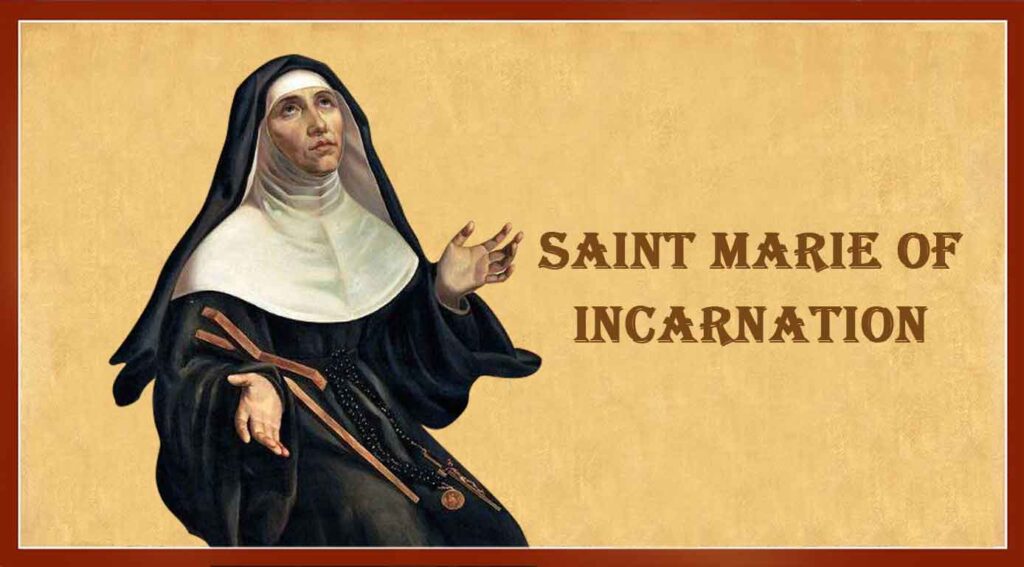
Saint Marie of Incarnation

Saint Marie of Incarnation was an Ursuline nun born in France as Marie Guyart. From an early age she was drawn to religious liturgy and the sacraments. When Marie was seven years old, she recounted her first mystical encounter with Jesus Christ.

Intent on belonging to Christ, Marie, aged fourteen, proposed to her parents that she enter religious life with the Benedictines of Beaumont Abbey but her parents disregarded her desire. Instead, she was married to Claude Martin, a master silk worker in 1617. Her husband died only months after the birth of their son, leaving Marie a widow at the age of nineteen.

With her husband’s death, Saint Marie inherited his failing business which she then lost. Forced to move into her parents’ home, Saint Marie secluded herself to pursue a deepening of her commitment to spiritual growth. Free to pursue her religious inclinations after her husband’s death, Saint Marie took a vow of chastity, obedience, and poverty. On 24 March 1620, she reported a religious vision that set her on a new path of devotional intensity.

In 1631, after working with a spiritual director for many years, Saint Marie decided to enter the Ursuline monastery in Tours to answer her religious vocation. As part of a group of nuns sent to New France to establish the Ursuline Order, Saint Marie was crucial in the spread of Catholicism in New France. She was a religious author and has been credited with founding the first girls’ school in the New World.

Saint Marie of Incarnation Read More »

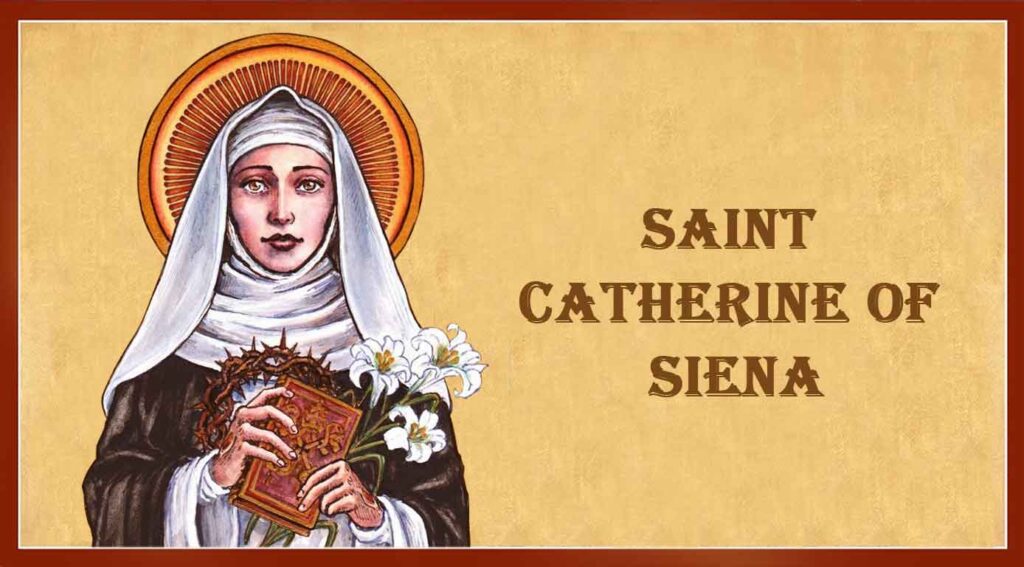
Saint Catherine of Siena

The value Catherine makes central in her short life and which sounds clearly and consistently through her experience is complete surrender to Christ. What is most impressive about her is that she learns to view her surrender to her Lord as a goal to be reached through time.

She was the 23rd child of Jacopo and Lapa Benincasa and grew up as an intelligent, cheerful, and intensely religious person. Catherine disappointed her mother by cutting off her hair as a protest against being overly encouraged to improve her appearance in order to attract a husband. Her father ordered her to be left in peace, and she was given a room of her own for prayer and meditation.

She entered the Dominican Third Order at 18 and spent the next three years in seclusion, prayer, and austerity. Gradually, a group of followers gathered around her—men and women, priests and religious. An active public apostolate grew out of her contemplative life. Her letters, mostly for spiritual instruction and encouragement of her followers, began to take more and more note of public affairs. Opposition and slander resulted from her mixing fearlessly with the world and speaking with the candor and authority of one completely committed to Christ. She was cleared of all charges at the Dominican General Chapter of 1374.

Her public influence reached great heights because of her evident holiness, her membership in the Dominican Third Order, and the deep impression she made on the pope. She worked tirelessly for the crusade against the Turks and for peace between Florence and the pope.

In 1378, the Great Schism began, splitting the allegiance of Christendom between two, then three, popes and putting even saints on opposing sides. Catherine spent the last two years of her life in Rome, in prayer and pleading on behalf of the cause of Pope Urban VI and the unity of the Church. She offered herself as a victim for the Church in its agony. She died surrounded by her “children” and was canonized in 1461.

Catherine ranks high among the mystics and spiritual writers of the Church. In 1939, she and Francis of Assisi were declared co-patrons of Italy. Pope Paul VI named her and Teresa of Avila doctors of the Church in 1970. Her spiritual testament is found in The Dialogue.

Sources:

https://www.franciscanmedia.org/saint-of-the-day/saint-catherine-of-siena/

Saint Catherine of Siena Read More »

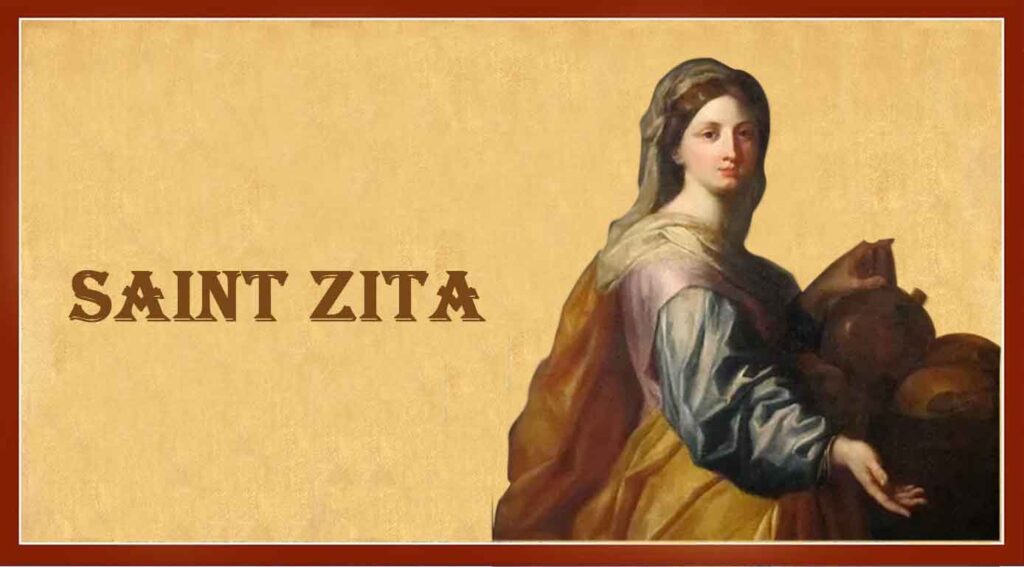
Saint Zita

Saint Zita was an Italian saint, born in Tuscany. She entered domestic service at the age of twelve and served the same family for almost fifty years.

Through her diligence and fidelity, she became a trusted and valued servant. She gave one-third of her wages to her parents, kept a third, and gave the rest to the poor. The mistress of the house placed Zita in charge of the household almsgiving, and allowed her to visit the sick poor in their own homes and tend to their needs.

She always rose several hours before the rest of the family and took care to hear Mass every morning before she began work. She attended to her tasks with diligence and fidelity, and studied when possible to anticipate what needed to be done. Saint Zita continued to serve the Fatinellis after the death in 1260 of Guglielmo Fatinelli when his son Pagano became the head of the family.

Saint Zita was known for her kindness and generosity to the poor. She is known as the patron saint of maids and domestic servants. She is often appealed to in order to help find lost keys.

Sources:

Saint Zita Read More »

Romans 12:16

Verse:

“Live in harmony with one another. Do not be proud, but be willing to associate with people of low position. Do not be conceited.” - Romans 12:16

Prayer For Guidance Today

Heavenly Father, I bow my knee before You in prayer and praise. Lead and guide me today in all You say and do. May I walk in spirit and truth today and be sensitive to Your gentle guidance.

Romans 12:16 Read More »