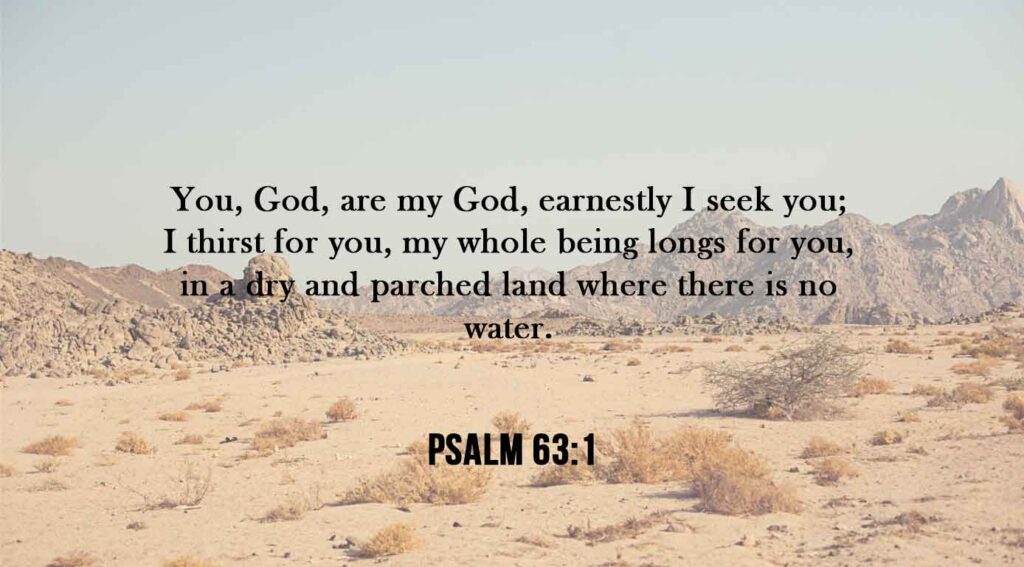
“You, God, are my God, earnestly I seek you;
I thirst for you, my whole being longs for you, in a dry and parched land where there is no water.” - Psalm 63:1
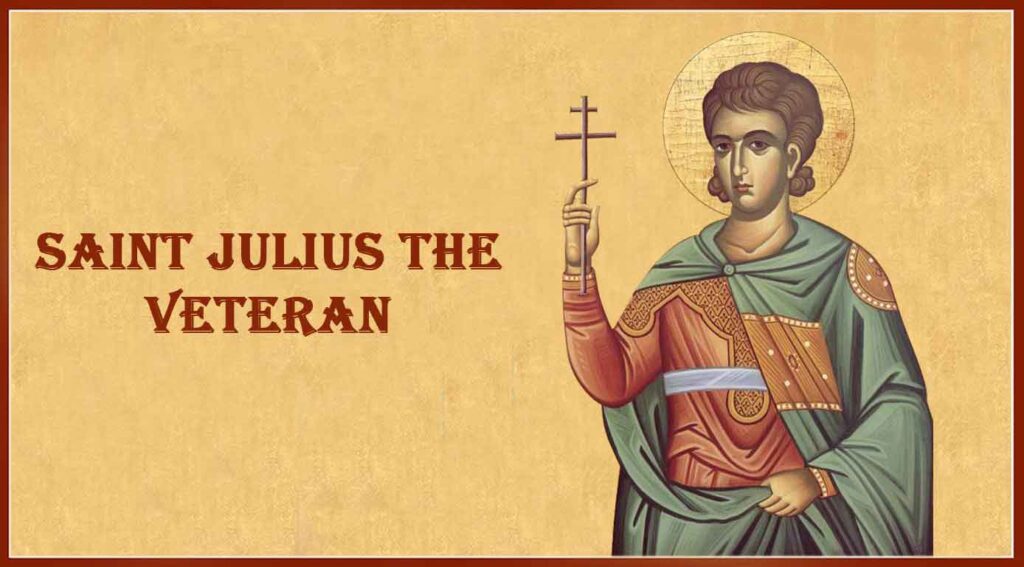
Saint Julius the Veteran, also referred to as Julius of Durostorum, is a Roman Catholic, Anglican and Eastern Orthodox saint and martyr.
Saint Julius’ date to conversion is unknown but he served as a Roman soldier for 27 years first as a conscript, then returning as a [veteran], totaling seven military campaigns in total. Given the years and locations in which Julius served, Rev. Herbert Musurillo, S.J. writes that Julius likely served in the Legio XI Claudia. Julius was Christian his entire military career.
Saint Julius the Veteran was brought to trial before the prefect, Maximus, after being arrested by Maximus’ staff soldiers for refusing to make a public sacrifice to the Roman gods. Upon hearing of his military service, Maximus complimented Julius for being a wise and serious man.
In gratitude for his military service, Maximus proposed Saint Julius a bargain: if Saint Julius offered the public sacrifice, Maximus would accept blame for the sin of the sacrifice and would give Saint Julius freedom, a ten-year bonus payment, and immunity from future charges. Saint Julius declined the offer and was sentenced to death. Saint Julius was killed by the sword in Durostorum, the Roman camp in Moesia Inferior.
https://en.wikipedia.org/wiki/Julius_the_Veteran#:~:text=Saint%20Julius%20the%20Veteran%20(Latin,feast%20day%20is%2027%20May.
Saint Julius the Veteran Read More »
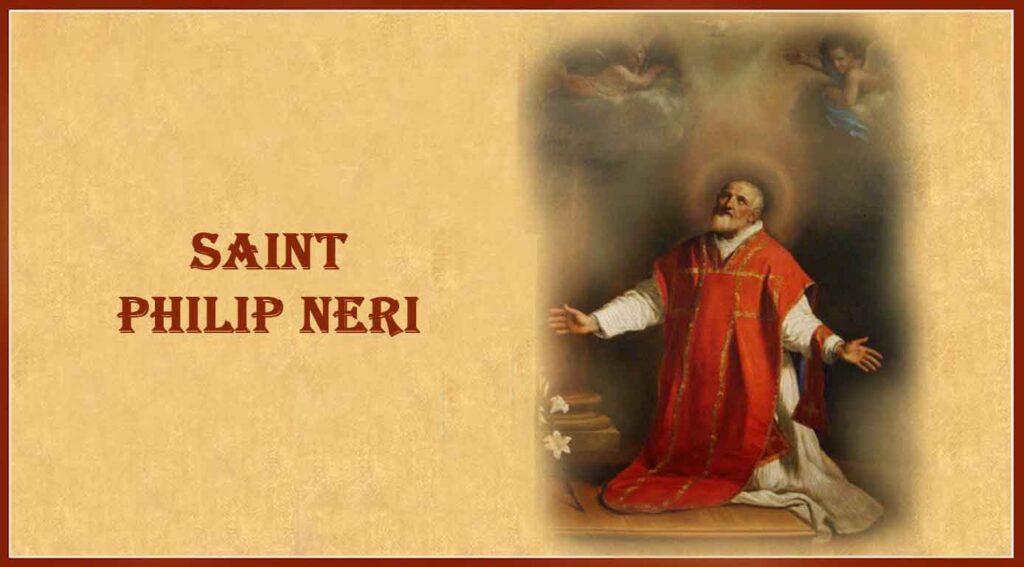
Saint Philip Neri was an Italian priest noted for founding a society of secular clergy called the Congregation of the Oratory. He was also known as the “Second Apostle of Rome” after Saint Peter.
Saint Philip Neri was carefully brought up, and received his early teaching from the friars at San Marco, the famous Dominican monastery in Florence. At the age of 18, in 1533, Philip was sent to his uncle, Romolo, a wealthy merchant at San Germano, to assist him in his business, and with the hope that he might inherit his uncle’s fortune. But soon after coming to San Germano, Philip had a religious conversion. From then onward, he no longer cared for things of the world and decided in 1533 to live in Rome.
He began those labors amongst the sick and poor which, in later life, gained him the title of “Apostle of Rome”. He also ministered to the prostitutes of the city. In 1538 he entered into the home mission work for which he became famous, traveling throughout the city, seeking opportunities of entering into conversation with people, and of leading them to consider the topics he set before them. For seventeen years Philip lived as a layman in Rome, probably without thinking of becoming a priest. But in 1551, Saint Philip Neri received all the minor orders, and was ordained deacon and finally priest.
Saint Philip Neri embodied several contradictions, combining popular veneration with intensely individual piety. He became deeply involved with the Church while seeking to reform a corrupt Rome and an indifferent clergy. He is one of the influential figures of the Counter-Reformation and is noted for converting to personal holiness many of the influential people within the Church itself.
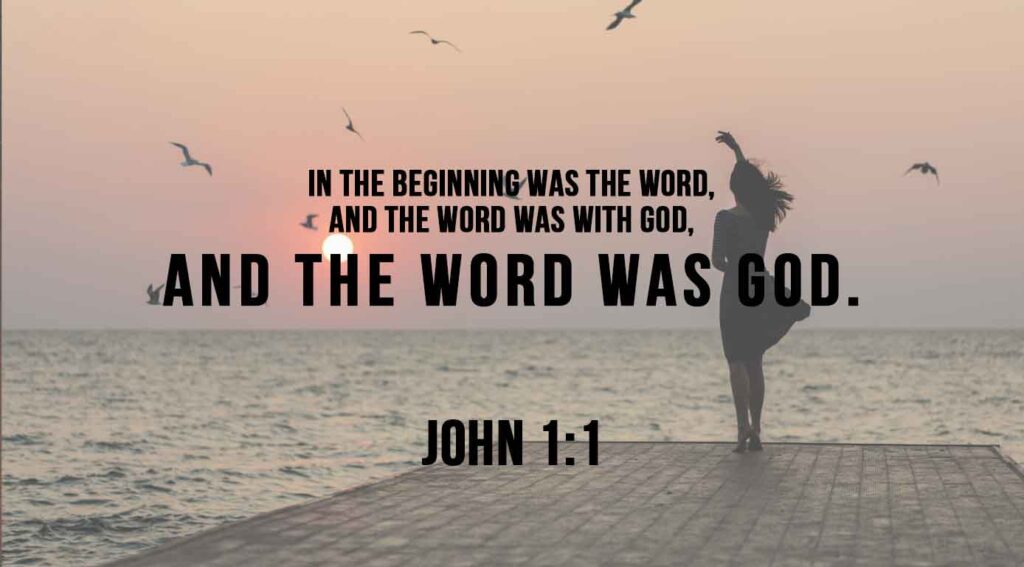
“In the beginning was the Word, and the Word was with God, and the Word was God.” - John 1:1
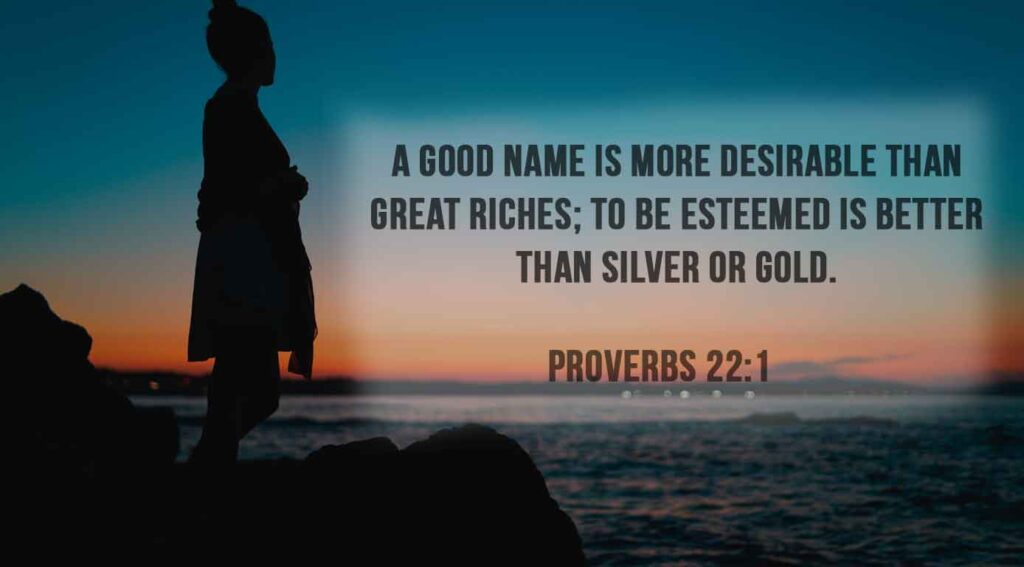
“A good name is more desirable than great riches; to be esteemed is better than silver or gold.” - Proverbs 22:1
Thank You, Father, that I am positioned in Christ and united in Him. What a great comfort this is to my heart and soul. Lord, I know that I have no right to have received Your amazing grace, for I acknowledge that it is against You alone that I have sinned in thought word and deed. And yet, You saw fit to leave Your heavenly throne and be born into this world of sin, as a little baby, so that by Your grace and mercy You could stoop down and pick me up, and seat me in heavenly places. Love so amazing, so divine demands my soul, my life, my all.
And so I kneel humbly before You and pray that by that same grace You would finish the good work that You started in me, when I trusted the Lord Jesus as my Saviour. I pray that my life may be a reflection of HIm and that the deep humility, meekness and goodness that was so evident throughout His entire life may be reflected in me.
I pray that like Jesus, I may learn obedience, even if it means having to experience suffering and pain. And Father, I pray that like Him I may act justly, love mercy and to walk humbly with You, all the days of my life, to Your praise and glory. In Jesus' name I pray,
Amen.
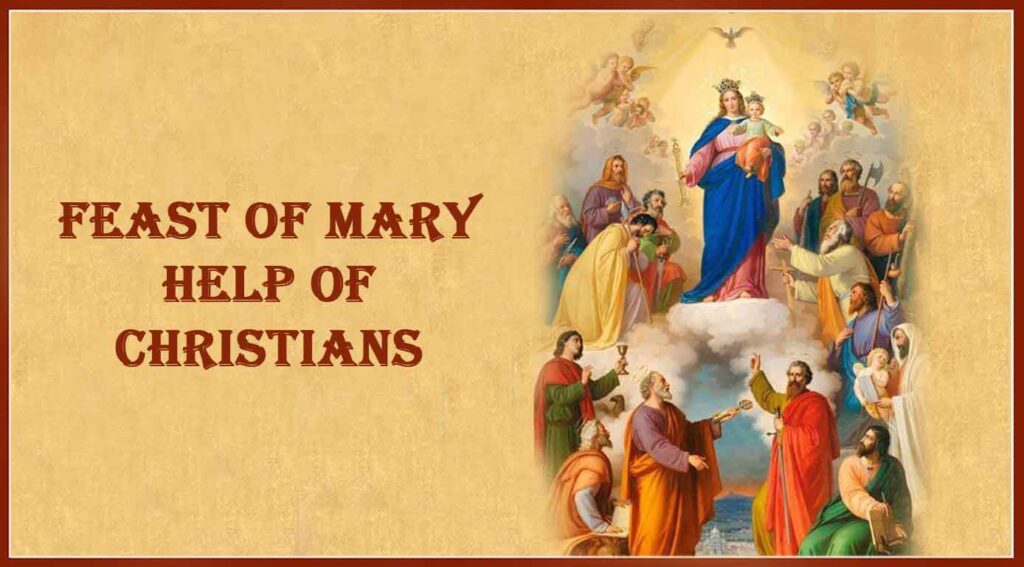
The Feast of Mary Help of Christians was instituted by Pope Pius VI. To commemorate his own sufferings and those of the church during his exile Pope Pius VII extended the feast of the Seven Dolours of Mary to the Catholic Church on 18 September 1814. To give thanks to God and Our Lady, on 15 September 1815 he declared 24 May, the anniversary of his first return, to be henceforth the feast of Our Lady, Help of Christians.
The Marian feast has been celebrated by the Order of Servites since the 17th century. The veneration to Mary became popular under this title in Rome especially, where the feast was especially promoted by John Bosco and Vincent Pallotti. Bosco was an ardent promoter of devotion to “Mary, Help of Christians”. He built a huge basilica in her honour in 1868 and founded a religious congregation for women, under the title of, “The Daughters of Mary, Help of Christians”.
The church focuses in this feast on the role of Our Lady’s intercession in the fight against sin in the life of a believer. In addition, it focuses on Our Lady as one who assists Christians as a community, through her intercession, in fighting against anti-Christian forces.
Feast of Mary Help of Christians Read More »
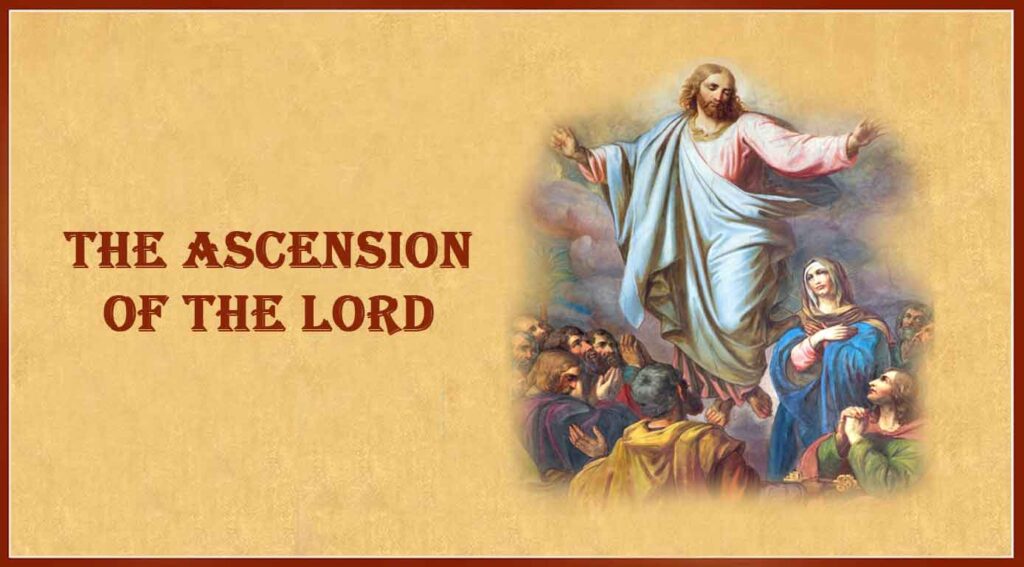
In the first book, Theophilus,
I dealt with all that Jesus did and taught
until the day he was taken up,
after giving instructions through the Holy Spirit
to the apostles whom he had chosen.
He presented himself alive to them
by many proofs after he had suffered,
appearing to them during forty days
and speaking about the kingdom of God.
While meeting with them,
he enjoined them not to depart from Jerusalem,
but to wait for “the promise of the Father
about which you have heard me speak;
for John baptized with water,
but in a few days you will be baptized with the Holy Spirit.”
When they had gathered together they asked him,
“Lord, are you at this time going to restore the kingdom to Israel?”
He answered them, “It is not for you to know the times or seasons
that the Father has established by his own authority.
But you will receive power when the Holy Spirit comes upon you,
and you will be my witnesses in Jerusalem,
throughout Judea and Samaria,
and to the ends of the earth.”
When he had said this, as they were looking on,
he was lifted up, and a cloud took him from their sight.
While they were looking intently at the sky as he was going,
suddenly two men dressed in white garments stood beside them.
They said, “Men of Galilee,
why are you standing there looking at the sky?
This Jesus who has been taken up from you into heaven
will return in the same way as you have seen him going into heaven.”
Response– God mounts his throne to shouts of joy: a blare of trumpets for the Lord
All you peoples, clap your hands,
shout to God with cries of gladness,
For the LORD, the Most High, the awesome,
is the great king over all the earth.
R–God mounts his throne to shouts of joy: a blare of trumpets for the Lord
God mounts his throne amid shouts of joy;
the LORD, amid trumpet blasts.
Sing praise to God, sing praise;
sing praise to our king, sing praise.
R–God mounts his throne to shouts of joy: a blare of trumpets for the Lord
For king of all the earth is God;
sing hymns of praise.
God reigns over the nations,
God sits upon his holy throne.
R–God mounts his throne to shouts of joy: a blare of trumpets for the Lord
Brothers and sisters:
May the God of our Lord Jesus Christ, the Father of glory,
give you a Spirit of wisdom and revelation
resulting in knowledge of him.
May the eyes of your hearts be enlightened,
that you may know what is the hope that belongs to his call,
what are the riches of glory
in his inheritance among the holy ones,
and what is the surpassing greatness of his power
for us who believe,
in accord with the exercise of his great might,
which he worked in Christ,
raising him from the dead
and seating him at his right hand in the heavens,
far above every principality, authority, power, and dominion,
and every name that is named
not only in this age but also in the one to come.
And he put all things beneath his feet
and gave him as head over all things to the church,
which is his body,
the fullness of the one who fills all things in every way.
Alleluia, alleluia. Go and teach all nations, says the Lord; I am with you always, until the end of the world.Alleluia, alleluia.
A reading from the holy Gospel according to Matthew
The eleven disciples went to Galilee,
to the mountain to which Jesus had ordered them.
When they saw him, they worshiped, but they doubted.
Then Jesus approached and said to them,
“All power in heaven and on earth has been given to me.
Go, therefore, and make disciples of all nations,
baptizing them in the name of the Father,
and of the Son, and of the Holy Spirit,
teaching them to observe all that I have commanded you.
And behold, I am with you always, until the end of the age.”
The Ascension of the Lord Read More »
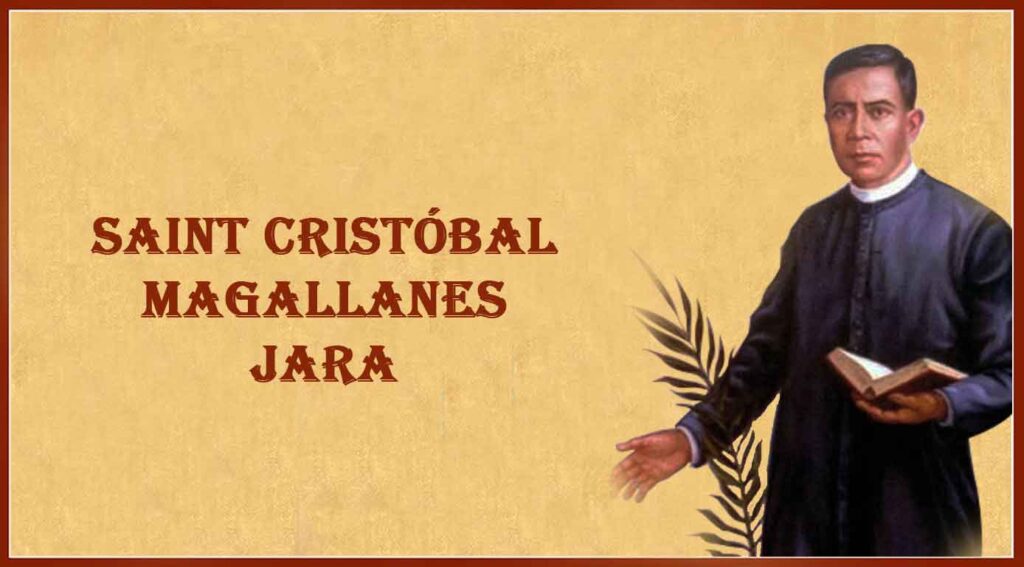
Saint Cristóbal Magallanes Jara, also known as Christopher Magallanes, was born in Totatiche, Jalisco, Mexico. He worked as a shepherd in his youth and enrolled in the Conciliar Seminary of San José in Guadalajara at the age of 19.
Saint Cristóbal Magallanes Jara was ordained at the age of 30 at Santa Teresa in Guadalajara in 1899 and served as chaplain of the School of Arts and Works of the Holy Spirit in Guadalajara. He was then designated as the parish priest for his hometown of Totatiche, where he helped found schools and carpentry shops and assisted in planning for hydrological works, including the dam of La Candelaria.
He took special interest in the evangelization of the local indigenous Huichol people and was instrumental in the foundation of the mission in the indigenous town of Azqueltán. In July 1915, he opened the Auxiliary Seminary of Totatiche, which achieved a student body of 17 students by the following year and was recognized by the Archbishop of Guadalajara, José Francisco Orozco y Jiménez, who appointed a precept and two professors to the seminary.
Saint Cristóbal Magallanes Jara wrote and preached against armed rebellion, but was falsely accused of promoting the Cristero Rebellion in the area. He was martyred, being killed without trial on the way to say Mass during the Cristero War.
Saint Cristóbal Magallanes Jara Read More »
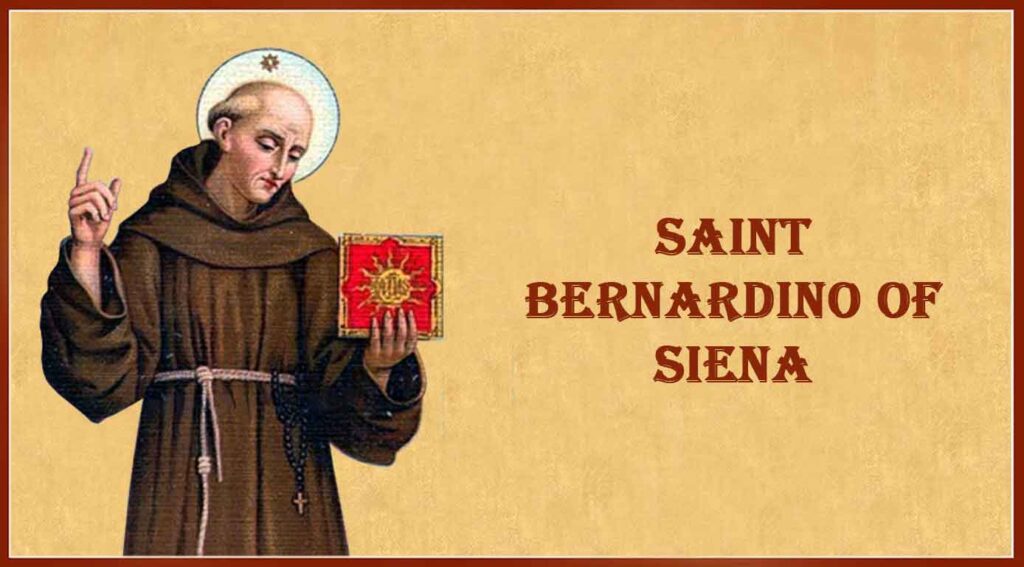
Saint Bernardino of Siena was an Italian priest and Franciscan missionary preacher in Italy. He was born in 1380 to the noble Albizzeschi family in Massa Marittima, Tuscany. He was left orphaned at six, he was raised by a pious aunt.
In 1397, after a course of civil and canon law, he joined the Confraternity of Our Lady attached to the hospital of Santa Maria della Scala. Three years later, when the plague visited Siena, he ministered to the plague-stricken, and, assisted by ten companions, took upon himself for four months entire charge of this hospital.
In 1403 he joined the Observant branch of the Order of Friars Minor (the Franciscan Order). He was ordained a priest in 1404 and was commissioned as a preacher the next year.
He was a systematizer of Scholastic economics. His preaching, his book burnings, and his “bonfires of the vanities” made him famous/infamous during his own lifetime because they were frequently directed against sorcery, gambling, infanticide, witchcraft, homosexuals, Jews, Romani “Gypsies”, usury, etc. For more than 30 years, he preached all over Italy and played a great part in the religious revival of the early fifteenth century, which made him known as “the Apostle of Italy”.
Saint Bernardino of Siena Read More »
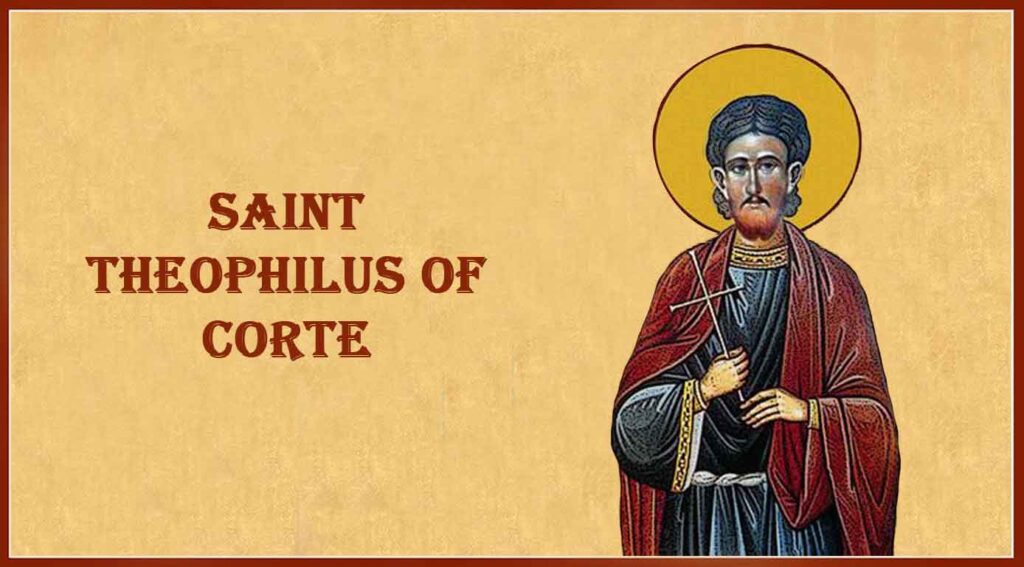
Saint Theophilus of Corte was an Italian Roman Catholic priest and a professed member from the Order of Friars Minor. He loved silence and solitude and found it a better method of communication with the Lord while exhorting his fellow Franciscans to do the same to reflect on the goodness of God.
He studied under the Franciscans and in 1693 he joined their order and assumed his religious name. He completed his theological studies in Rome with distinctions and began his theological studies in Naples. He made his profession in Salerno in 1694 and was ordained to the priesthood in Naples at the convent of Santa Maria La Nova. He founded houses for the order in the Tuscan region and in Corscia in places such as Zuani and Fucecchio.
He was a reformer who become known for his preaching and evangelization efforts. He was known for his cheerful demeanor and his willingness to assist others while also known for his tireless dedication to silence and solitude which he exhorted his fellow friars to exercise in order to better commune with God.
Saint Theophilus of Corte Read More »
Add San Jose Filipino Ministry as a new recipient, Send your donation using"donate@dosjfm.org"
Payable to - San Jose Filipino Ministry
Address - Poong Jesus Nazareno Filipino Catholic Center (PJNFCC); 3700 W. Orange Ave., Anaheim CA 92804
Poong Jesus Nazareno Filipino Catholic Center (PJNFCC); 3700 W. Orange Ave., Anaheim CA 92804
Phone: (657) 214-2507
Mobile (657) 208-2038
info@dosjfm.org

Poong Jesus Nazareno Filipino Catholic Center (PJNFCC); 3700 W. Orange Ave., Anaheim CA 92804
Phone: (657) 214-2507
Mobile (657) 208-2038
info@dosjfm.org
Add San Jose Filipino Ministry as a new recipient, Send your donation using"donate@dosjfm.org"
Payable to - San Jose Filipino Ministry
Address - 1235 S Magnolia Ave
Anaheim, CA 92804-5115
San Jose Filipino Ministry. All rights reserved. 2021 © Powered by Phoenix Virtual Solutions
Sponsored by EverClear Hospice and Palliative Care