2023

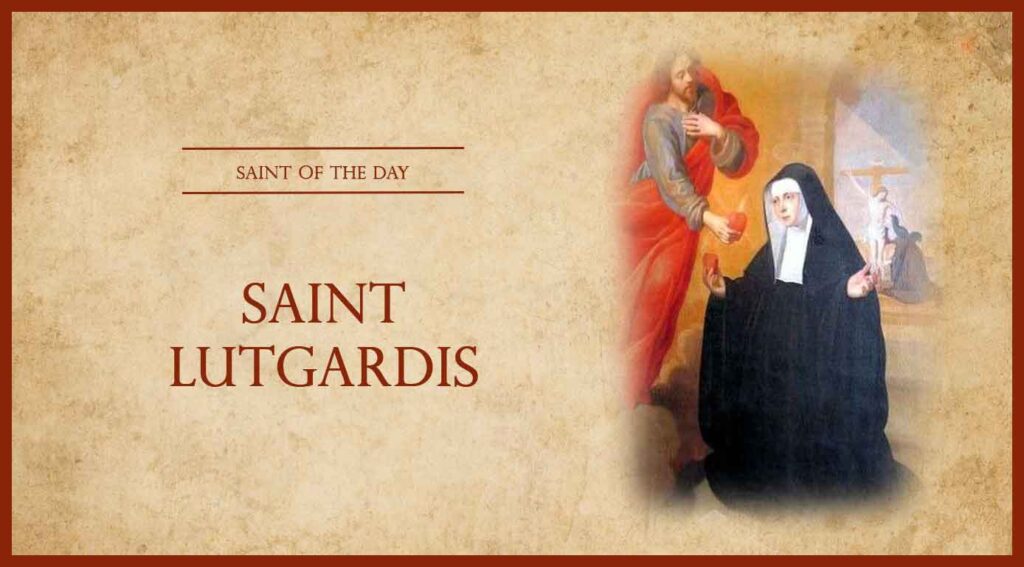
Saint Lutgardis

Saint Lutgardis, also known as Lutgardis of Aywieres, was born in Tongeren (Tongren) and entered monastic life at the age of twelve. She is a saint from the medieval Low Countries. She is considered as one of the leading mystics of the 13th century.

She was admitted into the Benedictine monastery of St. Catherine near Sint-Truiden at the age of twelve. She lived in the convent for several years without having much interest in religious life. She could come and go and receive visitors as she pleased.

She was visited with a vision of Jesus Christ showing her his wounds, and at age twenty she made her solemn vows as a Benedictine. Over the next dozen years, she had many visions of Christ, Mary and St. John the Evangelist. Accounts of her life state that she experienced ecstasies, levitated, and dripped blood from her forehead and hair when entranced. She refused the honor of serving as abbess. However, in 1205, she was chosen to be prioress of her community.

Saint Lutgardis was one of the great precursors of the devotion to the Sacred Heart of Jesus. The first recorded mystic revelation of Christ’s heart is that of Saint Lutgardis. During this time she is known to have shown gifts of healing and prophecy, and was an adept at teaching the Gospels. She was blind for the last eleven years of her life, and died of natural causes at Aywières. According to tradition, she experienced a vision in which Christ informed her of her forthcoming death. She died on June 16, 1246, the day after the Feast of the Holy Trinity, at the age of 64.
Saint Lutgardis Read More »

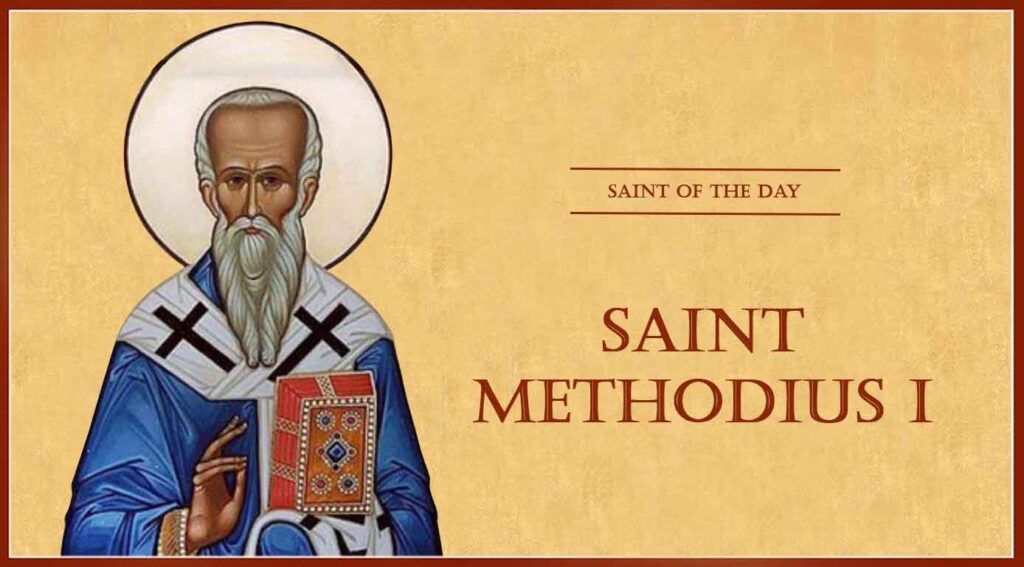
Saint Methodius I

Saint Methodius I of Constantinople was born to wealthy parents. Methodios was sent as a young man to Constantinople to continue his education and hopefully attain an appointment at court. But instead he entered a monastery in Bithynia, eventually becoming abbot.

In 815, Methodios went to Rome, perhaps as an envoy of the deposed Patriarch Nikephorοs. Upon his return in 821 he was arrested and exiled as an iconodule by the Iconoclast regime of Emperor Michael II. Methodios was released in 829 and assumed a position of importance at the court of the even more fervently iconoclast Emperor Theophilos.

The influential minister Theoktistos secured the appointment of Methodios as his successor, bringing about the end of the iconoclast controversy. A week after his appointment and after the Council of Constantinople (843), Methodios made a triumphal procession from the church of Blachernae to Hagia Sophia on March 11, 843, restoring the icons to the church. This heralded the restoration of Catholic orthodoxy, and became a holiday in the Byzantine Church, celebrated every year on the First Sunday of Great Lent, and known as the “Triumph of Orthodoxy”.

Throughout his short patriarchate, Methodios tried to pursue a moderate line of accommodation with members of the clergy who were formerly Iconoclasts. This policy was opposed by extremists. To rein in the extremists, Methodios was forced to excommunicate and arrest some of the more persevering monks.

Methodios was indeed well-educated; engaged in both copying and writing of manuscripts. His individual works included polemica, hagiographical and liturgical works, sermons and poetry.

Saint Methodius I Read More »

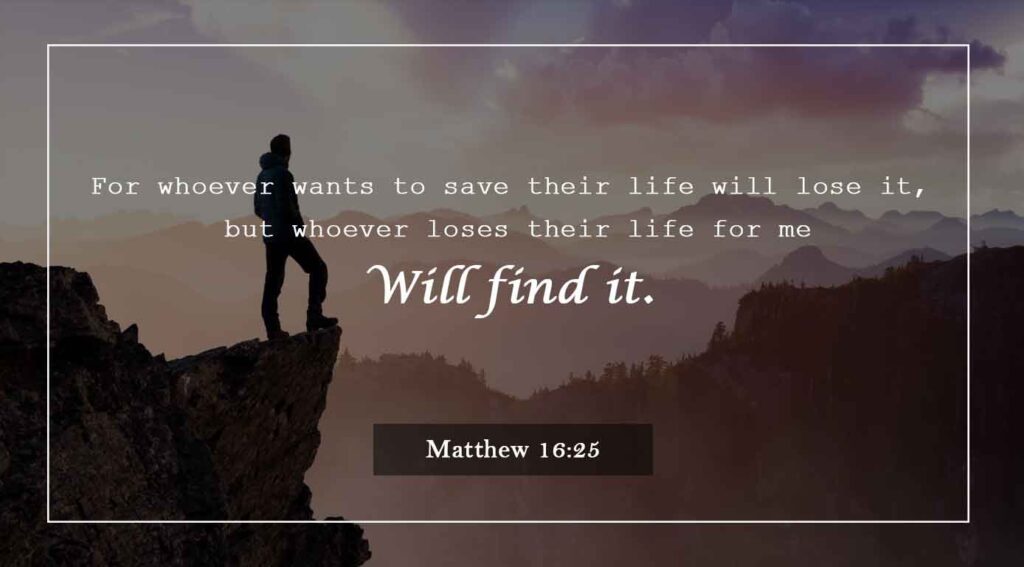
Matthew 16:25

Verse:

 “For whoever wants to save their life will lose it, but whoever loses their life for me will find it.” - Matthew 16:25

A Prayer For The Testing Of Our Faith

Thank You, Father, that You have promised that the testing of our faith produces perseverance and steadfastness, which in time will bring forth the beautiful Christlike character that You so desire in all Your children, but which all too often I personally seek to avoid, or regard as a time of bitter struggle. Help me Lord, to embrace any trials that You see fit to enter my life. Help me to look at the difficulties that engulf me with Your eyes, and give me an eternal perspective on all the problems I may be called upon to face, so that I may count it all joy when I am confronted with various trials, knowing that the testing of my faith produces the godly fruit of patience. Help me Lord, to use those times of testing as an opportunity to grow in grace, and as a springboard to develop a deeper and more secure relationship with You.

Lord, it is not alway easy to align our minds with the mind of Christ. It is often very hard to see trials in a positive light, and to embrace the various testings we have to go through as a thing to be highly prized, and yet Your Word tells us that life's difficulties sharpen our faith, while developing our trust in the Lord, which is more precious to You than much fine gold. Give me a heart that understands and chooses to look at trials and tests from Your perspective, so that the testing of my faith may bring forth the righteous fruit or patience and grace. I ask this in the name of Jesus,

Amen.

Matthew 16:25 Read More »

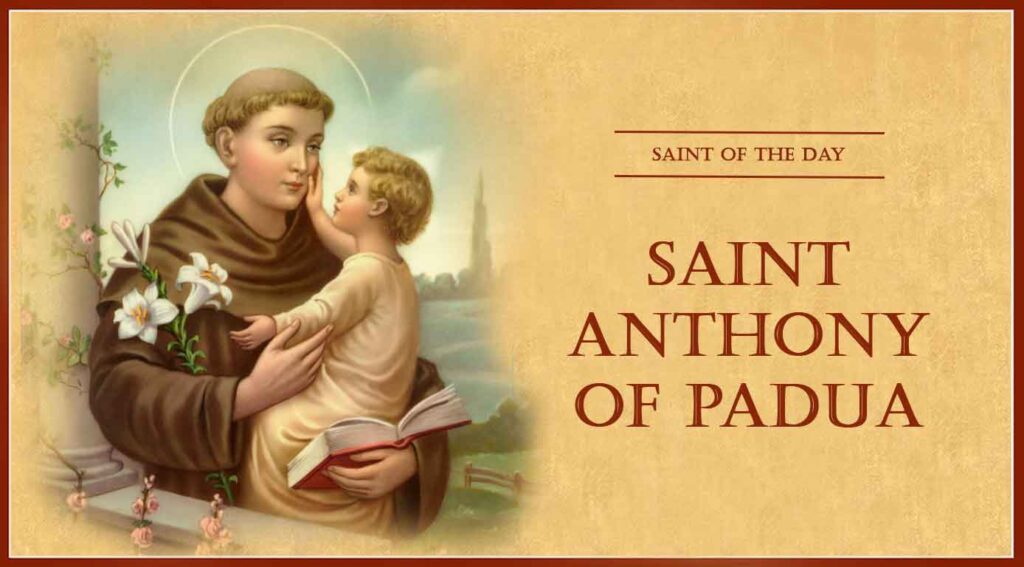
Saint Anthony of Padua

Saint Anthony of Padua was born and raised by a wealthy family in Lisbon, Portugal. His wealthy and noble family arranged for him to be instructed at the local cathedral school. At the age of 15, he entered the Augustinian community of Canons Regular of the Order of the Holy Cross at the Abbey of Saint Vincent on the outskirts of Lisbon. In 1212, distracted by frequent visits from family and friends, he asked to be transferred to the motherhouse of the congregation, the Monastery of the Holy Cross in Coimbra, then the capital of Portugal.

After his ordination to the priesthood, Saint Anthony of Padua was named guestmaster at the age of 19, and placed in charge of hospitality for the abbey. While he was in Coimbra, some Franciscan friars arrived and settled at a small hermitage outside Coimbra dedicated to Anthony the Great. He was strongly attracted to the simple, evangelical lifestyle of the friars, whose order had been founded only 11 years prior. He obtained permission from church authorities to leave the Canons Regular to join the new Franciscan order. Upon his admission to the life of the friars, he joined the small hermitage in Olivais.

Occasionally, Saint Anthony took another post as a teacher at universities like University of Montpellier and University of Toulouse in southern France, but his preaching was considered to be his supreme gift. According to historian Sophronius Clasen, Anthony preached “the grandeur of Christianity”. His method included allegory and symbolical explanation of scripture.

In 1228, he served as envoy from the general chapter to Pope Gregory IX. At the papal court, his preaching was hailed as a “jewel case of the Bible” and he was commissioned to produce his collection of sermons, Sermons for Feast Days.

Saint Anthony became sick with ergotism in 1231 and went to the woodland retreat at Camposampiero with two other friars for a respite. There, he lived in a room built for him under the branches of a walnut tree. Anthony died on the way back to Padua on 13 June 1231 at the Poor Clare monastery at Arcella (now part of Padua), at the age of 35.

He is especially invoked and venerated all over the world as the patron saint for the recovery of lost items and is credited with many miracles involving lost people, lost things and even lost spiritual goods.

Saint Anthony of Padua Read More »

Luke 12:6-7

Verse:

“Are not five sparrows sold for two pennies? Yet not one of them is forgotten by God. Indeed, the very hairs of your head are all numbered. Don’t be afraid; you are worth more than many sparrows.” - Luke 12:6-7

Prayer For Greater Confidence In God's Love

Father, forgive me for misrepresenting Your Father-heart of love, and thank You for showing me that Your love for me is not dependent on what I can do for You but rests entirely on what the Lord Jesus did for me, on the cross. Thank You, that Your approval does not rely on me at all but simply rests on the fact that I believed on the Lord Jesus as my Saviour, and that I am accepted by You because of Him. Accepted in the Beloved because I am a new creation in Christ, clothed in His righteousness and without condemnation. All because of Jesus.

Father, thank You for this liberating truth. May I never again be drawn into wrong thinking about Your Father-heart of love and may I gain greater confidence and understanding of what my position in Christ truly means. This I ask in the precious name of my Lord Jesus Christ, Who died for me that I might be free from any condemnation and receive Your unconditional and everlasting love. Praise His holy name.

Amen.

Luke 12:6-7 Read More »

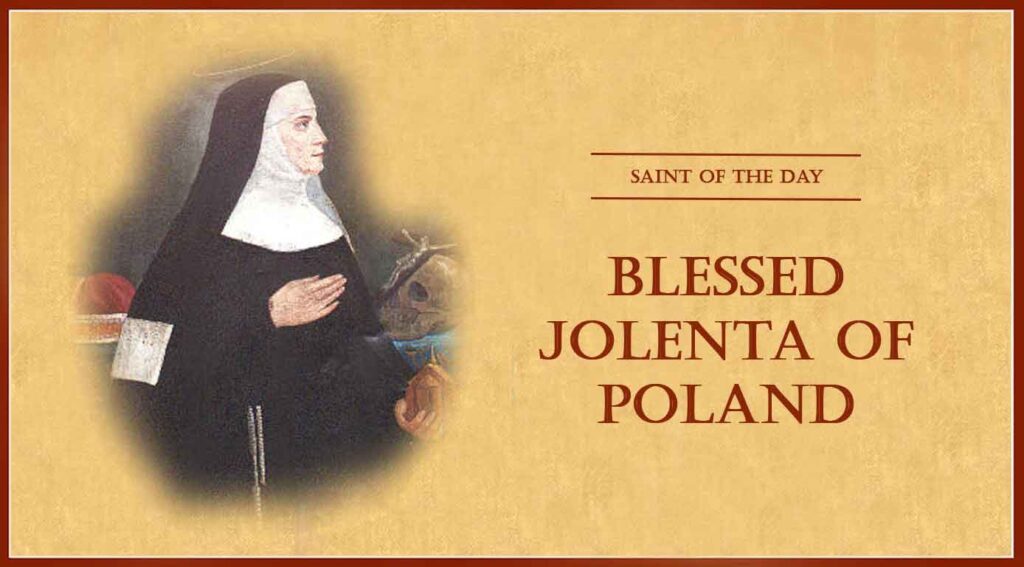
Blessed Jolenta of Poland

Blessed Jolenta of Poland was the daughter of King Béla IV of Hungary and Maria Laskarina. As a young girl, Yolanda was sent to Poland to be tutored under the supervision of her sister, Kinga, who was married to the Duke of Poland.

During the time of her marriage, she was noted for her great services to the poor and needy of the country, as well as being a major benefactor of the monasteries, friaries and hospitals connected to them. Her husband gave her so much support in her charities that he earned the nickname “the Pious”. She was widowed in 1279.

Upon the death of her husband and the marriage of two of her daughters, Jolenta and her third daughter entered the convent of the Poor Clares. War forced Jolenta to move to another convent where despite her reluctance, she was made abbess.

So well did Jolenta serve her Franciscan sisters by word and example, that her fame and good works continued to spread beyond the walls of the cloister. Her favorite devotion was the Passion of Christ. Indeed, Jesus appeared to her, telling her of her coming death. Many miracles, down to our own day, are said to have occurred at her grave.

Blessed Jolenta of Poland Read More »

Proverbs 10:28

Verse: :

“The prospect of the righteous is joy, but the hopes of the wicked come to nothing.” - Proverbs 10:28

Prayer For An Unwavering Hope

Father God, in a world that is ever changing and in a society that has all but rejected the truth of Your Word, I thank You that You are our never-changing Saviour, Who knows the end from the beginning and has the universe in the palm of His hand. Develop in me an unwavering trust in the hope that is set before me, knowing that in Christ I have already received Your gift of eternal life, by grace through faith in Christ Jesus my Lord.

May I learn more and more of Your divine character and perfect attributes, for the more I know You the more I trust You, and the more I trust You the more I come to love You. Develop in me an unwavering hope in Your promises, knowing that despite the evil and wickedness that seems to be suffocating all that is good and pure, Your plans and purposes for mankind will one day be brought to fruition. On that day, Christ will be all in all, and the whole world will be brought into submission under His feet as He rules and reigns on earth as King of kings and Lord of lords. May I hope in Him unswervingly and live my life to His praise and glory. In Jesus' name I pray,

Amen.

Proverbs 10:28 Read More »

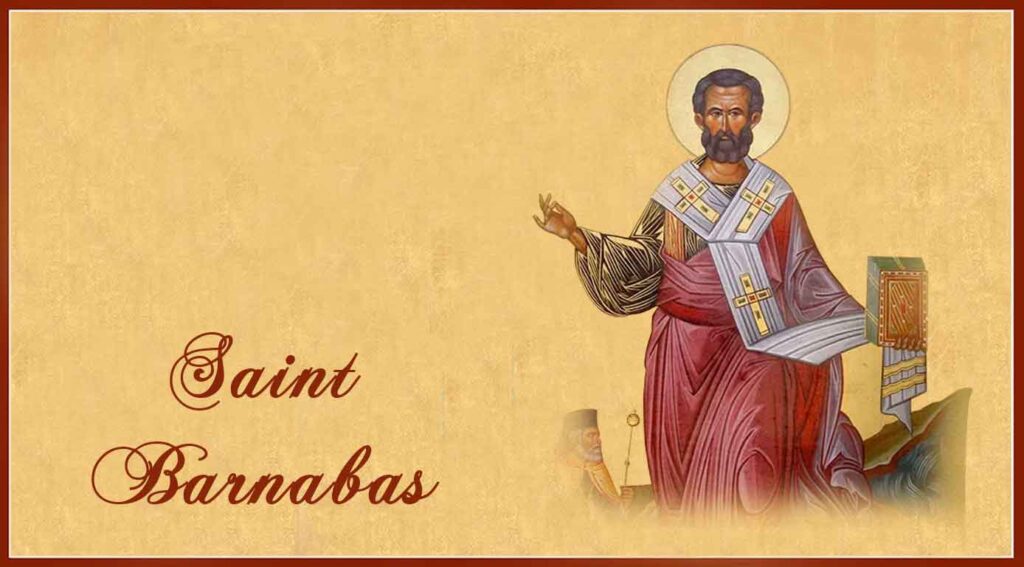
Saint Barnabas

Saint Barnabas was initially named as Joseph. But when recounting the story of how he sold his land and gave the money to the apostles in Jerusalem, the Book of Acts says the apostles called him Barnabas.

Barnabas’ story appears in the Acts of the Apostles, and Paul mentions him in some of his epistles. He and Paul the Apostle undertook missionary journeys together and defended Gentile converts against the Judaizers. They traveled together making more converts and participated in the Council of Jerusalem. Barnabas and Paul successfully evangelized among the “God-fearing” Gentiles who attended synagogues in various Hellenized cities of Anatolia.

According to tradition an early Christian, he was one of the prominent Christian disciples in Jerusalem. Christian tradition holds that Barnabas was martyred at Salamis, Cyprus. He is traditionally identified as the founder of the Cypriot Orthodox Church. In 1538, the Catholic religious order officially known as “Clerics Regular of St. Paul” (Clerici Regulares Sancti Pauli), gained the grand old Monastery of Saint Barnabas by the city wall of Milan as their main seat. The Order was known by the popular name of Barnabites.

St. Barnabas is venerated as the patron saint of Cyprus. He is also considered a patron saint in many other places in the world, highlighting Milan in Italy. On the island of Tenerife (Spain), St. Barnabas was invoked in historical times as patron saint and protector of the island’s fields against drought, together with St. Benedict of Nursia.

Saint Barnabas Read More »

Zechariah 4:6

Verse:

“This is the word of the Lord to Zerubbabel: ‘Not by might nor by power, but by my Spirit,’ says the Lord Almighty.” - Zechariah 4:6

Prayer To Do God’s Will

Heavenly Father, it is my desire to do Your will in my life and I have been praying how I may find out how to know what Your will is, so that I can do Your will in my life. Thank You, Lord, for sending me to 1 Thessalonians chapter five, where I see that You have clearly laid out exactly what Your will for each one of us is.
 
Help me to walk in spirit and truth and encourage my brothers and sisters in the faith. Help me to esteem others as better than myself and support them in love.
 
Help me I pray, to encourage the fainthearted, help the weak, be patient with everyone, always return good for evil and seek after that which is good and lovely and pleasing in Your sight.
 
Most of all I pray that I develop a heart of ready rejoicing and an attitude of continuous prayer and praise. And give me the ability to be thankful in all things, even those times that prove to be the most difficult and frustrating. Help me to grow in grace and in a knowledge of our Lord Jesus Christ and mature in the faith, knowing that this is Your will for my life. Praise Your holy name.
 
Amen.

Zechariah 4:6 Read More »

Solemnity of the Body and Blood of Christ

Liturgy of the Word

First Reading: Dt 8:2-3, 14b-16a

Moses said to the people:
"Remember how for forty years now the LORD, your God,
has directed all your journeying in the desert,
so as to test you by affliction
and find out whether or not it was your intention
to keep his commandments.
He therefore let you be afflicted with hunger,
and then fed you with manna,
a food unknown to you and your fathers,
in order to show you that not by bread alone does one live,
but by every word that comes forth from the mouth of the LORD.

"Do not forget the LORD, your God,
who brought you out of the land of Egypt,
that place of slavery;
who guided you through the vast and terrible desert
with its saraph serpents and scorpions,
its parched and waterless ground;
who brought forth water for you from the flinty rock
and fed you in the desert with manna,
a food unknown to your fathers."

Responsorial Psalm: Ps 147:12-13, 14-15, 19-20

Response– Praise the Lord, Jerusalem

Glorify the LORD, O Jerusalem;
praise your God, O Zion.
For he has strengthened the bars of your gates;
he has blessed your children within you.
R– Praise the Lord, Jerusalem

He has granted peace in your borders;
with the best of wheat he fills you.
He sends forth his command to the earth;
swiftly runs his word!
R– Praise the Lord, Jerusalem

He has proclaimed his word to Jacob,
his statutes and his ordinances to Israel.
He has not done thus for any other nation;
his ordinances he has not made known to them. Alleluia.
R– Praise the Lord, Jerusalem

Second Reading: 1 Cor 10:16-17

Brothers and sisters:
The cup of blessing that we bless,
is it not a participation in the blood of Christ?
The bread that we break,
is it not a participation in the body of Christ?
Because the loaf of bread is one,
we, though many, are one body,
for we all partake of the one loaf.

Sequence – Lauda Sion:

Lo! the angel's food is given
To the pilgrim who has striven;
see the children's bread from heaven,
which on dogs may not be spent.

Truth the ancient types fulfilling,
Isaac bound, a victim willing,
Paschal lamb, its lifeblood spilling,
manna to the fathers sent.

Very bread, good shepherd, tend us,
Jesu, of your love befriend us,
You refresh us, you defend us,
Your eternal goodness send us
In the land of life to see.

You who all things can and know,
Who on earth such food bestow,
Grant us with your saints, though lowest,
Where the heav'nly feast you show,
Fellow heirs and guests to be. Amen. Alleluia.

Alleluia:

Alleluia, alleluia. I am the living bread that came down from heaven, says the Lord;
whoever eats this bread will live forever. Alleluia, alleluia.

Gospel: Jn 6:51-58

A reading from the holy Gospel according to John

Jesus said to the Jewish crowds:
"I am the living bread that came down from heaven;
whoever eats this bread will live forever;
and the bread that I will give
is my flesh for the life of the world."

The Jews quarreled among themselves, saying,
"How can this man give us his flesh to eat?"
Jesus said to them,
"Amen, amen, I say to you,
unless you eat the flesh of the Son of Man and drink his blood,
you do not have life within you.
Whoever eats my flesh and drinks my blood
has eternal life,
and I will raise him on the last day.
For my flesh is true food,
and my blood is true drink.
Whoever eats my flesh and drinks my blood
remains in me and I in him.
Just as the living Father sent me
and I have life because of the Father,
so also the one who feeds on me
will have life because of me.
This is the bread that came down from heaven.
Unlike your ancestors who ate and still died,
whoever eats this bread will live forever."

The Readings and Gospel were sourced from:

Solemnity of the Body and Blood of Christ Read More »