2023

Luke 19:1-3

The Desire of the Heart

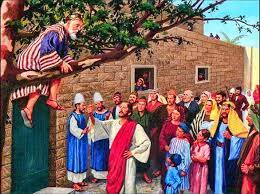
At that time, Jesus came to Jericho and intended to pass through the town. Now, a man there named Zacchaeus, who was a chief tax collector and also a wealthy man, was seeking to see who Jesus was; but he could not see Him because of the crowd, for he was short in stature. So he ran ahead and climbed a sycamore tree in order to see Jesus, who was about to pass that way.

Reflection:

Reflect, today, upon the fact that you and you alone have the ability to draw Jesus to yourself. You can do this by looking at your need for Him. Do not hide it. Climb the figurative tree by which you will be able to look for Jesus and, more importantly, by which Jesus can see your manifest desire for Him.

As you express your need for Him, know that He will be compelled, by His unshakable love and mercy, to come to you and to stay with you in the house of your soul. And when He does, be ready and willing to abandon all that has been a hindrance to your meeting with Christ in the past.

Source: https://catholic-daily-reflections.com/2023/11/20/the-desire-of-the-heart-2/

Luke 19:1-3 Read More »

Luke 18:35-39

Gospel:

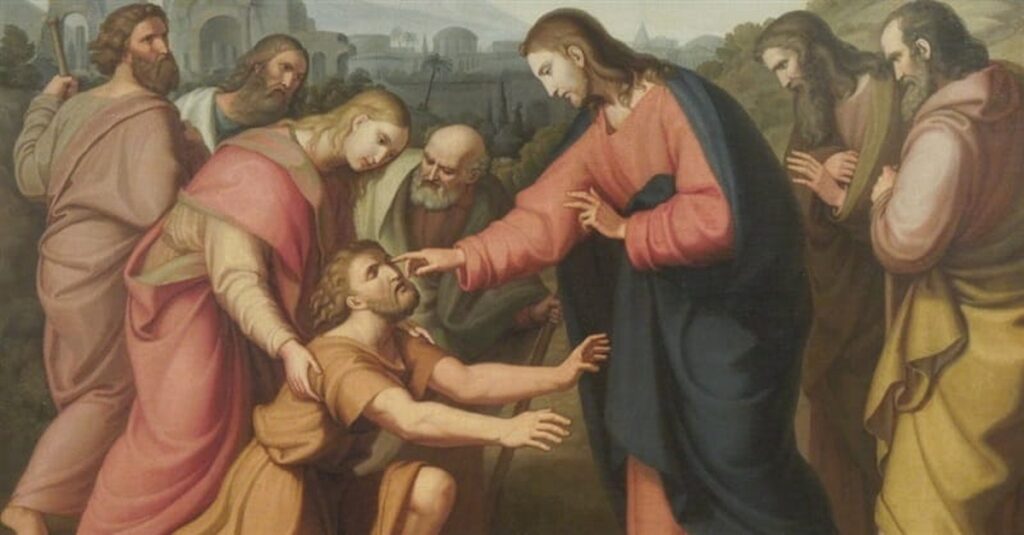
As Jesus approached Jericho, a blind man was sitting by the roadside begging, and hearing a crowd going by, he inquired what was happening. They told him, “Jesus of Nazareth is passing by.” He shouted, “Jesus, Son of David, have pity on me!” The people walking in front rebuked him, telling him to be silent, but he kept calling out all the more, “Son of David, have pity on me!”

Reflection:

Reflect, today, upon these four aspects of a deep prayer life that are presented to us through the witness of this blind beggar. First, ponder your weakness and poverty as you turn to God in prayer. Second, be attentive to the presence of God as He passes by, waiting for you to call to Him. Third, cry out to Him and beg Him to come closer. And fourth, work to overcome every obstacle to prayer and see those obstacles as opportunities to call out to God all the more.

Source: https://catholic-daily-reflections.com/2023/11/19/a-model-for-prayer-2/

Luke 18:35-39 Read More »

St. Edmund the Martyr

King of East Anglia, born about 840; died at Hoxne, Suffolk, 20 November, 870.

The earliest and most reliable accounts represent St. Edmund as descended from the preceding kings of East Anglia, though, according to later legends, he was born at Nuremberg (Germany), son to an otherwise unknown King Alcmund of Saxony.

Though only about fifteen years old when crowned in 855, Edmund showed himself a model ruler from the first, anxious to treat all with equal justice, and closing his ears to flatterers and untrustworthy informers.

In his eagerness for prayer, Edmund retired for a year to his royal tower at Hunstanton and learned the whole Psalter by heart, in order that he might afterwards recite it regularly.

In 870, Edmund bravely repulsed the two Danish chiefs Hinguar and Hubba who had invaded his dominions. They soon returned with overwhelming numbers, and pressed terms upon him which as a Christian he felt bound to refuse.

In his desire to avert a fruitless massacre, Edmund disbanded his troops and himself retired towards Framlingham; on the way, he fell into the hands of the invaders. Having loaded him with chains, his captors conducted him to Hinguar, whose impious demands he again rejected, declaring his religion dearer to him than his life. His martyrdom took place in 870 at Hoxne in Suffolk.

After beating him with cudgels, the Danes tied him to a tree, and cruelly tore his flesh with whips.

Throughout these tortures Edmund continued to call upon the name of Jesus, until at last, exasperated by his constancy, his enemies began to discharge arrows at him. This cruel sport was continued until his body had the appearance of a porcupine, when Hinguar commanded his head to be struck off.

From his first burial-place at Hoxne, Edmund’s relics were removed in the tenth century to Beodricsworth, since called St. Edmundsbury, where arose the famous abbey of that name.

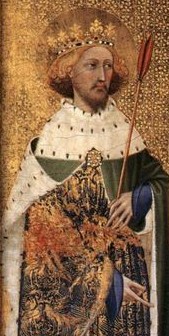
His feast is observed on 20th November, and he is represented in Christian art with sword and arrow, the instruments of his torture.

Source: https://www.newadvent.org/cathen/05295a.htm

St. Edmund the Martyr Read More »

16th Sunday in Ordinary Time

First Reading: Wis 12:13, 16-19

There is no god besides you who have the care of all,
that you need show you have not unjustly condemned.
For your might is the source of justice;
your mastery over all things makes you lenient to all.
For you show your might when the perfection of your power is disbelieved;
and in those who know you, you rebuke temerity.
But though you are master of might, you judge with clemency,
and with much lenience you govern us;
for power, whenever you will, attends you.
And you taught your people, by these deeds,
that those who are just must be kind;
and you gave your children good ground for hope
that you would permit repentance for their sins

Responsorial Psalm: Ps 86:5-6, 9-10, 15-16

Response– Lord, you are good and forgiving

You, O LORD, are good and forgiving,
abounding in kindness to all who call upon you.
Hearken, O LORD, to my prayer
and attend to the sound of my pleading.
R– Lord, you are good and forgiving

All the nations you have made shall come
and worship you, O LORD,
and glorify your name.
For you are great, and you do wondrous deeds;
you alone are God.
R– Lord, you are good and forgiving

You, O LORD, are a God merciful and gracious,
slow to anger, abounding in kindness and fidelity.
Turn toward me, and have pity on me;
give your strength to your servant.
R– Lord, you are good and forgiving

Second Reading: Romans 8:26-27

Brothers and sisters:
The Spirit comes to the aid of our weakness;
for we do not know how to pray as we ought,
but the Spirit himself intercedes with inexpressible groanings.
And the one who searches hearts
knows what is the intention of the Spirit,
because he intercedes for the holy ones
according to God's will.

Alleluia:

Alleluia, alleluia.Blessed are you, Father, Lord of heaven and earth;
you have revealed to little ones the mysteries of the kingdom. Alleluia, alleluia.

Gospel: Matthew 13:24-43

A reading from the holy Gospel according to Matthew

Jesus proposed another parable to the crowds, saying:
"The kingdom of heaven may be likened
to a man who sowed good seed in his field.
While everyone was asleep his enemy came
and sowed weeds all through the wheat, and then went off.
When the crop grew and bore fruit, the weeds appeared as well.
The slaves of the householder came to him and said,
'Master, did you not sow good seed in your field?
Where have the weeds come from?'
He answered, 'An enemy has done this.'
His slaves said to him,
'Do you want us to go and pull them up?'
He replied, 'No, if you pull up the weeds
you might uproot the wheat along with them.
Let them grow together until harvest;
then at harvest time I will say to the harvesters,
"First collect the weeds and tie them in bundles for burning;
but gather the wheat into my barn." "

He proposed another parable to them.
"The kingdom of heaven is like a mustard seed
that a person took and sowed in a field.
It is the smallest of all the seeds,
yet when full-grown it is the largest of plants.
It becomes a large bush,
and the 'birds of the sky come and dwell in its branches.'"

He spoke to them another parable.
"The kingdom of heaven is like yeast
that a woman took and mixed with three measures of wheat flour
until the whole batch was leavened."

All these things Jesus spoke to the crowds in parables.
He spoke to them only in parables,
to fulfill what had been said through the prophet:
I will open my mouth in parables,
I will announce what has lain hidden from the foundation
of the world.

Then, dismissing the crowds, he went into the house.
His disciples approached him and said,
"Explain to us the parable of the weeds in the field."
He said in reply, "He who sows good seed is the Son of Man,
the field is the world, the good seed the children of the kingdom.
The weeds are the children of the evil one,
and the enemy who sows them is the devil.
The harvest is the end of the age, and the harvesters are angels.
Just as weeds are collected and burned up with fire,
so will it be at the end of the age.
The Son of Man will send his angels,
and they will collect out of his kingdom
all who cause others to sin and all evildoers.
They will throw them into the fiery furnace,
where there will be wailing and grinding of teeth.
Then the righteous will shine like the sun
in the kingdom of their Father.
Whoever has ears ought to hear."
The Readings and Gospel were sourced from:

16th Sunday in Ordinary Time Read More »

Saints Rasiphus and Ravennus

Saints Rasiphus and Ravennus were natives of Britain who fled their country during the Anglo-Saxon invasions. They settled in Gaul and became hermits.

According to an account of their lives, the two saints founded their hermitage near the site of the current building, near a miraculous spring of water.

Since little is known about their lives, there are multiple versions of their martyrdom. According to one version, they were tossed against a great block of sandstone. Their heads dented the stone but the two saints were not hurt. They were then decapitated and buried near the present grounds of St-Aubin de Macé; a tombstone marks the site of their former grave.

Accounts also attribute many miracles to the Saints Rasiphus and Ravennus. They were venerated as great healers.

Saints Rasiphus and Ravennus Read More »

Matthew 6:19-20

Verse:

“Do not store up for yourselves treasures on earth, where moths and vermin destroy, and where thieves break in and steal. But store up for yourselves treasures in heaven, where moths and vermin do not destroy, and where thieves do not break in and steal.” - Matthew 6:19-20

Matthew 6:19-20 Read More »

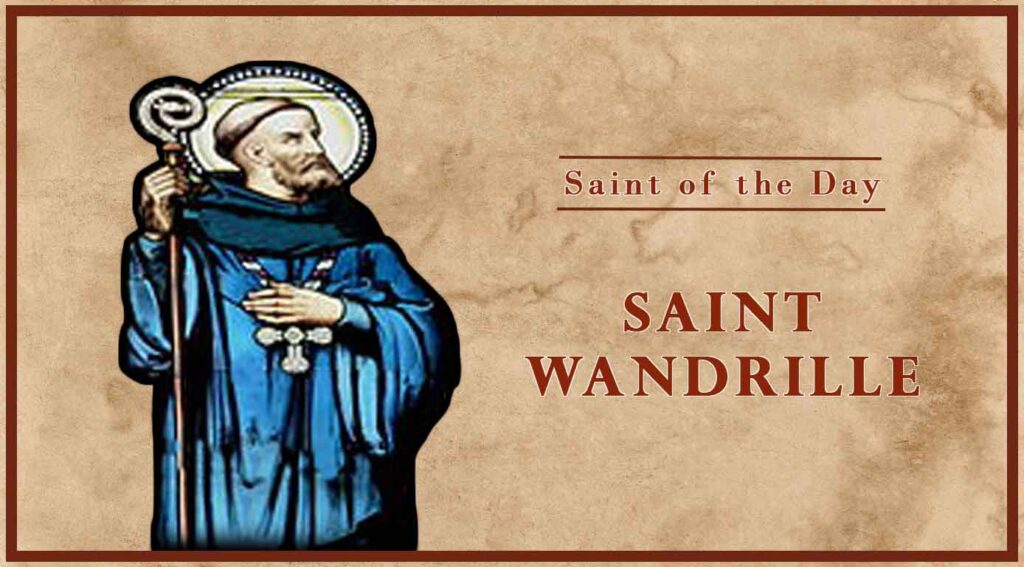
Saint Wandrille

Saint Wandrille, also known as Saint Wandregisel, was a Frankish courtier, monk, and abbot. He was born around 605 and educated at the Frankish court in Metz.

Saint Wandrille was part of a group of young courtiers who served Dagobert I. In 629, he retired from court to become a monk at Montfaucon under the guidance of Saint Balderic.

Saint Wandrille soon withdrew to live as a hermit in complete solitude at Saint-Ursanne in the Jura. He spent some time at the monastery of Saint Columban at Bobbio in northern Italy in 635. From there, he wished to travel to Ireland but got only as far as the abbey of Romainmôtier.

Saint Wandrille founded Fontenelle Abbey in Normandy. Fontenelle Abbey followed the rule of Saint Columbanus, and the abbey became an important center of learning. Saint Wandrille died on July 22, 668.

Saint Wandrille Read More »

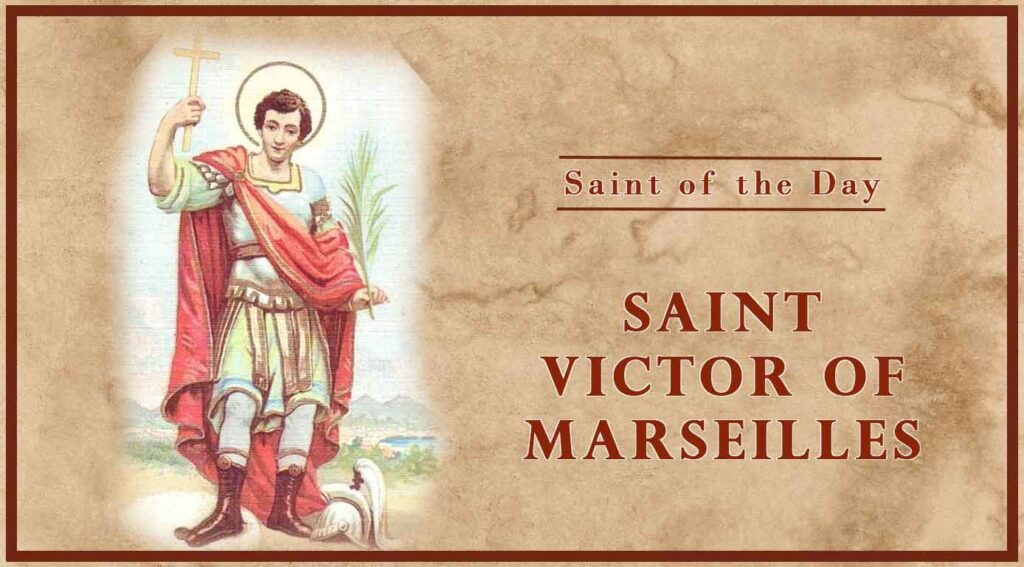
Saint Victor of Marseilles

Saint Victor of Marseilles was an Egyptian Christian martyr. He was a Roman army officer in Marseille, who publicly denounced the worship of idols.

Due to denouncing the worship of idols, he was brought before the Roman prefects, Asterius and Eutychius, who later sent him to the Emperor Maximian. He was then racked, beaten, dragged through the streets, and thrown into prison, where he converted three other Roman soldiers, Longinus, Alexander, and Felician, who were subsequently beheaded.

After refusing to offer incense to a statue of the Roman god Jupiter, Victor kicked it over with his foot. The emperor ordered that he be put to death by being ground under a millstone, but the millstone broke while Victor was still alive. He was then beheaded.

Saint Victor’s feast day, along with Saints Longinus, Alexander and Felician, is celebrated on July 21. He is venerated as a saint in the Catholic Church and the Eastern Orthodox Church.

Saint Victor of Marseilles Read More »