Verse

Mark 8:22-23

God’s Almighty Power

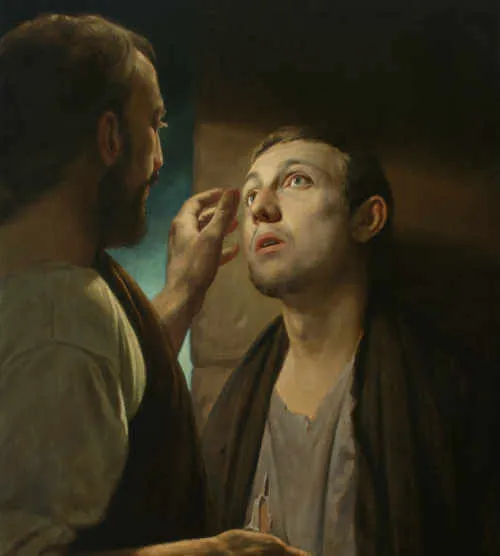
When Jesus and his disciples arrived at Bethsaida, people brought to him a blind man and begged Jesus to touch him. He took the blind man by the hand and led him outside the village.

Reflection:

Bethsaida was one of the towns just north of the Sea of Galilee in which Jesus preached. Later in His public ministry, Jesus condemns the town of Bethsaida for its failure to convert. “Woe to you, Bethsaida! For if the mighty deeds done in your midst had been done in Tyre and Sidon, they would long ago have repented in sackcloth and ashes” (Matthew 11:21).

It may be because of their lack of faith and immoral living that Jesus led the blind man outside of the city before He cured Him. And it appears that the people who brought the blind man to Jesus brought him not because of their deep faith, but because of curiosity. This might also be the reason that, once Jesus cured the man, He sent him to his home saying, “Do not even go into the village.” Thus, Jesus knew that this miracle would not lead to faith in the hearts of those living in Bethsaida. So, Jesus instructed the man not to return there.

God has almighty power and can clearly do whatever He chooses, whenever He chooses. And what He often chooses to do is to exercise His almighty power only in the presence of those who already believe, or at least in the presence of those who have not yet rejected Him. When Jesus encounters people who have heard Him preach but have failed to come to faith, He refuses to perform any miracles in their presence.

What this tells us is that faith must come first; then, God’s Almighty power flows freely. Of course, the grace of the Word of God is always given to everyone. The seed of God’s holy Word is always available to all. But it’s important to distinguish between the sending forth of His holy Word of the Gospel and the sending forth of His transforming almighty power. The only way to receive the latter is to first accept the former. Unless we hear, accept and believe in His Word, we will not receive the grace of His transforming power.

With that said, it must also be understood that God’s “almighty power” cannot be reduced to miracles alone. We all know that physical miracles are not nearly as prevalent today as they were at the time Jesus walked the earth. But His almighty power is still at work today; and in a way that is even greater than when Jesus walked the earth. Today, His power is one that transforms us interiorly by the fullness of grace and the bestowal of the Holy Spirit. That is the true miracle that we must always seek and anticipate when we have heard the Word of God and responded with authentic faith.

Reflect, today, upon your faith and your need for God’s transforming power in your life. Do you see faith alive within you? If so, then you will most certainly encounter the power of God in your life and the transformation given by the Holy Spirit. If you do not see this power of grace and interior transformation at work, then ponder the image of Jesus leading the blind man outside of the city to exercise his power. Seek first to have faith, because if you do, our Lord will be able to remain close to you and will do miracles within your soul.

Source: https://catholic-daily-reflections.com/2025/02/18/gods-almighty-power-2/
Mark 8:22-23 Read More »

Mark 8:17-18

Comprehending the Mysteries of Heaven

Do you not yet understand or comprehend? Are your hearts hardened? Do you have eyes and not see, ears and not hear?

Reflection:

How would you answer these questions that Jesus posed to His disciples if He had posed them to you? It takes humility to admit that you do not yet understand or comprehend, that your heart is in fact hardened, and that you fail to see and hear all that God has revealed. Of course there are various levels to these struggles, so hopefully you do not struggle with them to a grave degree. But if you can humbly confess that you do struggle with these to a certain extent, then that humility and honesty will gain you much grace.

Jesus posed these questions to His disciples within the larger context of a discussion about the leaven of the Pharisees and Herod. He knew that the “leaven” of these leaders was like a yeast that corrupted others. Their dishonesty, pride, desire for honors and the like had a seriously negative affect upon the faith of others. So by posing these questions above, Jesus challenged His disciples to see this evil leaven and to reject it.

Seeds of doubt and confusion are all around us. It seems these days that almost everything the secular world promotes is in some way contrary to the Kingdom of God. And yet, just like the disciples’ inability to see the evil leaven of the Pharisees and Herod, we also frequently fail to see the evil leaven within our society. Instead, we allow the many errors to confuse us and lead us down the path of secularism.

One thing this should teach us is that just because someone has some form of authority or power within society does not mean that they are a truthful and holy leader. And though it’s never our place to judge the heart of another, we absolutely must have “ears to hear” and “eyes to see” the many errors that are held up within our world as good. We must constantly seek to “understand and comprehend” the laws of God and use them as a guide against the lies within the world. One important way to make sure we do this well is to make sure that our hearts never become hardened to the truth.

Reflect, today, upon these questions of our Lord and examine them especially within the broader context of society as a whole. Consider the false “leaven” taught by our world and by so many in positions of authority. Reject these errors and recommit yourself to the full embrace of the holy mysteries of Heaven so that those truths and those truths alone become your daily guide.

Source: https://catholic-daily-reflections.com/2025/02/17/comprehending-the-mysteries-of-heaven-4/

Mark 8:17-18 Read More »

Mark 8:11-12

From the Depths

The Pharisees came forward and began to argue with Jesus, seeking from him a sign from heaven to test him. He sighed from the depth of his spirit and said, “Why does this generation seek a sign? Amen, I say to you, no sign will be given to this generation.

Reflection:

Jesus had performed many miracles. He healed the sick, restored sight to the blind, hearing to the deaf and fed thousands with only a few fish and loaves of bread. But even after all of that, the Pharisees came to argue with Jesus and demanded a sign from Heaven.

The response of Jesus is quite unique. “He sighed from the depth of his spirit…” This sigh was an expression of His holy sorrow over the hardness of hearts of the Pharisees. If they had the eyes of faith, they would have no need for yet another miracle. And if Jesus would have performed a “sign from heaven” for them, even that would not have helped them. And so Jesus does the only thing He can—He sighed.

At times, this type of reaction is the only good one. We may all face situations in life where others confront us with harshness and stubbornness. When this happens, we will be tempted to argue with them, condemn them, try to convince them we are right, and the like. But sometimes one of the holiest reactions we can have to the hardness of the heart of another is to experience a deep and holy sorrow. We must also “sigh” from the depths of our spirits.

When one is hard of heart, rational talking and arguing will prove to be of little avail. Hardness of heart is also what we traditionally call the “sin against the Holy Spirit.” It’s a sin of obstinacy and stubbornness. In that case, there is little or no openness to the truth. When you experience this in the life of another, silence and a sorrowful heart are often the best reaction. Their hearts need to be softened and your deep sorrow, shared with compassion, may be one of the only responses that can help make a difference.

Reflect, today, upon any person in your life with whom you regularly argue, especially regarding matters of faith. Examine your approach and consider changing how you relate to them. Dismiss their irrational arguments and let them see your heart in the same way that Jesus allowed His divine heart to shine forth in a holy sigh. Pray for them, have hope, and allow your sorrow to help melt the most stubborn of hearts.

Source: https://catholic-daily-reflections.com/2025/02/16/from-the-depths-4/

Mark 8:11-12 Read More »

Luke 6:24-26

Beatitudes and Woes

But woe to you who are rich, for you have received your consolation. Woe to you who are filled now, for you will be hungry. Woe to you who laugh now, for you will grieve and weep. Woe to you when all speak well of you, for their ancestors treated the false prophets in this way.

Reflection:

Luke 6:20–49 offers us a shortened version of the Sermon on the Mount found in Matthew’s Gospel. Luke’s version of this sermon takes place on a plain, “a stretch of level ground.” The teachings in the two Gospels are very similar, despite their difference in length. Luke’s teaching on the Beatitudes adds the “woe to you’s” quoted above, which are not found in Matthew’s version.

The early Church Father Saint Bede comments that Saint Luke’s version of the “woes” are meant for those who are “uninstructed hearers” because they “must first be brought by terrors to good works.” He goes on to say that the first part of the Beatitudes, the “blessings,” are meant for the “perfect” because they “need but be invited by rewards” rather than fear of punishment. The fact that Saint Luke includes a teaching for both the sinner and the saint should lead us to the conclusion that we can benefit from both approaches in our spiritual lives.

When your spiritual life is strong and you are consistently avoiding serious sin, it might be more helpful to reflect regularly upon the blessings found in the Beatitudes. This will have the effect of drawing you into greater perfection as the desire for the reward of holiness becomes the object of your hope.

When your spiritual life is weaker and you are regularly struggling with more serious sin, it might be more helpful to reflect upon the woes of the Beatitudes. This will have the effect of deterring you from the cycle of sin you struggle with, on account of the fear of the consequences of those sins.

In the end, the Beatitudes and their subsequent woes are meant to point us interiorly to the desires of our hearts. We must become more and more aware of what occupies our thinking and desires. Ultimately, wealth or poverty, hunger or satisfaction, worldly praise or persecution do not matter. What matters is that our hearts are detached from the desires identified in this sermon so that we more fully desire only God and His holy will, regardless of the circumstances of life we find ourselves in.

Reflect, today, upon your own spiritual and moral life and first consider whether you are blessed to be living a life that more imitates the saints or whether you more often reflect the serious struggles of the sinner. From there, try to choose which form of teaching you need the most. Do you need to ponder the rewards of seeking even greater beatitude in life so as to grow deeper in holiness? Or do you need Jesus’ clear condemnations to help you break free from the cycle of sin with which you are struggling? Humbly identify that which is most helpful to you right now in your spiritual life and allow this full sermon of Jesus to help you on your journey to the Kingdom of Heaven.

Source: https://catholic-daily-reflections.com/2025/02/15/beatitudes-and-woes/

Luke 6:24-26 Read More »

Mark 8:2-3

First Things First

My heart is moved with pity for the crowd, because they have been with me now for three days and have nothing to eat.  If I send them away hungry to their homes, they will collapse on the way, and some of them have come a great distance.

Reflection:

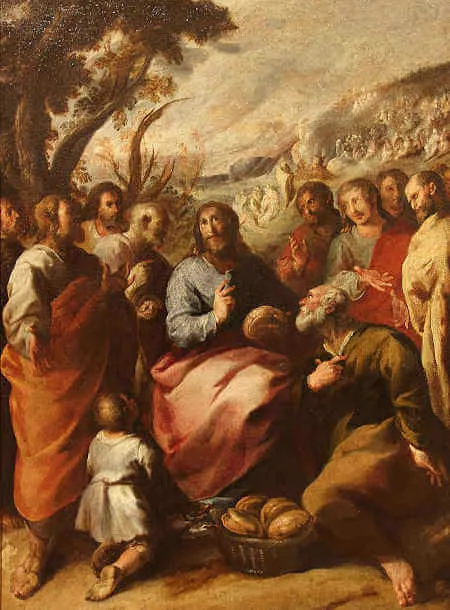
Jesus’ primary mission was a spiritual one. He came to set us free from the effects of sin so that we could enter the glories of Heaven for all eternity. His life, death and resurrection destroyed death itself and opened the way for all who turn to Him to be saved. But Jesus’ love for the people was so complete that He was also attentive to their physical needs.

First of all, ponder the first line of this statement of our Lord above: “My heart is moved with pity for the crowd…” Jesus’ divine love was intertwined with His humanity. He loved the entire person, body and soul. In this Gospel story, the people were with Him for three days and they were hungry, but they were showing no signs of leaving. They had become so amazed by our Lord that they didn’t want to leave. Jesus pointed out that their hunger was serious. If He sent them away, He feared that they would “collapse on the way.” Thus, these facts are the basis for His miracle.

One lesson we can learn from this story is that of our priorities in life. Oftentimes, we may tend to have our priorities reversed. Of course, taking care of the necessities of life is important. We need food, shelter, clothing and the like. We need to care for our families and provide for their basic needs. But too often we elevate these basic necessities in life over our spiritual need to love and serve Christ, as if the two were opposed to each other. But that’s not the case.

In this Gospel, the people who were with Jesus chose to put their faith first. They chose to remain with Jesus despite the fact that they did not have food to eat. Perhaps some people had left a day or two earlier, deciding that the necessity of food took precedence. But those who may have done this missed out on the incredible gift of this miracle in which the entire crowd was fed to the point of being completely satisfied. Of course, our Lord does not want us to be irresponsible, especially if we have a duty to care for others. But this story does tell us that our spiritual need to be fed by the Word of God should always be our greatest concern. When we put Christ first, all other needs are met in accord with His providence.

Reflect, today, upon your own priorities in life. What’s more important to you? Your next good meal? Or your life of faith? Though these do not have to be opposed to each other, it’s important to always put your love of God first in life. Ponder this vast crowd of people who spent three days with Jesus in the wilderness without food and try to see yourself with them. Make their choice to remain with Jesus your choice also, so that your love of God becomes the primary focus of your life.

Source: https://catholic-daily-reflections.com/2025/02/14/first-things-first-4/

Mark 8:2-3 Read More »

Mark 7:37

Hearing and Speaking the Word of God

They were exceedingly astonished and they said, “He has done all things well. He makes the deaf hear and the mute speak.”

Reflection:

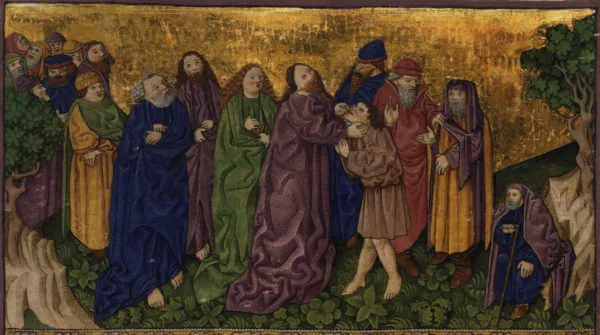
This line is the conclusion to the story of Jesus healing a deaf man who also had a speech impediment. The man was brought to Jesus, Jesus took him off by himself, cried out “Ephphatha!” (that is, “Be opened!”), and the man was cured. And though this was an incredible gift to this man and an act of great mercy toward him, it also reveals that God wants to use us to draw others to Himself.

On a natural level, we all lack the ability to hear the voice of God when He speaks. We need the gift of grace for this. As a result, on a natural level, we are also incapable of speaking the many truths that God wants us to speak. This story teaches us that God also desires to heal our ears so as to hear His gentle voice and to loosen our tongues so that we can become His mouthpiece.

But this story is not only about God speaking to each one of us; it also reveals our duty to bring others to Christ who do not know Him. The friends of this man brought him to Jesus. And Jesus took the man off by himself. This gives us insight into how we help others to come to know our Lord’s voice. Oftentimes when we want to share the Gospel with another, we tend to talk to them and try to rationally convince them to turn their lives to Christ. And though this can bear good fruit at times, the real goal we must have is to help them to go off with our Lord by themselves for a while so that Jesus can do the healing.

If your ears have truly been opened by our Lord, then your tongue will also be loosened. And only if your tongue is loosened will God be able to draw others to Himself through you. Otherwise your act of evangelizing will only be based on your effort alone. Therefore, if you have people in your life who do not appear to be listening to the voice of God and following His holy will, then first and foremost commit yourself to listening to our Lord yourself. Let your ears hear Him. And when you do hear Him, it will be His voice that, in turn, speaks through you in the way He desires to reach out to others.

Reflect, today, upon this Gospel scene. Ponder, especially, the friends of this man as they are inspired to bring him to Jesus. Ask our Lord to use you in a similar way. Prayerfully ponder those in your life whom God wants to call to Himself through your mediation and place yourself at the service of our Lord so that His voice can speak through you in the way He chooses.

Source: https://catholic-daily-reflections.com/2025/02/13/hearing-and-speaking-the-word-of-god-4/

Mark 7:37 Read More »

Mark 7:25-26

A Gentile’s Faith

Soon a woman whose daughter had an unclean spirit heard about him. She came and fell at his feet. The woman was a Greek, a Syrophoenician by birth, and she begged him to drive the demon out of her daughter.

Reflection:

A parent’s love is powerful. And the woman in this story clearly loves her daughter. It is that love that drives this mother to seek out Jesus in the hope that He will free her daughter from the demon who possessed her. Interestingly, this woman was not of the Jewish faith. She was a Gentile, a foreigner, but her faith was very real and very deep.

When Jesus first encountered this woman, she begged Him to free her daughter from the demon. Jesus’ response was at first surprising. He said to her, “Let the children be fed first. For it is not right to take the food of the children and throw it to the dogs.” In other words, Jesus was saying that His mission was first to the people of Israel, the chosen people of the Jewish faith. They were the “children” of whom Jesus was speaking, and the Gentiles, such as this woman, were the ones referred to as “the dogs.” Jesus spoke this way to this woman not out of rudeness but because He could see her deep faith, and He wanted to give her an opportunity to manifest that faith for all to see. And so she did.

The woman responded to Jesus, “Lord, even the dogs under the table eat the children’s scraps.” Her words were not only exceptionally humble but were also based on deep faith and a deep love for her daughter. As a result, Jesus responds with generosity and immediately frees her daughter from the demon.

In our own lives, it’s easy to fall into the trap of thinking we deserve the mercy of God. We can think that we have a right to God’s grace. And even though Jesus deeply desires to pour forth His grace and mercy in superabundance on our lives, it is essential that we fully understand our unworthiness before Him. The disposition of this woman’s heart sets for us a perfect example of how we must come to our Lord.

Reflect, today, upon the beautiful example of this woman of deep faith. Prayerfully read her words over and over. Try to understand her humility, her hope, and her love for her daughter. As you do, pray that you will be able to imitate her goodness so as to share in the blessings she and her daughter received.

Source: https://catholic-daily-reflections.com/2025/02/12/a-gentiles-faith-4/

Mark 7:25-26 Read More »

Mark 7:14-15

That Which is Within

Jesus summoned the crowd again and said to them, “Hear me, all of you, and understand. Nothing that enters one from outside can defile that person; but the things that come out from within are what defile.”

Reflection:

What is within you? What is in your heart? Today’s Gospel concludes with a list of vices that sadly come from within: “evil thoughts, unchastity, theft, murder, adultery, greed, malice, deceit, licentiousness, envy, blasphemy, arrogance, folly.” Of course, none of these vices are desirable when looked at objectively. They are all quite repulsive. And yet too often they are sins that people deal with on a regular basis to one extent or another.

Take greed, for example. When understood clearly, no one wants to be known as one who is greedy. It’s a shameful attribute to have. But when greed is not looked at as greed, it’s easy to fall into the trap of living it. One who is greedy desires an excessive amount of this or that. More money, a better house, a nicer car, more luxurious vacations, etc. Thus, when a person is acting in a greedy way, greed does not seem undesirable. It’s only when greed is looked at in an objective way that it is understood for what it is.

In this Gospel, by naming this long list of vices, Jesus does us an incredible act of mercy. He rattles us and calls us to step back and look at sin for what it is. Jesus also makes it clear that when you live one or more of these vices, you become defiled. You become greedy, a liar, cruel, a gossip, hateful, arrogant, etc. Objectively speaking, no one wants this.

What is it in that list of vices that you struggle with the most? What do you see within your own heart? Be honest with yourself before God. Jesus desires that your heart be pure and holy, freed from these and every filth. But unless you are able to look at your own heart with honesty, it will be difficult to reject the sin with which you struggle.

Reflect, today, upon this list of sins identified by our Lord. Consider each one and allow yourself to see each sin for what it truly is. Allow yourself to despise these sins with a holy wrath and then turn your eyes to that sin with which you struggle the most. Know that as you consciously see that sin and reject it, our Lord will begin to strengthen you and purify your heart so that you become freed from that defilement and become, instead, the beautiful child of God you were made to be.

Source: https://catholic-daily-reflections.com/2025/02/11/that-which-is-within-6/

Mark 7:14-15 Read More »

Mark 7:6-8

Worship from the Heart

When the Pharisees with some scribes who had come from Jerusalem gathered around Jesus, they observed that some of his disciples ate their meals with unclean, that is, unwashed, hands.

Reflection:

It seems quite clear that Jesus’ instant fame led these religious leaders to jealousy and envy, and they wanted to find fault with Him. As a result, they carefully observed Jesus and His disciples, and they noticed that Jesus’ disciples were not following the traditions of the elders. So the leaders began questioning Jesus about this fact. Jesus’ response was one of severe criticism of them. He quoted Isaiah the prophet who said, “This people honors me with their lips, but their hearts are far from me; in vain do they worship me, teaching as doctrines human precepts.”

Jesus strongly criticized them because their hearts were lacking true worship. The various traditions of the elders were not necessarily bad, such as the careful ceremonial washing of one’s hands before eating. But these traditions were empty if they were not motivated by a deep faith and love of God. The external following of human traditions was not truly an act of divine worship, and that’s what Jesus wanted for them. He wanted their hearts to be set ablaze with a love of God and with true divine worship.

What our Lord wants of each one of us is worship. Pure, heartfelt, sincere worship. He wants us to love God with a deep interior devotion. He wants us to pray, to listen to Him, and to serve His holy will with all the powers of our soul. And this is only possible when we engage in authentic worship.

As Catholics, our life of prayer and worship is grounded in the holy Liturgy. The Liturgy incorporates many traditions and practices that reflect our faith and become a vehicle of the grace of God. And though the Liturgy itself is far different from the mere “tradition of the elders” that Jesus was criticizing, it’s useful to remind ourselves that the many Liturgies of our Church must move from the external actions to interior worship. Going through the motions alone is pointless. We must allow God to act on us and within us as we engage in the external celebration of the Sacraments.

Reflect, today, upon the burning desire in the heart of our Lord to draw you into worship. Reflect upon how well you allow yourself to be drawn into this worship every time you attend the holy Mass. Seek to make your participation not only an exterior one but, first and foremost, an interior one. Doing so will help ensure that the rebuke of our Lord upon the scribes and Pharisees does not also fall upon you.

Source: https://catholic-daily-reflections.com/2025/02/10/worship-from-the-heart-4/

Mark 7:6-8 Read More »

Mark 6:56

Seeking Healing

Whatever villages or towns or countryside he entered, they laid the sick in the marketplaces and begged him that they might touch only the tassel on his cloak; and as many as touched it were healed.

Reflection:

It would have been truly awe-inspiring to witness Jesus healing the sick. The people who witnessed this clearly had never seen anything like it before. For those who were sick, or whose loved ones were sick, each healing would have had a powerful effect upon them and upon their whole family.

Today, modern science, with its ability to treat so many illnesses, has lessened the fear and anxiety over getting sick. But in Jesus’ time, serious illness was of far greater concern. For that reason, the desire of so many people to bring their sick to Jesus so that they could be healed was very strong. This desire drove them to Jesus so that “they might touch only the tassel on his cloak” and be healed. And Jesus didn’t disappoint.

Though Jesus’ physical healings were unquestionably an act of charity given to those who were sick and to their families, they obviously weren’t the most important thing Jesus did. And it’s important for us to remind ourselves of that fact. Jesus’ healings were primarily for the purpose of preparing the people to listen to His Word and to ultimately receive the spiritual healing of the forgiveness of their sins.

In your own life, if you were seriously ill and were given the option to receive either a physical healing or to receive the spiritual healing of the forgiveness of your sins, which would you choose? Clearly, the spiritual healing of the forgiveness of your sins is of infinitely greater value. It will affect your soul for all eternity. The truth is that this far greater healing is available to us all, especially in the Sacrament of Reconciliation. In that Sacrament, we are invited to “touch the tassel on his cloak,” so to speak, and be spiritually healed. For that reason, we should have a much deeper desire to seek out Jesus in the confessional than the people of Jesus’ day had for physical healing. And yet, too often we ignore the priceless gift of God’s mercy and healing offered so freely to us.

Reflect, today, upon the desire in the hearts of the people in this Gospel story. Think, especially, about those who were seriously ill and about their burning desire to come to Jesus for healing. Compare that desire in their hearts to the desire, or lack of desire, in your heart to run to our Lord for the spiritual healings your soul so desperately needs. Seek to foster a greater desire for this healing, especially as it comes to you through the Sacrament of Reconciliation.

Source: https://catholic-daily-reflections.com/2025/02/09/seeking-healing-4/

Mark 6:56 Read More »