Daily Saints

Nativity of the Lord

 Christmas Day is among the most celebrated feasts in the world. Everything else in life stops while the Christian world, in particular, celebrates the birth of the Savior of the World that took place over 2,000 years ago in the small town of Bethlehem.

The first Christmas was celebrated by Mary and Joseph, but a multitude of angels saw to it that poor shepherds from the nearby fields joined the celebration as representatives of the entire Christian world to come. Though the Incarnation took place nine months prior when the Archangel Gabriel announced to the Blessed Virgin Mary that she would conceive a Child, that Child exited her sacred womb and breathed His first breath of air on that holy night.

It is amazing that God chose such a humble birth. He came into the world while His parents were about seventy miles away from their home and family in Nazareth after journeying to Bethlehem, the City of David, so they could fulfill the requirements of the census promulgated by the Roman emperor, Caesar Augustus. The census required all who lived within the Roman Empire to enroll in their hometown, in large part for taxation reasons.

Joseph was from the house and lineage of King David, so he was required to go to David’s ancestral home, Bethlehem, to register with Mary, his betrothed wife. The fact that the Savior of the World permitted Himself to become subject to the rulers of the pagan Roman Empire reveals His profound humility. The Son of God’s perfection of humility is also revealed by the immediate circumstances of His birth. It took place not in a royal palace, not even in a nice home, but in a cave where animals dwelt.

The presence of the poor shepherds extends the Son of God’s humility even further and also reveals the intrinsic dignity of every person. In God’s eyes, every person is equal in dignity, and His life was for all people. From God’s perspective, poor shepherds offered Him just as much praise and honor as if the Roman emperor himself came to adore Him after His birth. The same remains true today. Every person is capable of offering honor and glory to God that do not depend upon social rank, wealth, or natural gifts. They depend upon that love and adoration that were found in the shepherds.

Jesus’ birth in Bethlehem was also a fulfillment of the Old Testament prophecy found in Micah 5:1(2): “But you, Bethlehem-Ephrathah least among the clans of Judah, from you shall come forth for me one who is to be ruler in Israel; Whose origin is from of old, from ancient times.” In God’s perfect foreknowledge and providence, He revealed the location of the birth of the Ruler of Israel through Micah, several centuries before.

The reason we celebrate the Solemnity of Christmas on December 25 is uncertain, but it might have been chosen in relation to the Solemnity of the Annunciation. One tradition states that the dating of the Annunciation on March 25 was chosen because early Christians believed Jesus died on that date. Some believe that Jewish thought at that time suggested that the greatest prophets died on the same day of the year they were created.

Some have further suggested that March 25 was the date of the creation of Adam, the fall of Adam, the fall of the angels, the sacrifice of Isaac by Abraham, and the passing of the Israelites through the Red Sea. Whether this was the belief in the early Church and is the reason for choosing March 25 for the Annunciation (and Incarnation), making Jesus’ birth nine months later on December 25, is unable to be verified historically, but it is an inspiring thought to ponder from a symbolic perspective.

Others have suggested that December 25 was chosen because it closely aligned with the winter solstice, the day of the year with the least amount of sunlight in the northern hemisphere. It was during that darkest time of the year that the New Light came into the world to permeate the darkness. This symbolic view draws creation itself into the praise and glory of God.

A final hypothesis regarding the date of Christmas comes from the fourth century. Some records indicate Pope Julius I declared December 25 to be the date in 350, once the Roman Empire was becoming more Christianized and pagan practices were dwindling. The pagan festival Saturnalia, which was a three-day celebration of the winter solstice, was celebrated each year with great solemnity, and the pagan festival of Sol Invictus has been celebrated on December 25 since 274. It’s possible that Pope Julius wanted to offer an alternative Christian feast to replace these popular pagan ones.

Regardless of the actual historical reason that December 25 was chosen, it is now cemented within our Christian tradition. It’s also important to remember that the Church celebrates the greatest Solemnities for eight straight days, an octave. Thus, Christmas Day is December 25 through January 1. Jesus’ birth being the first day of the year is symbolically significant. Our calendar system is based on the date of Christ’s birth: Anno Domini (A.D.), meaning, “in the year of our Lord.”

As we celebrate this annual Solemnity, the historical accuracy of the date must give way to the liturgical calendar. God, in His perfection of humility, molds His grace around the structures that His Church has been inspired to create. For that reason, we can be confident that the December 25 liturgical Solemnity is a day in which an abundance of grace is poured forth upon those who believe and honor His birth.

Commit yourself, this year and every year, to a celebration of Christmas that goes beyond mere gifts, good food, and gatherings. Choose to celebrate Christmas Day for eight straight days. Don’t pack away the decorations and nativity scene. Keep pondering the Christmas story. Prayerfully give thanks to God for His Incarnation and Birth. Make this Christmas celebration one that is permeated with faith, so that the Light of the World can permeate the darkness of the world in which you live.

Source: https://mycatholic.life/saints/saints-of-the-liturgical-year/25-december-nativity-of-the-lord–solemnity

Nativity of the Lord Read More »

Saint Trasilla

Profile

Trasilla was a sister of Saint Sylvia of Rome and Saint Emiliana. She was the aunt of Pope Saint Gregory the Great. She Llived as a religious sister without joining any order, taking private vows. She received a vision of Pope Saint Felix III, an ancestor, who encouraged her to leave this vale of tears; she died a few days later on Christmas Eve. A few days after her death, she appeared to Emiliana with the same message; Emiliana died on Epiphany eve.

Born

  • Roman citizen

Died

  • 24 December, year unknown
  • relics at the Oratory of Saint Andrew, Celian Hill, Rome, Italy

Canonized

  • Pre-Congregation

Patronage

  • single laywomen

Source: https://catholicsaints.info/saint-trasilla/

Saint Trasilla Read More »

Saint John of Kanty (Cantius), Priest

Patron Saint of teachers, students, priests, pilgrims, Lithuania, and Poland, Canonized by Pope Clement XIII on July 16, 1767

Jan Kanty (John Cantius in English) was born in 1390 in the small town of Kęty, in the Kingdom of Poland. Kęty is about ten miles south of Oświęcim, which the Nazis renamed Auschwitz, the location of the largest and most horrific concentration camp in World War II. Kęty is also thirteen miles west of Wadowice, where Pope Saint John Paul II was born 530 years later.

As a youth, John proved to be both intelligent and devout, receiving his early education in his hometown. Around the age of twenty-three, he enrolled in the Kraków Academy where he studied philosophy. Kraków Academy was the only university in the Kingdom of Poland at that time, being founded in 1364 by King Casimir III the Great.

In 1817 it was renamed the Jagiellonian University and is where Pope John Paul II studied. During John Cantius’ studies, he was introduced to the spiritual movement called Devotio Moderna (Modern Devotion), which emphasized personal devotion, humility, and interior conversion, especially through the meditation upon Sacred Scripture and personal prayer.

Around the year 1418, John earned his doctorate in philosophy, taught philosophy classes at the Kraków Academy, and studied theology for three years. Upon completing his theological studies, John was ordained a priest and became the rector at the school of the Canons Regular of the Most Holy Sepulcher in Miechow, about twenty-five miles north of Kraków, where he served for about eight years.

The Canons Regular of the Most Holy Sepulcher followed the Rule of Saint Augustine. One of Father John’s duties was to work as a copyist of Scripture and books, since the printing press had not yet been invented. As a copyist, Father John grew in an intimate knowledge of Sacred Scripture. He also copied the works of Saint Augustine, inspiring within him a deep love of Augustinian philosophy and theology. Throughout his life, Father John copied more that 18,000 pages of text that still exist, and most likely many more that do not. 

In 1429, Father John happily accepted a position at Kraków Academy. He became a beloved professor of Sacred Scripture, philosophy, and theology. His disposition was always humble, cheerful, serious, and godly. Most notably, Father John had a reputation for making complex philosophical and theological concepts accessible to his students, combining depth with clarity and practical application.

He also continued his theological studies at the Kraków Academy, earning a doctorate in theology, and later fulfilled additional administrative responsibilities as the head of the Philosophy Department, and eventually as head of the Theology Department.

In addition to being an excellent professor, Father John took care of the spiritual needs of his students with compassion and concern. In the pulpit, Father John was known as a powerful preacher and a defender of orthodoxy. At that time, one of the raging debates within the Church was conciliarism, an assertion that the pope should submit to the authority of Church councils. Father John became a staunch defender of the papacy, which had a profound effect upon his colleagues and students.

Father John also became well known and well loved within the city of Kraków for his exceptional generosity and love of the poor. Whatever he had was theirs, minus the meager amount he needed to provide for his own needs. His clothing, money, and food were not off limits. One story relates that one time he even gave away his shoes to a poor person. When asked why he was going barefoot, he replied that a poor person needed his shoes more than he did.

Father John’s prayer life was greatly enhanced by his penitential life. He slept on the floor and ate very little. He made an 1,800-mile pilgrimage on foot to the Holy Land, carrying with him his one sack of belongings. He made four such pilgrimages to Rome, a mere 900-mile walk each way. 

As with many saints, miracles are also attributed to him. One legend relates that he came upon a poor young lady who was a servant to a strict and severe woman. While on an errand to fetch some milk, she accidentally dropped her jar, breaking it and spilling the milk. Father John had compassion for her, prayed over the jar, and miraculously fixed it. Even the milk was returned.

Other stories relate miraculous healings of the sick and the recovery of stolen money. Many more miracles were attributed to his intercession by those who visited his tomb after his death. These later miracles drew pilgrims from across Europe to the university’s Collegiate Church of Saint Anne, where he was buried.

As we honor Saint John Cantius, ponder the fact that his attributes that made him so beloved were his humility, generosity, simplicity, concern for others, and diligence in his daily duty. These are qualities that we can all imitate in our own lives and are qualities that can produce saints. Consider any ways that you struggle with these qualities, and seek to imitate this humble servant of God.

Source: https://mycatholic.life/saints/saints-of-the-liturgical-year/23-december-saint-john-of-kanty-priest–optional-memorial

Saint John of Kanty (Cantius), Priest Read More »

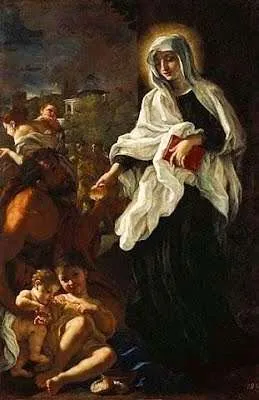
Saint Frances Xavier Cabrini

Profile

Frances was one of thirteen children raised on a farm. She received a convent education, and training as a teacher. She tried to join the order at age 18, but poor health prevented her taking the veil. A priest asked her to teach at a girl‘s school, the House of Providence Orphanage in Cadagono, Italy, which she did for six years. She took religious vows in 1877, and acquitted herself so well at her work that when the orphanage closed in 1880, her bishop asked her to found the Missionary Sisters of the Sacred Heart to care for poor children in schools and hospitals. Pope Leo XIII then sent her to the United States to carry on this mission.

She and six Sisters arrived in New York in 1889. They worked among immigrants, especially Italians. Mother Cabrini founded 67 institutions, including schools, hospitals, and orphanages in the United States, Europe and South America. Like many of the people she worked with, Mother Cabrini became a United States citizen during her life, and after her death she was the first US citizen to be canonized.

Born

  • 15 July 1850 at Sant’Angelo Lodigiano, Lombardy, Italy

Died

  • 22 December 1917 at Chicago, Illinois, USA of malaria
  • interred at 701 Fort Washington Avenue, New York, New York, USA

Venerated

  • 21 November 1937 by Pope Pius XI (decree on heroic virtues)

Beatified

  • 13 November 1938 by Pope Pius XI
  • her beatification miracle involved the restoration of sight to a child who had been blinded by excess silver nitrate in the eyes

Canonized

  • 7 July 1946 by Pope Pius XII
  • her canonization miracle involved the healing of a terminally ill nun

Patronage

  • against malaria
  • emigrants (given on 8 September 1950 by Pope Pius XII)
  • hospital administrators
  • immigrants
  • orphans

Source: https://catholicsaints.info/saint-frances-xavier-cabrini/

https://en.wikipedia.org/wiki/Frances_Xavier_Cabrini#/media/File:Francesca_Cabrini.JPG

Saint Frances Xavier Cabrini Read More »

Saint Peter Canisius, Priest and Doctor

Patron Saint of the Catholic press, Germany, and writers of catechisms Canonized and declared a Doctor of the Church by Pope Pius XI on May 21, 1925

In 1540, at the age of nineteen, Peter received his Master’s Degree of Arts. His father wanted him to marry a wealthy noblewoman, but Peter’s deepening faith led him to make a personal commitment to a life of celibacy. That same year, the future Saints Ignatius of Loyola, Francis Xavier, Peter Faber, and four others co-founded what would become the Society of Jesus, or Jesuits.

Over the next two decades, the Jesuits grew to an estimated 1,000 members, founded about thirty-five schools, and became missionaries to non-Christian territories. The Jesuits also played a significant role in the Catholic Counter-Reformation, becoming staunch defenders of the Catholic Church.

In 1543, Peter made a thirty-day retreat with the new Jesuit Father Peter Faber using the Spiritual Exercises written by Father Ignatius of Loyola. The primary goals of the Spiritual Exercises are personal conversion and the discernment of God’s will. They are especially designed to help a person arrive at a major life decision and resolution. Upon the completion of his thirty-day retreat, Peter Kanis discerned a call to enter the Jesuits. It was around that time that Peter began using the Latinized form of his name, Peter Canisius.

In 1545, the Holy Father opened the Council of Trent that helped lay the theological groundwork for the Catholic-Counter Reformation. The council clarified Catholic doctrines that were under attack due to the Protestant Reformation and enacted various reforms that were sorely needed within the Church. The Council of Trent continued to hold sessions until 1563.

In 1546, Peter Canisius was ordained a priest and was asked to attend the Council of Trent as an assistant to Cardinal Otto Truchsess von Waldburg, Bishop of Augsburg. In 1548, Peter went to Rome with Father Ignatius for further studies, and the following year was sent to Sicily where he assisted at the College of Messina, preaching and carrying out humble domestic duties. In 1549, he received his doctoral degree and made his final profession as a Jesuit.

Fully professed, well trained in Catholic doctrine, and intimately united to Christ through a life of personal prayer and devotion, Father Peter Canisius was ready for his life’s mission. At that time, Pope Paul III asked Father Ignatius of Loyola to recommend a Jesuit priest whom he could send to Germany to help renew the Catholic faith that was in turmoil. Father Peter Canisius was chosen.

After meeting with the pope, Father Peter went to Saint Peter’s Basilica to pray to Saints Peter and Paul, asking them to make the apostolic blessing he received from the Holy Father permanent, so he could fulfill the daunting task ahead of him. He later wrote in his journal that he sensed great consolation at that moment. He had a conviction that he was being sent as an apostle to Germany, and that the Apostles Peter and Paul would accompany him.

In 1549, Father Peter set out for the Duchy of Bavaria, modern-day southern Germany, where he first served as dean, rector, and vice chancellor of the University of Ingolstadt. He quickly sought to personalize the faith and to win over hearts and minds. His concern for the students and faculty reached far beyond academics and good doctrine. He was also concerned with forming them spiritually, helping them come to know Christ through prayer and the Sacraments.

In 1554, he was asked to become the Bishop of Vienna, but he declined, preferring to continue his Jesuit mission of teaching and preaching. Instead, he served as the interim diocesan administrator for a year where he continued to share his intimate love for Christ and the people by engaging in pastoral work, such as serving in hospitals and prisons.

It was there that he also took up the pen and began to write his influential German catechism: Summa Doctrinae Christianae (Summary of Christian Doctrine). This three-volume catechism was written for three different groups of people: theology students, older youth who were educated, and younger youth needing initial instruction. He wrote in a clear, concise, and down-to-earth way, using a question-and-answer format.

One of Father Peter’s deep convictions was that those who had left the faith often did so out of ignorance, not out of ill-will. He believed that if their questions were answered with kindness and clarity, the true faith would once again be accepted. Pope Benedict XVI, a German born in 1927, said of these catechisms, “So it was that still in my father’s generation people in Germany were calling the Catechism simply ‘the Canisius.’ He really was the Catechist of Germany for centuries…”

After his time in Vienna, Father Peter worked nonstop. He founded the College of Prague in 1556, served as the first superior of the Jesuits in northern Germany, coordinated a network of Jesuit communities and colleges, was entrusted with diplomatic missions, and continued to contribute to the Council of Trent.

In 1580, he moved to Fribourg, Switzerland, where he spent the last seventeen years of his life preaching and writing. His writings were voluminous, flooding Germany with devotionals, theological commentaries, spiritual texts, apologetic works, educational guides, and translations of Latin texts into German. He was so influential that 300 years after his death, Pope Leo XIII proclaimed him the “Second Apostle of Germany” (after Saint Boniface).

As we honor this great apostle of the Catholic faith, ponder the reasons for his success. He loved Christ, and he loved God’s people. He didn’t teach with arrogance or pride. He wasn’t harsh or heavy-handed. Instead, he won hearts as he won minds, gently but clearly leading people back to the faith, introducing them to the Person of Christ, and showing them the way to Heaven. Seek Saint Peter Canisius’ intercession today, praying that you, too, will become an evangelist in his mold. Commit yourself to sharing the Gospel with compassion, while never wavering from the truth.

Source: https://mycatholic.life/saints/saints-of-the-liturgical-year/21-december-saint-peter-canisius-priest-and-doctor–optional-memorial

Saint Peter Canisius, Priest and Doctor Read More »

Saint Dominic of Silos

Profile

Born to a peasant family, Dominic worked as a shepherd in his youth. He was a Benedictine monk at San Millán de Cogolla monastery. He was a priest, a novice master, prior of the house. He was ordered by King Garcia III of Navarre to give him the monastery‘s lands, Dominic refused, and with two of his brother monks was driven from the house by force.

They sought protection from King Ferdinand I of Old Castile. They found a new home in the San Sebastian monastery at Silos, diocese of Burgos where Dominic was appointed abbot. Founded in 954, the house had fallen on hard times, had only six monks, and was in terrible shape physically, financially and spiritually. He turned around the house’s spiritual life, straightened out its finances, rebuilt its structure.

The house was soon a spiritual center noted for book design, printed art, its gold and silver work, and charity to the local poor. The rebuilt abbey cloisters survive to today, and are considered a great architectural treasure. Reported to heal by prayer. He got wealthy patrons to endow the monastery, and raised funds to ransom Christians taken prisoner by the Moors.

One of the most beloved of Spanish saints, there were churches and monasteries dedicated to him as early as 1085, and the monastery he rebuilt is now known as Saint Dominic’s. Many miracles were attributed to his prayers after his death, especially with regard to pregnancy. Dominic’s abbatial staff was used to bless Spanish queens and was kept by their beds when they were in labor. Blessed Joan de Aza de Guzmán prayed at his shrine to conceive the child whom she called Dominic, after the abbot of Silos, and who founded the Order of Preachers (the Dominicans).

Born

1000 in Cañas (modern Rioja), Navarre, Spain

Died

  • 10 December 1073 in Silos, Spain of natural causes
  • on 5 January 1076 his body was translated to the monastery church for veneration

Patronage

  • against hydrophobia
  • against insects
  • against mad dogs
  • against rabies
  • captives
  • pregnant women
  • prisoners
  • shepherds

Representation

  • abbot surrounded by the Seven Virtues
  • chains, referring to prisoners and slaves
  • mitred abbot enthroned with a book, a veil tied to his crozier

Source: https://catholicsaints.info/saint-dominic-of-silos/

Saint Dominic of Silos Read More »

Saint Anastasius I, Pope

Profile

All that is known of his early life is that he was considered pious as a youth, and cared nothing for material things as an adult.

As a pope, he was immediately involved in the turmoil resulting from the heretical writings of Origen. He convened a synod to condemn the works. He fought against the heresy of Donatism.

He was a friend of Saint Augustine of Hippo, Saint Jerome, and Saint Paulinus of Nola.

Born

4th century in Rome, Italy

Papal Ascension

27 November 399

Died

402 of natural causes

Canonized

Pre-Congregation

Source: https://catholicsaints.info/pope-saint-anastasius-i/

Saint Anastasius I, Pope Read More »

Expectation of the Blessed Virgin Mary

Article

This is a memorial to impress on the faithful the sentiments of the Blessed Virgin as the time of her delivery approached.

The feast originated in Spain. When the feast of the Annunciation (25 March) was transferred to 18 December because of the regulation forbidding feasts in Lent, it remained on this date after the Annunciation was again celebrated on its original date.

Source: https://catholicsaints.info/expectation-of-the-blessed-virgin-mary/

Expectation of the Blessed Virgin Mary Read More »

Saint Begga of Andenne

Profile

Begga was born to the nobility, the daughter of Saint Pepin of Landen, mayor of the palace, and Saint Ida of Nivelles. She was the sister of Saint Gertrude of Nivelles.

Begga was married to Ansegilius, son of Saint Arnulf of Metz. Her son, Pepin of Herstal, was the founder of the Carolingian dynasty of rulers in France, in 635.

On the death of her husband in 691 in a hunting accident, Begga took the veil, founded seven churches, and built a convent at Andenne on the Meuse River (in modern Belgium) where she spent the rest of her days as abbess.

Died

693 at Andenne on the Meuse River in modern Belgium

Canonized

Pre-Congregation

Patronage

Andenne, Belgium

Source: 

Saint Begga of Andenne

https://en.wikipedia.org/wiki/Begga#/media/File:Begga_de_landen.jpg

Saint Begga of Andenne Read More »

Saint Adelaide of Burgundy

Profile

Adelaide was born a princess, the daughter of King Rudolf II (Rupert II) of Upper Burgundy. She was promised at age two in an arranged marriage as part of a treaty between Rudolf and Hugh of Provence. She was married at age 16 to Lothair of Italy, who eventually became king of Italy.

Adelaide was widowed in 950 while still a teenager; Lothair was probably poisoned by his successor to the throne, Berengarius. As part of his attempt to solidify his grip on power, Berengarius ordered Adelaide to marry his son; she refused, and was imprisoned. She was freed soon after when the German king Otto the Great defeated Berengarius.

Adelaide married Otto in Pavia, Italy in 951. He was crowned Emperor in Rome, Italy in 952, and Adelaide reigned with him for 20 years. Widowed in 973, she was ill-treated by her step-son, Emperor Otto II and his wife Theophano, but eventually reconciled with her royal in-laws.

When Otto II died in 983, he was succeeded by his infant son, Otto III. Theophano acted as regent, and since she still did not like Adelaide, used her power to exile her from the royal court. Theophano died in 991, and Adelaide returned once again to the court to act as regent for the child emperor.

Adelaide used her position and power to help the poor, to evangelize, especially among the Slavs, and to build and restore monasteries and churches. When Otto III was old enough, Adelaide retired to the convent of Selta near Cologne, a house she had built. Though she never became a nun, she spent the rest of her days there in prayer.

Born

c. 931 in the kingdom of Burgundy, Holy Roman Empire (modern Burgundy, France)

Died

16 December 999 at the monastery of Selta (Seltz), Alsace of natural causes

Canonized

1097 by Pope Urban II

Patronage

  • abuse victims
  • against in-law problems
  • brides
  • empresses
  • exiles
  • parenthood
  • parents of large families
  • people in exile
  • princesses
  • prisoners
  • second marriages
  • step-parents
  • victims of abuse
  • widows

Representation

  • empress dispensing alms and food to the poor, often beside a ship
  • escaping from prison in a boat
  • holding a church
  • veil

Source/s:

Saint Adelaide of Burgundy

https://en.wikipedia.org/wiki/Adelaide_of_Italy#/media/File:Sainte-Ad%C3%A9la%C3%AFde_-_%C3%89glise_de_Toury,_vitraux_par_Lorin.jpg

Saint Adelaide of Burgundy Read More »