Daily Saints

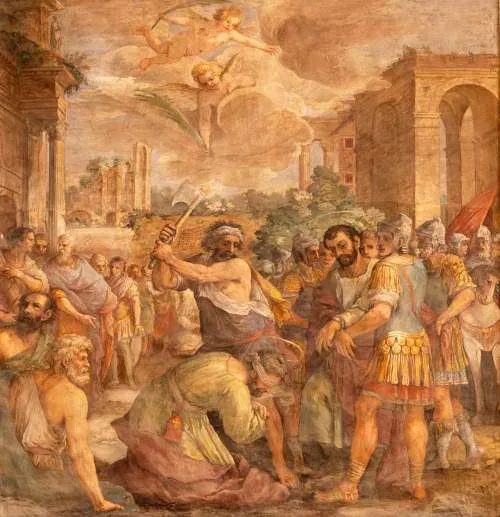
Saints Nereus and Achilleus, Martyrs

Died c. 98; Pre-Congregation canonization

Not long after Jesus’ death and resurrection, Saint Stephen, a deacon of the Church in Jerusalem, became the first Christian martyr. Then came James, the son of Zebedee; James the brother of the Lord; Saints Peter and Paul; and other apostles. Before the turn of the first century, dozens would follow. It is believed that today’s martyrs were among these first witnesses to the faith who shed their blood for Christ.

Very little is known for certain about Saints Nereus and Achilleus. Today theirs are among the 140 statues of saints towering over Saint Peter’s Square, Rome. In 1874, when the Catacomb of Domitilla was discovered and excavated, a fourth-century basilica dedicated to Saints Nereus and Achilleus was found. In that basilica was discovered a well-preserved pillar with the name Achilleus on it, images depicting the men’s decapitation, and the above inscription from Pope Saint Damasus (c. 304–384). In the sixth century, the relics of these saints were moved to another Roman church built in their honor in which they lie today.

Though details are uncertain, Saints Nereus and Achilleus might have been soldiers in the army of the Roman Emperor Domitian. They might have been brothers who were eunuchs responsible for the protection of Emperor Domitian’s niece, Domitilla. Domitilla and Clemens, to whom she was betrothed, were arrested by the emperor for “sacrilege or godlessness,” because they rejected the Roman gods and converted to Christianity. Clemens was put to death and Domitilla was exiled. Her guards, Nereus and Achilleus, also converted and fled their post, and might have even been responsible for converting Domitilla and Clemens. The brothers were arrested and sent into exile. Emperor Domitian died in 96 and was succeeded briefly by Emperor Nerva and then by Emperor Trajan in 98, who is believed to have ordered the beheading of the brothers while they were in exile. Their bodies were later buried in the family catacomb of Domitilla, one of the earliest Christian cemeteries in existence. One tradition states that Saint Peter himself baptized the brothers in Rome.

On May 12, 592, Pope Saint Gregory the Great celebrated Mass at the tomb of these martyrs and said in his sermon, “These saints before whose tomb we are assembled, despised the world and trampled it under their feet, when peace, plenty, riches, and health gave it charms. And this world, which was still so flourishing in itself, was already withered in their hearts.”

Regardless of the lack of certainty regarding the historical details of the lives of these saints, it is certain that they were greatly honored in the early Church. Their witness inspired Christians of their time and for centuries to follow. They are among the earliest witnesses to Christ; and, with the blood they shed, undoubtedly planted the seeds of faith in the hearts of many. Today, their influence is hard to estimate; but in Heaven, the veil will be lifted, and we will be in awe of the effect that their sacrifice had not only on the early Church but also on the Church throughout the ages.

As we ponder these great saints today, reflect upon the important fact that the seeds you plant in the hearts of others is not only for them, it is also for everyone that they will touch with God’s grace. The seeds we plant do grow, and though we might not always be able to point to the fruit that is borne, we can be certain that God will reveal this to us with great joy in the glories of Heaven.

Source: https://mycatholic.life/saints/saints-of-the-liturgical-year/may-12—saints-nereus-and-achilleus-martyrs/

Saints Nereus and Achilleus, Martyrs Read More »

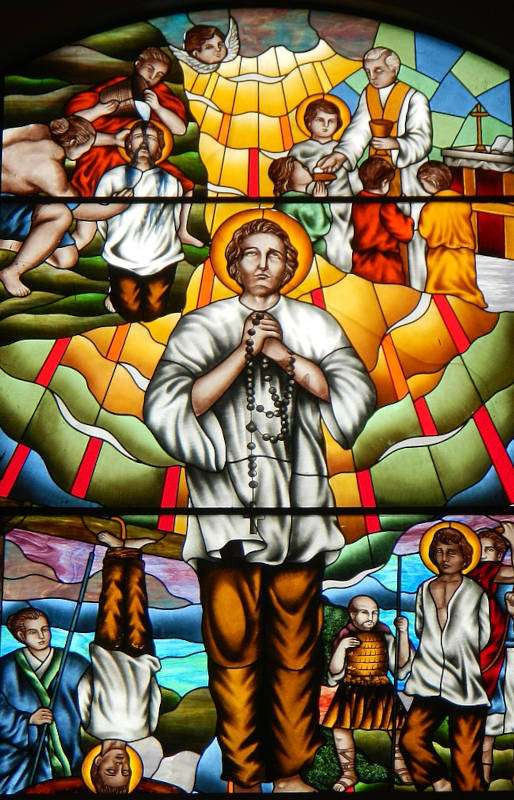
Saint Damien de Veuster of Molokai, Priest

1840–1889; Patron Saint of outcasts and those suffering from leprosy; Canonized by Pope Benedict XVI on October 11, 2009

Jozef De Veuster was the youngest of seven children born into a poor farming family in central Belgium. Jozef went to school until the age of thirteen, at which time he had to assist his father on the family farm. A few years later, after his older brother entered religious life, Jozef’s father sent Jozef to college to prepare him to take over the family business. At school, during a mission, he heard God calling him to religious life. At the age of twenty, Jozef followed in his brother’s footsteps and entered the Congregation of the Sacred Hearts of Jesus and Mary. Jozef later took the name Damien after a fourth-century saint who was a physician and martyr. His brother Auguste took the name Pamphile. Two of their sisters also entered religious life.

During his formation, Brother Damien had to work diligently on his studies to catch up to the other students. His older brother tutored him, satisfying the superiors who then permitted him to the priesthood. During those first few years in formation, Brother Damien often prayed before an image of Saint Francis Xavier, seeking his intercession for the grace of being sent on a foreign mission.

In 1863, Brother Damien’s brother, Father Pamphile, received word from his superiors that he was being sent to Hawaii as a missionary. Before Pamphile could leave, he became seriously ill. Brother Damien stepped in and asked for permission to go to Hawaii in his brother’s place. The superiors agreed, and Brother Damien arrived in Honolulu on March 19, 1864, after six months on a ship. Two months later, he was ordained a priest.

At that time in the Kingdom of Hawaii, a serious health crisis was taking place. During the previous century, European explorers and traders brought with them various diseases, such as influenza, smallpox, syphilis, cholera, and whooping cough. It is believed that in the 1830’s, Chinese ships brought the dreaded disease of leprosy to the islands. In response to this growing crisis, on January 1, 1865, the Hawaiian government passed legislation to stop the spread of leprosy. The legislation forced those who contracted leprosy to be sent to a settlement on a remote part of the island of Molokai where they were to live and ultimately die. This law tore families apart and devastated those who became infected. Over the next decade, many who were sent to Molokai fell victim to alcohol abuse and immoral conduct. There was scarcely enough food for them all, and morale was quite low.

In 1873, after being a priest for nine years, Father Damien volunteered to go to the leper colony to meet the spiritual needs of this community of outcasts. Shortly after his arrival, Father Damien sent a letter to the Hawaiian Board of Health, describing the state of the approximately 700 lepers. He wrote that “these wretches, banished from society, live together, without any distinction being made regarding age or gender, and without anyone being classified according to whether their illness is advanced or in its early stages, and all of them, more or less, unknown to each other. They pass all their time playing cards, drinking some kind of rice beer and giving themselves over to various excesses.” His superiors had ordered him not to touch the lepers, not to be touched by them, and not to eat with them. But Father Damien could not obey that command, knowing that Jesus freely touched the lepers. In a letter to his brother, Father Damien said, “As for me, I make myself a leper with the lepers to gain all for Christ. Because of this, when I preach I normally say, ‘We lepers.’”

Over the next fifteen years, Father Damien worked tirelessly as a true father, doctor, construction worker, farmer, gravedigger, and priest. Throughout his ministry to the lepers, he personally dug more than 1,000 graves and built as many coffins for the people he buried, giving them a dignified funeral. For the living, he built hundreds of homes, chapels, roads, hospitals, and even a fresh water system. He taught catechism, celebrated the sacraments, and converted many souls. He regularly visited every person under his care—Catholic, Protestant, and atheist alike. In 1885, he wrote, “During the week I visit my numerous sick and busy myself with orphans, who are all lepers. At times it can be quite unpleasant to be always surrounded by these unfortunate children, but I find consolation in it. They learn their catechism well, and are present daily at morning Mass and the evening rosary.” Father Damien transformed that wretched community into a community of believers, giving them the hope of the Gospel and the dignity they deserved.

It soon became clear that Father Damien’s ministry was not only to those on the island. Many in Europe began to hear about and were inspired by his ministry. Letters he had written home were published in newspapers and as his fame grew, donations poured in to assist with the work. Though many held him up as a modern hero, others criticized him as reckless for touching the lepers and allowing himself to be touched. Even some within the Hawaiian government were critical, given his constant pleas for assistance for his lepers.

After eleven years of ministering to the lepers, Father Damien contracted leprosy himself. He suffered with the disease for five more years, dying during Holy Week in his sixteenth year of ministry on the island. On his deathbed, he announced to his companions that the Lord was calling him to celebrate Easter that year in Heaven. He died with a heart filled with joy.

Throughout history, the Church has always honored martyrs. Those who willingly endured suffering and death rather than renounce their faith give us a powerful witness. Father Damien, though not a martyr by blood, was a martyr of charity. His love for the rejects of society led him to lay his life down for them all, holding nothing back. The result of his heroic sacrifice was the transformation of a disordered society of outcasts into a community of faith and hope.

Ponder your own calling to reach out to those who experience isolation within your community. The poor, sick, mentally ill, and sinner are all in need of God’s mercy. Be open to any way that God may want to use you as an instrument of His limitless charity by pledging to be a martyr of charity yourself.

Source: https://mycatholic.life/saints/saints-of-the-liturgical-year/may-10—saint-damien-de-veuster-of-molokai-priest—usa-optional-memorial/

Saint Damien de Veuster of Molokai, Priest Read More »

 Saint John of Ávila, Priest and Doctor of the Church

1499–1569; Patron Saint of Spanish priests; Canonized by Pope Paul VI on May 31, 1970; Proclaimed a Doctor of the Church by Pope Benedict XVI on October 7, 2012

Though today’s saint bears the name of Ávila, that was simply his name, not where he was from. John of Ávila was born in the town of Almodóvar del Campo, Spain, less than a decade after Spain was liberated from almost 800 years of Muslim rule. He was an only child born later in life to his parents who had struggled to conceive. His noble, wealthy, and devout parents attributed John’s birth to the intercession of Saint Bridget of Sweden. Notably, John was born on the Feast of the Epiphany.

At the age of fourteen, John was sent to study law at the renowned University of Salamanca, but he never completed his law degree. After four years of study, John had a profound conversion experience, after which he returned to his parents’ home for a three-year period of prayer and discernment. During that time, John began to hear God calling him to the priesthood. He sought spiritual advice from a Franciscan friar who told John that he believed him to be called to the priesthood and that he must go. That spiritual advice confirmed John’s interior calling, and in 1520 he began his theological studies. While in seminary, John was blessed with excellent teachers who were well versed in the theology of Saint Thomas Aquinas. John was smart, a good student, and very devout, especially regarding the Holy Eucharist. When John returned home in 1526, he was ordained a priest and celebrated his first Mass in his home parish.

Toward the end of his studies, both of John’s parents died. Being an only child of wealthy parents, John received a large inheritance. Though he could have used some of that money to throw a large ordination party for himself, he chose to do something more radical. He went out into the streets, found twelve poor people, and invited them to share a feast with him. He then sold the property he inherited and gave his money to the poor.

With his parents and childhood home gone, Father John decided to become a missionary to the West Indies. To achieve that goal, he contacted the newly appointed first bishop of Mexico who was waiting to sail to the New World. After receiving permission to travel with him, Father John went to Seville to wait for a ship. While waiting, he began to engage in public ministry in Seville, quickly drawing admiration for his devout celebration of the Mass, his preaching, and his catechetical approach. A local priest named Father Contreras, with whom he might have been living, became very impressed with Father John. Father Contreras spoke to the Archbishop of Seville, asking him to intervene and convince Father John to stay in the archdiocese. The archbishop did intervene and convinced Father John to abandon his desire to travel to the New World so he could remain in Spain to help revive the faith that had been so severely damaged by centuries of Muslim rule, as well as the confusion that was emerging from the Protestant Reformation.

In 1529, at the age of thirty, just three years a priest, Father John of Ávila began his ministry in the town of Andalusia. He would later be known affectionately as “the apostle of Andalusia.” He continued his studies at the local university and eventually earned the impressive title of “Master.” Father “Master” Ávila’s priestly ministry was abundantly fruitful in Andalusia. He often preached on repentance and on the value of the Sacrament of Confession, preparing for his sermons and celebration of Mass with long periods of prayer. After his sermons to an overflowing congregation, he would often enter the confessional and remain there for hours until everyone who wanted to confess their sins was able to do so.

Father John’s preaching not only bore good fruit, it also stirred up animosity. Father John lived a life of radical poverty and regularly preached about the dangers of excessive wealth. Some of the local clergy were convicted by his preaching because of their lavish lifestyles, so Father John was reported to the Inquisition, subsequently arrested, and imprisoned. The charge was that he had preached in a sermon that “the doors of Heaven are closed to the rich…” Though many would despair during such a personal persecution, Father John did not. During his yearlong imprisonment he devoted himself to prayer, study, and writing. He translated the book, Imitation of Christ, and wrote much of his most famous book Audi, filia (Listen, O Daughter), a spiritual masterpiece on Christian perfection and the universal call to holiness, written at the request of a Spanish nun, a spiritual directee of Father John. After a year, the Inquisition found him not guilty of any crime, and he was released in 1533. For the next eighteen years, Father John engaged in active ministry in Andalusia and the surrounding towns where he gained quite a following. In 1551 he began to experience ill health and lived a semi-retired life until his death in 1569.

Throughout his ministry, Father John became a saint among other saints, offering spiritual direction and counsel to many. He became a mentor to Saint Ignatius of Loyola and inspired many young men to join Ignatius’ newly founded Society of Jesus. He advised the great Saint Teresa of Ávila, who sought his counsel on her writings. Saint John of God was converted by John of Ávila’s preaching and then founded the Brothers Hospitallers, a religious congregation devoted to the poor, sick, and mentally ill. He counseled Saint Francis Borgia, the third General Superior of the Jesuits, the Franciscan friar Saint Peter of Alcántara, the bishop Saint Thomas of Villanova, as well as other bishops, religious, civil rulers, and numerous spiritual directees. Not only did he leave behind a legacy by affecting so many people during his lifetime, he also left behind his spiritual classic Audi, filia, eighty-two sermons, Scripture commentaries, 257 letters, and various other minor works on reform in the Church in the spirit of the great Council of Trent in which he participated.

Though he lived in the sixteenth century, Saint John of Ávila was not canonized until 1970 and was made a Doctor of the Church in 2012. Why did it take so long? Perhaps one reason is that the Church of the twenty-first century needs to revisit John’s preaching. We need to return to his teachings on simplicity, poverty, the universal call to holiness, his vigorous attempts to reform the clergy, his devotion to the holy Mass, and his passionate pleas for repentance from sin.

As we honor this sixteenth-century saint, look to him also as a role model for the Church. He began with a desire to be a foreign missionary but found his homeland to be the mission field to which he was called. Ponder your own call to evangelize those closest to you. Doing great things for God often starts at home. Commit yourself to that mission field, and pray that God will bear much good fruit through your efforts. If you suffer as a result, be encouraged by Saint John’s imprisonment and know that God can bring forth good from everything you are called to endure.

Source: https://mycatholic.life/saints/saints-of-the-liturgical-year/saint-john-of-avila/

 Saint John of Ávila, Priest and Doctor of the Church Read More »

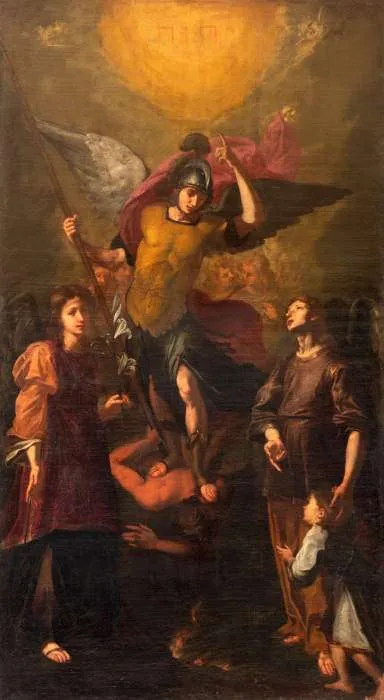
Apparition of Saint Michael the Archangel

Profile

Archangel. Leader of the army of God during the Lucifer uprising. Devotion is common to Muslims, Christians and Jews, and there are writings about him in all three cultures. Considered the guardian angel of Israel, and the guardian and protector of the Church. In the Book of Daniel (12:1), Michael is described as rising up to defend the Church against the Anti-Christ.

The feast of the Apparition of Saint Michael commemorates appearance of the archangel to a man named Gargan in 492 on Mount Gargano near Manfredonia in southern Italy. Gargan and others were pasturing cattle on the mountain; a bull wandered off and hid in a cave. An arrow was shot into the cave, but it came flying back out and wounded the archer. The cowherds went to their bishop who ordered three days of fasting and prayer to seek an explanation for the mystery. At the end of the three days Michael appeared to the bishop and requested a church built in the honour of the Holy Angels in the cave. If you find medals or holy cards with ‘relics‘ of Michael, they are probably rock chips from the cave, or pieces of cloth that have touched it.

Canonized

  • Pre-Congregation

Name Meaning

  • Who is like God? (the battle cry of the army of heaven)

Source: https://catholicsaints.info/michael-the-archangel/

Apparition of Saint Michael the Archangel Read More »

Saint Flavia Domitilla of Terracina

Profile

Flavia was a Roman noble lay woman. She was the granddaughter of Emperor Vespasian; niece of Emperors Titus and Domitian. She was married to Titus Flavius Clemens, a Roman consul, nephew of Emperor Vespasian, and first cousin of Emperors Titus and Domitian; She was the foster sister of Saint Ephyrosyna of Terracina and Saint Theodora of Terracina. She converted to Christianity. She was widowed when her husband was martyred in 96. She was banished to the island of Pandataria in the Tyrrhenian Sea. She was possibly martyred, though records are sketchy.

Died

  • at Terracina, Italy

Canonized

  • Pre-Congregation

Patronage

  • Grotte di Castro, Italy

Source: https://catholicsaints.info/saint-flavia-domitilla-of-terracina/

Saint Flavia Domitilla of Terracina Read More »

Saint John Before the Latin Gate

Commemorates the attempted martyrdom of Saint John the Apostle in 95. John was bound and brought to Rome, Italy from Ephesus by the order of Domitian; the Senate condemned him to be taken to the Latin Gate and thrown in a cauldron of boiling oil. John stepped out of the cauldron without injury, and instead was exiled to Patmos.

Source: https://catholicsaints.info/saint-john-before-the-latin-gate/

Saint John Before the Latin Gate Read More »

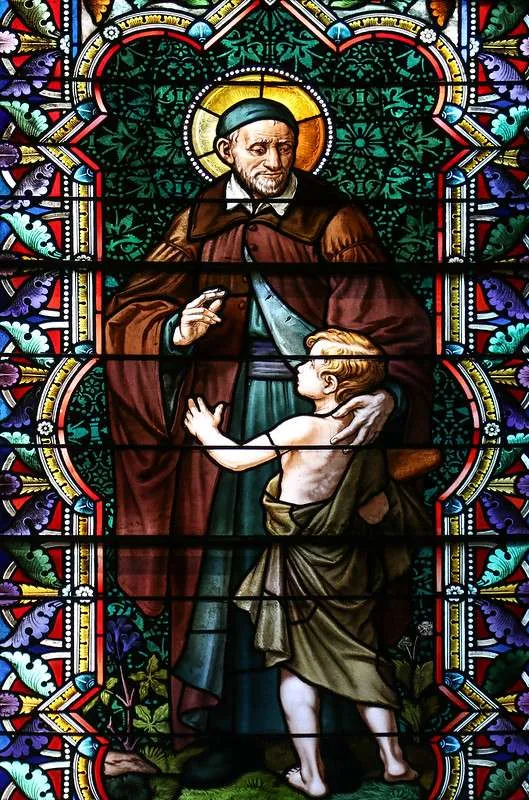
Saint Louis Grignion de Montfort, Priest

1673–1716; Patron Saint of preachers; Canonized by Pope Pius XII on July 20, 1947

Louis Grignion was the second of eighteen children born to Jean-Baptiste and Jeanne Robert Grignion in the small town of Montfort-sur-Meu, northwest France. Several of their children died in infancy, including the firstborn, leaving Louis as the oldest of the surviving siblings. He was given the name Louis at his baptism and later added Marie to his name at his confirmation, a fitting name for one who would later become the definitive source on total consecration to Jesus through Mary.

Louis’ parents were strong Catholics. Three of their sons became priests, and two of their daughters became nuns. However, the family was not without difficulties. Louis’ father had a fierce temper, and Louis was often the recipient of his outbursts. His father longed for wealth and prestige, yet he could not pull the family out of poverty, which often left him frustrated. His father’s outbursts affected Louis such that he himself was tempted with the same vice throughout his life. Nonetheless, those who knew Louis as a child saw him as an “angelic boy” whose spiritual depth was beyond his years. His deep compassion for his mother, who also suffered from her husband’s outbursts, was also well noted. Perhaps it was this compassion for his mother that later led him to a profound devotion to the Blessed Mother.

When he turned twelve, Louis-Marie was sent to the nearby town of Rennes, where he entered a large free school run by the Jesuits. He remained there for about eight years and completed his elementary education, as well as courses in philosophy and theology. During those years, Louis lived a virtuous life, had a strong love for the poor and sick, practiced severe penances, became devoted to the Blessed Virgin Mary and the angels, and prayed often. His mother’s brother, a priest in Rennes, later remarked that Louis was so virtuous that he almost appeared “immune from Adam’s sin.” At that time, he also enjoyed listening to stories from a local priest about his missionary work as an itinerant preacher. This fueled a desire in Louis’ heart for the same.

In 1693, at the age of twenty, Louis’ dream of the priesthood moved forward. He received a scholarship from a benefactor to study in Paris at the famed Seminary of Saint-Sulpice. The school was about 200 miles away from his home, and his father wanted him to arrive in style. He offered Louis a horse, money, and new clothing. Louis, however, wanted to walk to Paris as penance and to do so in poverty, so he rejected the horse but reluctantly accepted the money and new clothing. On his journey, he gave away all his money to the poor, exchanged his new clothing for tattered rags, and begged for food. When he finally arrived in Paris, he discovered that the benefactor had not given enough money for him to enter and reside at Saint-Sulpice, so he obtained modest boarding elsewhere and instead attended school at Sorbonne University for the next two years. Though his meager accommodations and diet were penitential in and of themselves, he continued to add to these mortifications through his own acts of penance. Two years later, after recovering from a serious illness, he was able to move into the poorer accommodations offered at Saint-Sulpice and complete his studies while working at the school library.

As a librarian, Louis-Marie became very familiar with some of the greatest books of theology, especially on Mariology. His faith and devotional practices grew so strong that some of the worldly clergy ridiculed him, thinking him to be a fraud. His frequent visits to the chapel before and after every class, his profound devotion to Mary, his penances, and his loving devotion to the poor and infirm made him stand out. After completing his studies, he was ordained a priest but not given faculties to preach or hear confessions. Eventually, he was invited to assist a priest in Nantes, just south of where he grew up.

Over the next six years, Father Louis had a series of ups and downs. He was especially drawn to the poor and worked on and off as a chaplain at a hospital for the poor. On a spiritual level, his ministry was a great success and the people loved him, especially those who were poor. However, he continually met with opposition from some of the worldly clergy and the social elite, so he was forced to move over and over again, even being without an assignment for a year. Finally, in 1706, discouraged by his ministerial struggles, he decided to walk 1,000 miles to Rome to consult with the Holy Father. On June 6, he was granted an audience with Pope Clement XI who saw through the veneer of this impoverished beggar priest and perceived his God-given vocation. The Holy Father appointed him as Apostolic Missionary and sent him back to France.

Over the next ten years, Father Louis thrived in his new ministry. He began preaching missions from town to town, regularly performed miracles, encountered apparitions of our Blessed Mother, lived a life of extreme poverty and penance, constructed Calvary grottos to foster devotion, and won the hearts of countless people. He confronted the heresies of the day, rejoiced in every persecution he endured (even attempts on his life by heretics), and remained faithful to the commission he was given by our Lady through the pope. Though he continued to endure persecution from the local bishop and clergy, he pressed on. Toward the end of his life, Father Louis wrote a rule of life for a community of priests and brothers, but that community was never fully established before his death. In the years after his death, however, the seeds he planted evolved into two strong communities that continue to thrive today: the Daughters of Wisdom and the Company of Mary.

His most enduring legacy would not become known to the Church for more than a century after his death. During his life, Father Louis wrote several books and many hymns. His books remained unknown until April 22, 1842, when a priest of the community he founded discovered the manuscripts in an old trunk. Soon after, his writings on the Blessed Virgin Mary, especially True Devotion, Secrets of Mary, and Secrets of the Rosary, became among the most widely loved and influential Marian books ever written. Since then, six popes have honored Saint Louis de Montfort and praised his writings and virtues. Saint Pope John Paul II even took his papal motto from the saint’s writings: Totus Tuus, “totally yours.”

Saint Louis de Montfort lived for “God alone” by consecrating himself totally to God through the instrumentality of the Blessed Virgin Mary. He was poor, penitential, devout, and fully committed to the salvation of souls and the care of the poor. Miracles accompanied his ministry, and, when the time was right, the Holy Spirit introduced the Blessed Virgin Mary more fully to the world through him.

As we ponder this great saint today, reflect upon your own devotion to our Blessed Mother. Saint Louis believed that the quickest and safest way to Jesus was through the Blessed Mother. Consider reading through his consecration found in his work, True Devotion, so that Saint Louis’ profound faith will also spark deep faith in your life.

Source: https://mycatholic.life/saints/saints-of-the-liturgical-year/april-28-saint-louis-grignon-de-montfort-priest/

Saint Louis Grignion de Montfort, Priest Read More »

Saint Athanasius, Bishop and Doctor

c. 296–373; Patron Saint of theologians; Pre-Congregation canonization; Proclaimed a Doctor of the Church by Pope Saint Pius V in 1568

Can something be 100% black and 100% white at the same time? Certainly not. It was logic similar to this that created a fierce controversy known as Arianism in the fourth-century Church. Among the greatest opponents of Arianism was Saint Athanasius, whom we honor today.

Arius was a priest from Alexandria, modern-day Egypt. The belief that Jesus was 100% human and 100% divine seemed logically incompatible to him. As a result, Arius taught that the Father created the Son, making the Son subordinate to the Father and neither co-eternal nor co-equal with Him. The debate would finally be resolved at a Church council in Nicaea, called by the Roman Emperor Constantine the Great. The answer came by way of the formulation of the Nicene Creed, which we continue to profess as a Church today. The Nicene Creed got it right, and today’s saint made sure of it.

Little is known about the early life of Saint Athanasius, but much is known about his unwavering leadership, courage, and depth of faith, due to the voluminous writings he left behind. One story relates that when Athanasius was only a child, he and two friends were playing on the beach when the Bishop of Alexandria noticed them. The bishop observed that young Athanasius was pretending to baptize the other boys, in imitation of the bishop himself. After examining Athanasius’ faith and understanding of the sacrament, the bishop declared that Athanasius’ baptisms of the other boys were truly valid. The bishop then took Athanasius under his wing and saw to it that he received the best education the flourishing Christian city of Alexandria could offer him. He became an excellent student and especially immersed himself in the Holy Scriptures.

At that time, Alexandria was an important trade center, with a mixture of Greek and Roman culture. The faith was strong and the city’s schools were renowned. What came out of Alexandria affected the entire Church. In 311, the Bishop of Alexandria was martyred in one of the final Roman persecutions of the faith. In 313, the Emperor Constantine issued the Edict of Milan, legalizing the practice of the Christian faith. Upon completing his education, Athanasius was ordained a deacon in Alexandria. As a deacon, his knowledge of Scripture would especially be made known through his first great work, On the Incarnation of the Word, in which he powerfully articulates that Jesus is the divine and eternal Word of the Father.

With the legalization of Christianity and the end of external persecutions of the Church, a new attack on the Church began—this time from within. Around the year 318, Arius, a priest in a wealthy parish in Alexandria, pronounced from the pulpit that his bishop was a heretic. He promoted his belief that the Son of God was subordinate to the Father, did not share in His divinity, and was, therefore, neither eternal nor co-eternal. The Bishop of Alexandria worked hard to reconcile Arius but to no avail. In 321 a synod of nearly 100 bishops was held in Alexandria, and they rejected the teachings of Arius. Arius subsequently rejected the bishops and fled to Palestine where he continued to spread his errors. With Christianity legal throughout the empire, Arius went on a preaching campaign, even going so far as to compose short hymns he taught the people with words such as, “there was a time when He was not…” Eventually, the Emperor Constantine heard about the controversy and wanted it resolved.

In 325, Constantine called the first ecumenical Church council in the city of Nicaea, near Constantinople, with the cooperation of Pope Sylvester. As the bishops gathered from across the empire, many of them bore the physical marks of persecution by the Roman emperors that had endured throughout their lives. Now, they faced a new enemy, one which sought to deny the divinity of Christ. At the council, Arius was given the freedom to make his case within the hearing of all. The Bishop of Alexandria also made his case. Later testimony also states that Deacon Athanasius was one of the clearest and most convincing voices in support of the divinity of Christ, basing his arguments upon his work On the Incarnation of the Word of God. Of the more than 300 bishops in attendance, only two refused to support the position articulated by the Bishop of Alexandria and Deacon Athanasius. A creed was formulated to clearly and concisely articulate the pure faith of the Church: the Nicene Creed. Those two bishops who refused to accept it, along with Arius, were exiled. Shortly after the council, the Bishop of Alexandria died and thirty-year-old Athanasius was chosen as his successor, to the delight of all of the people.

One might think that the Council of Nicaea, with its issuance of the Nicene Creed, would have ended the troubles, but it did not. Soon after, the exiled bishops who supported Arius gained the support of the Emperor Constantine and convinced him to exile Bishop Athanasius from Alexandria. This was the first of five exiles Bishop Athanasius would endure from four different Roman emperors. In fact, seventeen of his forty-eight years as Bishop of Alexandria were spent in exile.

Romans 8:28 states, “We know that all things work for good for those who love God, who are called according to his purpose.” This Scripture was certainly fulfilled in the life of Saint Athanasius. During his five exiles, he wrote over fifty letters that have survived, numerous works on the faith, and the first detailed biography of a saint, Saint Anthony of the Desert. His book on Saint Anthony was based on his firsthand knowledge of the life of this desert monk. It is believed that Athanasius spent at least a year with Anthony prior to Anthony’s death, and then spent five or six more years with the community of desert monks Anthony had helped to form. Athanasius’ knowledge of this unique vocation, as well as his participation in it, provided the early Church with a powerful witness of the vocation of solitude and prayer. His book became one of the most copied books of that time and remains very popular today. There is little doubt that that work alone contributed greatly to an understanding of the contemplative life not only of desert monks, but also for religious, clergy, and laity. Additionally, Athanasius’ other works not only eventually led to the complete repudiation of the Arian heresy but provided theologians since that time with treasured insights into the faith, especially into the Incarnation and divinity of Christ.

As we honor this great Doctor of the Church, ponder especially his unwavering devotion to the truth, despite enduring lifelong persecution for it. It would have been easier for him to remain silent, but he did not. If you find yourself compromising your faith at times, take inspiration from Saint Athanasius and seek his intercession today.

Source: https://mycatholic.life/saints/saints-of-the-liturgical-year/may-2–st-athanasius-bishop/

Saint Athanasius, Bishop and Doctor Read More »

Saints Philip and James, Apostles

Saint Philip: c. 4–c. 80 Patron Saint of hatmakers and pastry chefs; Saint James: First century BC–c. 62; Patron Saint of pharmacists and the dying; Pre-Congregation canonizations

In the sixth century, Pope Pelagius I traveled to Constantinople and brought the relics of the Apostles Philip and James back to Rome, placing them in what is today called the Church of the Holy Apostles. It is for this reason that we honor these two Apostles together with one feast.

Saint Philip was one of the Twelve Apostles. He was most likely a follower of Saint John the Baptist and was aware of John pointing to Jesus as the Messiah. Philip might have been a brother to Simon Peter and Andrew, making him a fisherman by trade. The day after Simon and Andrew were invited to follow Jesus, Jesus encountered Philip and said, “Follow me” (John 1:43). Philip obeyed. He was from the town of Bethsaida, just north of the Sea of Galilee. Philip’s first act of evangelization was to tell his friend, Nathanael, that they had found the Messiah. Nathanael was reluctant at first, stating to Philip, “​​Can anything good come from Nazareth?” Philip’s response was ideal. He said to his friend, “Come and see” (John 1: 46). When Nathanael came and saw, he immediately professed his faith in Jesus as the Messiah, the Son of God. Early Church theologians believe that Philip followed our Lord from that time forward, witnessing Jesus’ first miracle at Cana.

When Jesus established the Twelve, Philip was among them. He is mentioned in John’s Gospel during the feeding of the 5,000 when Jesus sees the large crowd and then turns to Philip and says, “Where can we buy enough food for them to eat?” (John 6:6). Philip is also mentioned in connection with Greek-speaking Gentiles who want to see Jesus (see John 12:21), possibly indicating that Philip could speak Greek and was known to the Greek community. At the Last Supper, as Jesus was speaking about the Father, Philip said to him, “Master, show us the Father, and that will be enough for us”, to which Jesus gently responded, “Have I been with you for so long a time and you still do not know me, Philip? Whoever has seen me has seen the Father” (John 14:8–14).

After Pentecost, little is known about Philip’s missionary activity. Ancient traditions state he preached in Greece, Phrygia, and Syria, being martyred at an old age in Hierapolis, Phrygia, modern-day southwest Turkey, not far from Ephesus where Saint Paul established a church. Philip is believed to have died either by being crucified upside down or by beheading.

Saint James is also one of the Twelve. The traditional view, from as early as the second century, is that there are only two disciples of Christ in the New Testament with the name James. Some modern scholars identify three or more. If we stick with the traditional view, which was also held by Saint Jerome in the fourth century, then the two Jameses are James the Son of Zebedee and James the Less (also referred to as James the brother of the Lord, and James the Son of Alphaeus). Later authors call him James the Just. If James the Less is also the James who is the Lord’s brother, then James’ father was Alphaeus and his mother was Mary of Clopas, the sister of the Blessed Virgin Mary. This would make James the nephew of the Blessed Virgin and a first cousin to Jesus. He is referred to as Jesus’ “brother” because it was common at that time to refer to cousins and other relatives as brothers and sisters. In Mark’s Gospel, Levi (better known as Matthew) is also referred to as the son of Alphaeus (Mark 2:14) which could make James and Matthew brothers.

In his letter to the Corinthians, Saint Paul relates that the Lord appeared to James after His Resurrection (1 Corinthians 15:7). After Pentecost, James became the first bishop of the Church in Jerusalem. The Acts of the Apostles relates that it was James, as the head of the Jerusalem Church, who oversaw the First Council of Jerusalem and declared the final judgment on behalf of Peter (see Acts 15). Eusebius, a fourth-century bishop, writes that James spent long hours in the Temple of Jerusalem: “…he was in the habit of entering alone into the temple, and was frequently found upon his knees begging forgiveness for the people, so that his knees became hard like those of a camel.” Eusebius also wrote about James’ martyrdom, “…he was thrown from the pinnacle of the temple, and was beaten to death with a club.” Traditionally, the New Testament letter of James is believed to have been written by James the Less, although modern scholars question this fact. That letter was a general letter, most likely sent to all of the Jewish Christian communities. It begins, “James, a slave of God and of the Lord Jesus Christ, to the twelve tribes in the dispersion, greetings” (James 1:1). The letter then goes on to give encouragement in trials and persecutions, exhortations and warnings, and concludes by speaking of the power of prayer.

What we know for certain about these two disciples is that they were among the Twelve Apostles. They were uniquely chosen by the Savior to continue His divine mission of evangelizing the world. They embraced their ministry heroically, establishing communities of believers, preaching the Gospel, offering the sacraments, performing miracles, and governing the early Church. Allow the apostolic zeal and the courageous martyrdom of these apostles to inspire you today with the same zeal and courage, so that God can also send you forth on mission.

Source: https://mycatholic.life/saints/saints-of-the-liturgical-year/may-3—saints-philip-and-james-apostles/

Saints Philip and James, Apostles Read More »

Saint Joseph the Worker

Patron Saint of workers

Every age has its challenges. Therefore, every age needs a role model to look up to and to help the faithful navigate the particular challenges of their day and age. During the nineteenth and twentieth centuries, Saint Joseph was especially held up to the faithful who engaged in the daily toil of work to support themselves and their families with dignity and love.

Work was not part of God’s original plan for humanity. Recall that when Adam and Eve were cast out of the Garden of Eden, God said to Adam, “Cursed is the ground because of you! In toil you shall eat its yield…” Thus, working “by the sweat of your brow” is a consequence of Original Sin. However, we must not see this consequence as something evil, but as a means by which we now fulfill our human mission. Human labor has dignity because it is an act of obedience to the will of God and is a participation in the work of God, the work of creation.

The invitation to turn to Saint Joseph as the patron saint of workers emerged over the past two centuries as societies went through drastic social and economic changes. Through the eighteenth century, most societies remained the same as they had always been. The majority of people tilled the land and raised animals to provide food for their families. Some engaged in various trades: a carpenter, blacksmith, tailor, baker, or shoemaker. With the rise of the Industrial Revolution in the nineteenth century, societies began to change. Machines were developed to perform tasks that had been performed by hand. Workers moved into cities to labor in factories of mass production, and many of the individual tradesmen were left behind. And though production increased, new abuses also arose. Child labor, long hours, unsafe work environments, and low wages were among the new problems. These problems especially affected family life. In response to these new societal problems, the Church held up Saint Joseph as a model for all to emulate.

In 1889, Pope Leo XIII pointed the faithful to Saint Joseph. Unchecked capitalism began to tear families apart as profit started to become the goal of work, rather than as a means of providing for one’s family. An even greater concern was the introduction of the philosophy of socialism, which was coupled with atheism. Socialism presented itself as a friend and ally to the worker, but it did so through objectively distorted means. It sought to eliminate religion, the family, and private ownership of property. Instead, each individual was to become a subject of the state, while the state took the place of God. Work was for the fatherland or motherland, not primarily to care for one’s family. In Saint Joseph, workers had someone to emulate. Saint Joseph did not work to get rich. He was not a servant of the state. He was not an oppressed laborer who needed liberating. He was a family man who found dignity in work as he provided for his family in a humble way.

On May 1, 1955, in an address to the Catholic Association of Italian Workers, Pope Pius XII took devotion to Saint Joseph one step further. He confronted the growing concerns posed by communism and its socialist philosophy on human labor and family life by instituting the Feast of Saint Joseph the Worker. “The humble craftsman of Nazareth not only personifies to God and the Holy Church the dignity of the laborer, but he is also always the provident guardian of you and your families.” May 1 (May Day) was chosen for the feast because socialist countries celebrated “International Workers’ Day” on that date. A Catholic feast, honoring the laborer in the person of Saint Joseph, was a fitting way of combating socialist ideology and restoring the dignity of labor to its proper place.

Though socialism and communism have faded in many parts of the world, they certainly have not gone away. Their philosophies continue to permeate many political systems. Unchecked capitalism also remains a threat to healthy human development and family life when the common good is overshadowed by selfish gain. The answer is simple: Go to Saint Joseph! We do not have to become intellectuals who comprehend all of the economic and political systems of our times. Instead, we must all turn to holy role models whom we can imitate. For the laborer and the family, Saint Joseph is a just man, a faithful spouse and father, a hard worker whose primary concern is for his family, a guardian and protector, an obedient servant of God, one who is humble and hidden from the spotlight, but faithful in all he does.

As we honor Saint Joseph the Worker, ponder your own call to engage in the dignity of work. As you do, put your work into proper perspective. What is the goal of your work? Do you work in an excessive way, seeking excessive gain? Do you grumble about your work and feel as though it is beneath you, holding you back from personal fulfillment? Strive for the virtuous way of Saint Joseph. Work hard to fulfill your vocation in life, and avoid excesses and extremes. We are made for love, for family, for faith, for charity, and for the glory of God and the salvation of souls. If your goals in life are anything other than these, then go to Saint Joseph the Worker and choose him as your model.

Source: https://mycatholic.life/saints/saints-of-the-liturgical-year/may-1—saint-joseph-the-worker/

Saint Joseph the Worker Read More »