Daily Saints

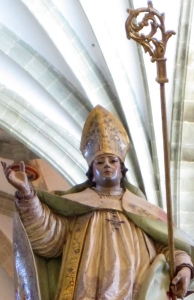
Saint Nicholas, Bishop

c. 270–c. 346; Patron Saint of children, sailors, merchants, archers, repentant thieves, brewers, pawnbrokers, unmarried people, Russia, and numerous countries and cities; Pre-Congregation canonization

Saint Nicholas of Myra, also known as Nicholas of Bari, Nicholas the Wonderworker, and Saint Nick, was a fourth-century bishop in Myra, Asia Minor, modern-day Demre, Turkey. His life is also the origin of the legend of Santa Claus. By the sixth century, his tomb had become widely venerated because of the numerous reported miracles worked through his intercession. In the eleventh century, his body was transferred to Bari, Italy, where it remains today. To this day, his bodily remains excrete a liquid, at first thought to be an oil but now believed to be water, which is collected, mixed with holy water, and distributed to the faithful in bottles every May 9, the day his remains arrived in Bari. The liquid is commonly referred to as the “Manna of Saint Nicholas” and is believed to contain miraculous healing power. For this reason, along with the mythical character of Santa Claus, he remains a highly venerated saint within the Church. 

Very little is known about Saint Nicholas that is historically verifiable. What we do know is that he was the Bishop of Myra, most likely suffered imprisonment during the persecution of Roman Emperor Diocletian, and was one of the bishops who attended the Council of Nicaea in 325. In addition to these historical details, many later legends have developed about his life. 

Nicholas was born into an affluent and devout Christian family. When Nicholas was young, his parents died from an epidemic, leaving him an orphan and heir to his family wealth. Conscious of the exhortation Jesus gave to the rich young man to “sell what you have and give to the poor,” Nicholas did exactly that. He sold his inheritance and distributed it to those in need. Some accounts of his life state that his uncle instead was the Bishop of Myra and that he ordained Nicholas a priest.

One popular legend is that among the recipients of his wealth were three girls whose father could not afford dowries for them to be married. Their future options were grim and included the possibility of their resorting to prostitution to survive. When Nicholas found out about this dire situation, he threw a bag of gold through the window of their home that the father used as a dowry for his first daughter. Nicholas then did this a second time. After the second daughter was married, the father stayed up all night waiting for a third bag of money. When Nicholas threw the third bag through the window, the father ran out and thanked him. Nicholas asked him not to tell anyone. One version of the story states that each night, the bag of gold landed in stockings hung by the fire to dry, leading to the Christmas tradition of placing stockings out for Saint Nick, who secretly fills them.

In another popular story, Nicholas was traveling to the Holy Land by ship. A storm suddenly arose, and the crew were fearful for their lives. Nicholas prayed, and the storm ceased. For this reason, Saint Nicholas is patron saint of sailors and those taking sea voyages.

How Nicholas became a bishop is a mystery. One version of the story is that shortly after Father Nicholas’ return from the Holy Land, the bishop of Myra died. The clergy of Myra then gathered to pick a successor. During their meeting, God inspired them to pick the first person to enter their church the following morning. Because Father Nicholas had spent the entire night in prayer, he was the first person in the church and was chosen bishop.

During his time as Bishop of Myra, a great persecution broke out in the Roman Empire under Emperor Diocletian. In 303, Diocletian, Maximian, Galerius, and Constantius—who made up a tetrarchy that governed the whole Roman Empire—issued a series of edicts outlawing Christianity and imposing the penalties of torture and death on those who practiced the faith. This was the last and the most violent persecution of Christians in the Roman Empire. At some point, between the years of 303 and 306, Bishop Nicholas was among those arrested and tortured. In 305, Diocletian renounced the throne, and in 306, Caesar Constantius died. Constantius’ son, Constantine, then became Caesar in his place and ordered Bishop Nicholas’ release. In 312, Constantine is said to have seen a vision of the Cross with the words, “In this sign, you will conquer.” In 313, he and his co-emperor ​​Licinius issued the Edict of Milan, granting religious tolerance to Christians.

An early list of the bishops who attended the Council of Nicaea in 325 includes Bishop Nicholas. That council was called to address the heresy of Arianism that denied the full divinity of Christ, asserting that the Son was a created being and not co-eternal with the Father. Some legends relate that Bishop Nicholas was so appalled by the Arians at the council that he slapped one of them across the face, was imprisoned for that act, but was released by Jesus and the Blessed Virgin Mary. Other accounts state that the heretic he slapped was Arius himself. The slap is a common motif in sacred art, including Orthodox iconography.

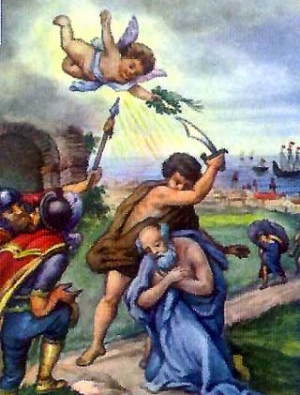
Other legends abound about Saint Nicholas. He is said to have won the release of various individuals unjustly condemned to death, going so far as to stay the sword of the executioner. During a famine, an evil butcher killed three children and pickled their remains to sell them as ham. Bishop Nicholas intervened and raised the pickled children from the dead. While shocking to the modern hearer, the story was widely told in the Middle Ages. An image of that miracle is found in sacred art and is one of the reasons many came to consider Saint Nicholas as the patron saint of children. Still another story relates that during another famine, a ship full of wheat for the emperor arrived in Myra. Bishop Nicholas convinced the sailors to give him enough to feed the people for two years, promising them that the emperor would still receive all his wheat. When the trusting sailors delivered the rest of the wheat to the emperor, it weighed the same as when it was loaded, despite much of it having been given to the people of Myra.

Bishop Nicholas died on or around December 6, 346 (the year of death varies by source), and was canonized by popular acclaim. His feast day became a day when the faithful performed charitable works, especially toward children, a custom that continues today. In 1054, the Catholic Church split between the East and West, resulting in the Catholic and Orthodox Churches. This left the remains of Saint Nicholas in the hands of the Orthodox. In 1071, the Seljuk Turks captured Orthodox-controlled Myra. In 1087, fearful that the Turks would mistreat the relics of their revered saint, Catholic Italian sailors from Bari took part of Saint Nicholas’s remains from his Myra tomb and brought them to Bari, Italy, where the pope later had a church built in the saint’s honor.

Though most of what we know about Saint Nicholas’ life is legendary rather than historically certain, those legends have added much to the faith of the people of God throughout the centuries. These tales have inspired faith and hope and have led to numerous reported miracles.

As we honor this saintly bishop from 1,700 years ago, ponder the faith of the people of God throughout those centuries who have benefitted from the sacred art, pilgrimages to his tomb, and the miraculous Manna of Saint Nicholas. Allow the longtime devotion to him to inspire you, entrusting yourself more fully to his intercession, as well as the intercession of all the saints of Heaven.

Source: https://mycatholic.life/saints/saints-of-the-liturgical-year/december-6—saint-nicholas-bishop–optional-memorial/

Saint Nicholas, Bishop Read More »

Saint John Almond

Profile

John grew up in Ireland. He was educated at Much Woolton, in Rheims, France, and at the English College, Rome, Italy at age 20. He was ordained in 1598. He returned to England as a home missioner in 1602. He was arrested in 1608 and 1612 for the crime of being a priest. The effectiveness of his debating skills against the anti–Catholic powers of the time led to his being one of the Forty Martyrs of England and Wales.

Born

  • c.1577 at Allerton, Lancashire, England

Died

  • hanged, drawn, and quartered on 5 December 1612 at Tyburn, London, England

Venerated

  • 8 December 1929 by Pope Pius XI (decree of martyrdom)

Beatified

  • 15 December 1929 by Pope Pius XI

Canonized

  • 25 October 1970 by Pope Paul VI

Source: https://catholicsaints.info/saint-john-almond/

Saint John Almond Read More »

Saint John Damascene, Priest, Religious and Doctor

c. 676–749; Patron Saint of pharmacists, icon painters, and theology students; Pre-Congregation canonization; Declared a Doctor of the Church by Pope Leo XIII in 1890

In the early seventh century, Damascus, Syria, was a thriving city within the Eastern (Byzantine) Roman Empire. Being one of the oldest continuously inhabited cities in the world, the city enjoyed a rich cultural heritage and diversity. Being part of the Roman Empire, it was primarily Christian, with some Jews, small pockets of paganism, and heretical Christian sects. After the death of Muhammad in 632, Islamic conquerors expanded into the Roman Empire, capturing and occupying Damascus in 635. In 661, Damascus became the capital for the Umayyad Caliphate, leading to further Islamic influence in the region. Though Christians’ rights were restricted, they were permitted religious freedom under certain conditions and limitations, such as paying a special tax and wearing distinct clothing. They also occupied a lower legal status than Muslims. Some Christians, however, were given important roles in the government, especially financial administration, due to their Greek and Roman education and administrative skills that many Muslim leaders admired. It was into this historical situation that Saint John of Damascus (John Damascene) was born.

John was born to Christian parents who did not allow their Muslim rulers to affect their faith. In fact, John’s father was one of the Christians held in high esteem by the local rulers and was entrusted with important administrative responsibility by the Caliphate. During his early years, John is believed to have received an excellent education. He might have been educated in the faith by local clergy, also learning Greek and Roman philosophy. At some point, his father came across a slave named Cosmas for sale in the public market. Some records indicate that Cosmas was a highly educated monk from Sicily, who was captured on a raid. His father secured the monk’s release, perhaps by purchasing him at a high price, and entrusted his son’s education to Cosmas. Another youth, possibly an orphan whom John’s father cared for, studied alongside John. Cosmas was not only well-versed in theology, but also in philosophy, music, astronomy, and a variety of other subjects. John greatly advanced in learning under Cosmas. Given the Muslim control of Damascus, John also became well versed in Islamic law, culture, and theology.

When John’s father died, the Caliphate recognized John as a man of great learning and virtue. Like his father, John was given an important role in the city’s administration. John, however, became increasingly sensitive to the non-Christian environment and feared its influence. In his mid- to late-twenties, he resigned his position, sold his possessions, and retreated to the desert monastery of Mar Saba, near Jerusalem, taking Cosmas with him.

As a monk, John spent his first two decades growing in spiritual perfection. Under the guidance of his spiritual director, he embraced monastic disciplines, such as renouncing his own will, avoiding worldly attachments, dedicating all actions to God, rooting out pride, rejecting the seeking out of extraordinary spiritual experiences, eliminating worldly thoughts, and maintaining silence. He fulfilled every humble task his superiors assigned him. He studied, prayed, did penance, and continuously entrusted himself to His merciful God. He advanced so greatly in the spiritual life, humility, and learning, that his superiors deemed him worthy of priestly ordination, which was uncommon among the monks. They also believed that, as a priest, he could offer great service to the Church through ministry and writing. Thus, John was ordained and instructed by his superiors to address important theological issues within the Caliphate and Byzantine Empire.

According to various early sources, the first issue arose from Yazid ibn Abd al-Malik, the Islamic Umayyad Caliph, who opposed the use of icons and sacred images in Christian churches. One story relates that a Jewish magician from Tiberias promised Yazid a long life of fortune if he banned Christian icons within his caliphate. The Jews followed the Torah, which banned using images of God. Yazid took his advice and, in 721, issued an edict by which Christian icons were destroyed in churches across the caliphate. Shortly afterward, between the years 726–729, Byzantine Emperor Leo III, a very religious man, also became convinced that the veneration of sacred images was idolatry. Therefore, he issued his own series of edicts by which he outlawed icons and sacred images throughout the Byzantine Empire. The Patriarch of Constantinople opposed Leo, so Leo appointed a new patriarch on his own authority. The pope also opposed Leo, so grave tensions arose between East and West.

Under obedience, Father John wrote his first great work, Apologetic Treatises against those Decrying the Holy Images, in which he articulated in three treatises the rationale for the use of icons in a profoundly theological way but also in a way that the common layman could understand. In these treatises, Father John was the first to distinguish between latreia (worship), which is due only to God, and proskynesis (veneration), which can be directed towards sacred images representing divine figures. Because the Old Testament forbade the worship of idols or any images of God, Father John’s explanation had the effect of reconciling the Christian use of sacred images with the Old Testament prohibition. He argued that veneration of images was proper because of the Incarnation of the Son of God. In Old Testament times, the Incarnation had not yet taken place. Therefore, it was forbidden to use any material means to represent the unseen and immaterial God. In Christ, however, the invisible God became visible and material, sanctifying the physical world, thus endowing the physical world with the ability to reflect the majesty of God. Father John extended this logic to the veneration of images of the saints who now share in the glory of God’s divine life (See quote above).

Tradition holds that the Byzantine Emperor was so outraged at Father John’s condemnation of his decrees that he forged a letter in Father John’s name that implicated him in a planned attack against Damascus. When the Caliph received the letter, he ordered that Father John’s hand be cut off and mounted on a pole. Once the deed was done, Father John beseeched the Mother of God to intervene so he could continue writing. The next day, his hand was miraculously restored.

Five years after his death, John’s treatise was condemned by the Council of Hieria in 754, which was called by the Byzantine Emperor. In 787, however, John was fully exonerated at the Second Council of Nicaea, which ruled in favor of icon veneration and declared that the Council of Hieria was illegitimate, given the absence of the five patriarchs.

In addition to his writings against the iconoclasts, Saint John Damascene is known for his summary of the doctrinal teachings of the Early Church Fathers, called De Fide Orthodoxa (An Exact Exposition of the Orthodox Faith). Along with that work, he also wrote against heresies and on logic and philosophy. Further works include hymns, letters, commentaries, and sermons. Among his sermons is a series on the Blessed Virgin Mary. He was also critical of Islam, pointing out many of its flaws.

Saint John Damascene left behind a clear exposition of the faith of the Church that became a standard for study in the centuries to follow. None of that would have been possible, however, had he not first entered the monastery and perfected his spiritual life as a hermit. As we honor this great saint, reflect upon the foundation that you need to establish within your own spiritual life. Without that solid foundation of deep union with God, God will be limited in the ways He can use you. With that foundation established, great things can be done in and through you for the salvation of souls and the glory of God.

Source: https://mycatholic.life/saints/saints-of-the-liturgical-year/december-4—saint-john-damascene-priest-and-doctor–optional-memorial/

Saint John Damascene, Priest, Religious and Doctor Read More »

Saint Francis Xavier, Priest

1506–1552; Patron Saint of foreign missions, missionaries, navigators, and parish missions; Invoked against plague epidemics; Canonized by Pope Gregory XV on March 12, 1622

Francisco de Jasso y Azpilicueta (Francis) was born into a noble family at the Castle of Xavier in the Kingdom of Navarre, the youngest of several children. His father was seneschal (administrator) to the royal court of the King of Navarre, giving him important administrative, financial, and judicial authority. In 1512, when Francis was six, the King of Aragon and regent of Castile attacked the Kingdom of Navarre, with devastating consequences for Francis’ family’s wealth and power. Three years later, Francis’ father died. At the age of nineteen, Francis moved to Paris to study philosophy and the arts. As was common at that time, he went by the name Francis Xavier, identifying himself with his place of origin, the Castle of Xavier.

Francis entered the University of Paris with secular ambitions. After being at the university for four years, Francis and his roommate, Peter Favre, welcomed a new student who was fifteen years older: Ignatius of Loyola. Ignatius had moved to Paris to study theology in preparation for priestly ordination after experiencing a radical conversion. After his conversion, Ignatius began to write down his experiences in what would become one of the greatest programs of conversion ever written: The Spiritual Exercises of Saint Ignatius of Loyola. After becoming roommates with Peter and Francis, Ignatius worked on the two men, attempting to convert them and encouraging them to join him in a new religious society he desired to form. Peter was receptive, but Francis was not. Through Ignatius’ persistence, Francis’ heart underwent conversion, and he sensed a call to embrace the priestly ministry.

After four years of study, Francis earned a master’s degree in 1530 and began teaching at the university. Four years later, Ignatius and six companions, including Francis, embraced a common mission to consecrate themselves to God and to live as companions. On the hill of Montmartre, overlooking the city of Paris, these seven men made private vows of poverty, chastity, and obedience to the Roman pontiff, with a commitment to convert the infidels in the Holy Land. Following these private vows, Francis spent the next three years studying theology before his ordination as a priest in 1537, at the age of thirty-one. Together with his companions, Ignatius drew up a formal rule of life for their new company in 1539, which was approved by Pope Paul III the following year, formally establishing the Society of Jesus, later referred to as the Jesuits, which means “Companions of Jesus.”

Central to Jesuit spirituality are Saint Ignatius’ Spiritual Exercises, based on his own conversion. Francis Xavier was among the first to use the exercises to deepen his prayer life and communion with God. The exercises, along with the spiritual support and encouragement from his brothers—especially Ignatius—transformed him into one of the greatest missionaries in the history of the Church.

During his first three years as a priest, Father Francis Xavier cared for the poor and sick and deepened his prayer life, first in Venice and then in Rome. Decades earlier, Portuguese explorers had captured and colonized Goa, a city on India’s western coast. In 1540, the King of Portugal, upon hearing reports of immoral behavior among the Portuguese colonizers of Goa, petitioned the pope to send missionaries to Goa to assist. Seeing that the Society of Jesus was newly formed and young, the pope identified the Jesuits as the ideal group to send. Upon receiving the request, Father Ignatius of Loyola chose two of his first companions for the mission. When one became ill, Ignatius chose Father Francis instead, sending him to Portugal to have an audience with the king and queen. In 1541, at the age of thirty-five, after being named apostolic nuncio to the East by the pope, Father Francis and two Jesuits companions set sail to Mozambique and then to Goa, arriving on May 6, 1542.

For the next ten years, Father Francis’ missionary activity of traveling, preaching, converting, catechizing, building churches, baptizing, and miracle working were so extensive that he has since been referred to as another Saint Paul and the “Apostle to the East.” In 1904, Pope Pius X named him the patron saint of foreign missions. In addition to his ordinary missionary work of preaching, teaching, and administration of the Sacraments, stories abound about Father Francis healing the sick, calming a storm at sea, raising the dead, and preaching in tongues, a charism which enabled him to preach in his language while others heard him in their language.

Upon arriving at his first mission in Goa, Father Francis and his companions ministered to the Portuguese settlers. Though a bishop and diocesan priests were present, there was a need for preachers who would call the people to repentance. He began by tending the sick, which won the esteem of the people. He also called the children to himself by walking through town ringing a bell, inviting them to follow him to the church where he taught them about Jesus. The children, in turn, shared the faith with their family and friends. After several months, Father Francis became aware of numerous indigenous people along the southern coast and on the southern tip of India who had been baptized years earlier but were never catechized and formed in the faith. In a desire to minister to these natives, Father Francis and local priests from the seminary in Goa traveled south, teaching, offering the sacraments, and building dozens of churches with the help of the natives. Many unbaptized were converted, and thousands were baptized on that two-year mission. Though many welcomed him, others fiercely opposed him. At times, attempts were made on his life, but he persevered.

Over his decade of missionary activity, Father Francis set up missions in Malacca, in modern-day Malaysia; the Spice Islands, in modern-day Indonesia; Cochin and the coastal areas of modern-day Kerala, India; and the island of Sri Lanka. In 1548, Father Francis wrote a letter to his Jesuit brothers in Europe saying, “All the Portuguese merchants coming from Japan tell me that if I go there I shall do great service for God our Lord, more than with the pagans of India, for they are a very reasonable people.” Father Francis took their advice and set sail for Japan, arriving on August 15, 1549, at Kagoshima, making him the first foreign missionary to reach that land. He was accompanied by a Japanese convert named Anjiro (whose Christian name was Paul), a fellow Jesuit priest, and a lay brother. After spending many months learning the Japanese language and translating the Gospel into Japanese, he was able to make a considerable number of converts. Father Francis’ initial success in Japan was due to the fact that he learned and respected the local customs and culture, allowing him to more effectively share the Gospel in a way that the Japanese would embrace. Because of his foundational effort, the Catholic faith grew to number over 300,000 Japanese converts within the next sixty-five years. Saint Francis Xavier later wrote about the Japanese people: “These are the best people so far discovered, and it seems to me that among unbelievers no people can be found to excel them.” By the end of the century, however, Japanese Christians had undergone decades of severe persecution and hundreds of thousands of martyrdoms, so the Church went underground. The faith, however, was passed on from generation to generation, emerging once again in the public eye in the mid-nineteenth century.

In 1552, Father Francis received an invitation to travel to China to bring the Gospel to that land for the first time. During the journey, he fell ill and died on the island of Shangchuan, just off the coast of mainland China, at the age of forty-six.

Within ten years of intense missionary work, it is estimated that Saint Francis Xavier traveled about 38,000 miles on land and sea, being the first to bring the Gospel to many parts of Asia, baptizing about 30,000 souls. Though he wrote extensively to those he left behind in Europe, he never returned; once he left his family at the age of nineteen, he never saw them again. His life was a true sacrifice. His body was eventually brought back to Goa where it is buried and venerated today. In honor of his numerous baptisms, his arm was removed from his body in 1614 and is venerated at the Gesù, the Jesuit church in Rome.

Saint Francis Xavier was truly another Saint Paul to the Asian peoples. His constant traveling and founding of mission churches planted the seeds of faith deep in the soil he traversed. Though persecution stifled Catholicism’s later growth in Japan, that stifling ultimately deepened the resolve and faith of those persecuted. As we honor this great apostle of Christ, ponder all that he accomplished in ten short years. As you do, consider the next ten years of your own life, and rededicate yourself to the mission Christ has for you.

Source: https://mycatholic.life/saints/saints-of-the-liturgical-year/december-3—saint-francis-xavier-priest–memorial/

Saint Francis Xavier, Priest Read More »

Saint Chromatius of Aquileia

Profile

Chromatius’ father died when he was an infant, and he was raised by his mother and large family of older siblings. He was ordained in c. 387. He attended the Synod of Aquileia, and worked for the strong denunciation of Arianism that resulted from the synod. He became the Bishop of Aquileia in 388.

Chromatius worked for peace with invading troops led by Alaric, and provided aid to those who suffered by being in his path. He was an active correspondent with Saint Ambrose of Milan. He was a friend of Saint Jerome, who dedicated several works to him. He was influential in the translation of early Christian works into Latin for wider use. He financed Saint Jerome‘s translation of the Bible, and Rufinus’ translation of Eusebius’ Ecclesiastical History. He wrote several respected scripture commentaries, seventeen of which survive. He was a friend of Saint John Chrysostom, supporting him and writing on his behalf against the unjust accusations of Emperor Arcadius.

Born

  • 4th century at Aquileia, Italy

Died

  • 2 December 407 in Italy of natural causes

Canonized

  • Pre-Congregation

Source: https://catholicsaints.info/saint-chromatius-of-aquileia/

Saint Chromatius of Aquileia Read More »

Saint Alexander Briant

Profile

Born to a yoeman family, Alexander was described as a handsome young man, and raised as a Protestant. He studied in Oxford, converted to Catholicism, and studied at the English College at Rheims, France. He was ordained on 29 March 1578.

Alexander returned to Somersetshire, England as a missioner in August 1579. He was arrested on 28 April 1581 in London at the home of Father Robert Persons. He was tortured in the Tower of London, partially for information on Father Robert’s location. During this misery, he wrote to the Jesuits, asking for admission; they accepted him sometime in his last weeks in prison.

Alexander was condemned to death with six other priests on 16 November 1581 at Westminster for the treason of priesthood. He was martyred with Saint Ralph Sherwin and Saint Edmund Campion in the persecutions of Queen Elizabeth I. He was one of the Forty Martyrs of England and Wales.

In prison, Alexander made himself a small wooden cross, and gripped it tightly all the times, even during trial. In the courtroom it was wrestled away from him. He told the judge, “You can take it out of my hands, but not out of my heart.” The cross was later bought by Catholics, and is at the English College at Rome.

Born

  • 1556 at Somersetshire, England

Died

  • hanged, drawn, and quartered on 1 December 1581 at Tyburn, England

Beatified

  • 29 December 1886 by Pope Leo XIII (cultus confirmed)

Canonized

  • 25 October 1970 by Pope Paul VI

Source: https://catholicsaints.info/saint-alexander-briant/

Saint Alexander Briant Read More »

Saint Andrew the Apostle

c. 5–10–c. 60–80; Patron Saint of boatmen, butchers, farm workers, fish dealers, fishermen, happy marriages, maidens, miners, paralytics, pregnant women, ropemakers, sailmakers, sailors, singers, spinsters, textile workers, water carriers, and women who wish to become mothers Invoked against cramps, convulsions, dysentery, fever, gout, neck pain, paralysis, sore throats, and whooping cough; Pre-Congregation canonization

 Saint Andrew, one of the Twelve Apostles, was most likely born in Bethsaida, just north of the Sea of Galilee, in what is today the Golan Heights. As a young man, he and his brother, Peter, worked as fishermen on the Sea of Galilee. John’s Gospel reveals that Andrew was a disciple of Saint John the Baptist prior to his encounter with Jesus. This shows that Andrew was searching and took his faith seriously. As is recorded in John 1:35–42, Andrew and another disciple were listening to John preach in the desert. As they listened to him, the Baptist saw Jesus in the distance and prophetically exclaimed, “Behold, the Lamb of God.” After Andrew and the other disciple inquired of Jesus where He was staying, Jesus invited them to follow Him by saying, “Come, and you will see.” They then spent the rest of the day with Jesus. Andrew is, therefore, the first of the Apostles to be called and to respond to that call. For that reason, the Greek Church calls Andrew the “Protokletos,” meaning, “the first called.”

Shortly after this encounter, Andrew becomes an apostle to his brother, Simon Peter. He tells Simon, “We have found the Messiah.” This statement says much about Andrew’s interior spiritual sensibilities. First, he clearly understood that John the Baptist’s ministry was special. Andrew followed John the Baptist, discerning that he was a prophet. When John points Andrew to Jesus, Andrew immediately follows Him, engages Him, and believes in Him. It’s clearly an act of supernatural revelation that enabled Andrew to profess his faith in Jesus as the Messiah within a day of meeting Him. And the fact that he wanted his brother to share in this discovery shows that this grace was overflowing.

The Gospels of Matthew and Mark present Jesus’ first encounter with Andrew and Peter a bit differently, although those passages are not contradictory. “As he passed by the Sea of Galilee, he saw Simon and his brother Andrew casting their nets into the sea; they were fishermen. Jesus said to them, ‘Come after me, and I will make you fishers of men.’ Then they abandoned their nets and followed him” (Mark 1:16–18). It’s possible that after Andrew’s and Peter’s first encounters with Jesus, they allowed their discovery of the Messiah to sprout within their hearts, continued their work as fishermen, and awaited Jesus’ definitive call. In this passage, Jesus gives that definitive call, and the brothers do not hesitate to abandon their trade to become His full-time disciples.

Peter and Andrew appear to have been living in Capernaum at that time, a small fishing village on the north end of the Sea of Galilee. “On leaving the synagogue he entered the house of Simon and Andrew with James and John” (Mark 1:29). Upon entering the house of Simon and Andrew, Jesus cured Simon’s mother-in-law of a fever. That house in Capernaum then became a base of operation for Jesus’ ministry throughout Galilee.

In Mark 13:3–4, Andrew is among the Apostles who privately asked what Jesus meant when He predicted the destruction of the Temple. Jesus answered by giving a discourse about coming persecutions and the end of time. John Chapter 6 begins with Jesus going up a mountain north of the Sea of Galilee with a large crowd following. He asks Philip where they can get enough food for everyone. Philip responds, “Two hundred days’ wages worth of food would not be enough for each of them to have a little [bit]” (John 6:7). Andrew, however, responds with a spark of faith, stating, “There is a boy here who has five barley loaves and two fish; but what good are these for so many?” (John 6:9). It appears that this little faith, which flows with a small amount of hope that the five barley loaves and two fish might be of use, is enough for Jesus to perform the miracle of the Multiplication of the Loaves and Fishes.

In John 12:20–22, Andrew and Philip mediate a request from the Greeks to Jesus. The Greeks wanted to see Jesus, so Philip and Andrew—who probably knew Greek—were the ones to present this request to the Lord. This is a prefiguration of their role in mediating the Word of God to the world, including the Gentiles. Andrew’s familiarity with the Greek language and culture is also evidenced by the fact that his name is of Greek origin, not Hebrew.

Other than these passages, Andrew is only mentioned a few other times in the New Testament, including in the listing of the Apostles (Matthew 10:2Mark 3:18Luke 6:14). The Acts of the Apostles relates that Andrew was among those who, after Jesus’ Ascension, went into Jerusalem, entered an upper room in a home, and “devoted themselves with one accord to prayer, together with some women, and Mary the mother of Jesus, and his brothers” (Acts 1:14). Andrew was then involved with picking Matthias as Judas’ replacement and was present in that same upper room during Pentecost. Peter’s activity after Pentecost is well documented in Acts, and it can be presumed that his brother Andrew was also active.

Though Andrew’s missionary work after Pentecost is not recorded in the New Testament, later traditions emerged from the late second or early third century. According to those traditions, Andrew traveled to Scythia, a region that today makes up part of Ukraine, southern Russia, and parts of Kazakhstan. He is also believed to have founded the Church in Byzantium, which became known as Constantinople when Emperor Constantine made it the capital of the Roman Empire. Today it is the city of Istanbul, Turkey. Byzantium-Constantinople became the central Church for the East, the Greeks. Many have seen it as significant that Peter founded the Church of Rome in the West, and his brother founded the Church in the East, revealing the unity of East and West. In addition to other legends that Andrew preached in Asia Minor and the Black Sea region, his life is said to have ended in the city of Patras, Greece, where he was crucified on an X-shaped cross. Peter is believed to have requested to be crucified upside-down because he did not deem himself worthy of dying on a cross like Jesus. Andrew is said to have requested the X-shaped cross for the same reason.

According to that tradition, which comes to us in a second-century document called Acts of Andrew, Proconsul Ægeates was visiting the city of Patras, where Andrew was preaching. Ægeates sought to put an end to the new Christian religion and to convince Christians to honor the Roman gods and offer sacrifice to them. When Andrew heard of this, he ran to meet Ægeates, telling him that the Son of God “came on account of the salvation of men.” Of the Roman gods he said, “…these idols are not only not gods, but also most shameful demons, and hostile to the human race…” Ægeates was outraged but carried out a long dialogue in which he inquired about Jesus’ death on the Cross, suggesting that Jesus’ death was foolish and was because of Jesus’ false doctrine. Andrew, however, proclaimed to him the true mystery of the Cross in which Christ embraced it freely so that He could win the salvation of those who would believe in Him. By the end of their conversation, Ægeates ordered Andrew’s crucifixion. Saint Andrew did not see Christ’s Cross as an instrument of torture and death but as a glorious means of eternal salvation. He saw his own suffering and death as a sharing not only in Christ’s sufferings but also in Christ’s redemption. Thus, he ran to that cross and embraced it wholeheartedly.

As we honor this Apostle of Christ, ponder not only the legends about his final days but especially his initial conversion. Like Saint Andrew, we must always be searching, as he was searching when he followed John the Baptist. Like Saint Andrew, we must also recognize Christ as the Messiah every time He comes to us by grace. Our response to Him must be immediate and wholehearted, ready to go wherever He leads.

Source: https://mycatholic.life/saints/saints-of-the-liturgical-year/november-30–st-andrew-apostle/

Saint Andrew the Apostle Read More »

Saint Columban (Columbanus), Abbot

543–615; Patron Saint of motorcyclists; Invoked against floods; Pre-Congregation canonization

Columban (commonly called Columbanus in Latin) was born in the Kingdom of Leinster, on the southeast coast of Ireland, a century after Saint Patrick brought the Catholic faith to the island. Writing shortly after Columban’s death, his first biographer and fellow monk, Jonas, states that when Columban’s mother was pregnant with him, she had a dream of the sun rising from her womb. She later interpreted her dream to mean that her child would be a man of incredible genius, shining the light of faith upon the people of God whom he would serve. Because of this dream, Columban’s mother took great care in raising her son, protecting him from every evil influence. He was tutored at home, studying the liberal arts and excelling in his pursuit of knowledge.

As Columban grew, he became acutely aware of worldly temptations, especially those of the flesh, and guarded himself carefully from all sin through his prayer and Scripture study. After being counseled in this area by an old and wise woman, Columban decided to heed her warnings and enter a monastery. His mother was deeply distressed by his decision and tried to stop him, even lying across the threshold of their home. Columban courageously stepped over her, exhorted her to trust in God, and informed her that though she would never see him again in this life, he would obey the will of God and go wherever God led him.

He first traveled north to Cleenish Island (Cluain Inis, in modern-day Northern Ireland) where he studied Scripture under the saintly Abbot Sinell. Around the age of twenty, Columban traveled about 100 miles east to the coast of Ireland and entered the monastery in Bangor, becoming a monk under Abbot Comgall, another saintly man. In Bangor, Columban embraced a life of study, deep prayer, and severe asceticism, in accord with the ideals of Irish monasticism at that time. He was ordained a priest and spent thirty years at the monastery, preparing himself for what would become his second vocation.

At the age of fifty, Father Columban sensed God calling him to leave his homeland and become a pilgrim and missionary for Christ, a peregrinatio pro Christo. After the fall of the Roman Empire in the late fifth century and the subsequent invasion of those lands by pagan barbarian tribes from the north and east, the Church in what would become modern-day Europe was struggling. Monasteries and the clergy were in need of reform, political instability was common as new rulers vied for power, theological disputes from heretics lingered, and pagan practices were reintroduced as invaders moved in. Since the Church in Ireland had been isolated from the rest of the Roman Church, it instead enjoyed relative stability. Father Columban desired to extend that stability to the people of Europe.

After Abbot Comgall reluctantly agreed to Father Columban’s request, Father Columban and twelve other monks set sail for Gaul, modern-day France. They first crossed the Irish Sea to England, and from Cromwell crossed the English Channel, landing in Saint-Malo, France. The king of that region was Good King Gontrand, as Saint Gregory of Tours called him. King Gontrand had lived a sinful life of fleshly indulgence as a young man, but remorse led him to a radical conversion. Afterward, he was known as a holy man who cared for all of his subjects as a father. His penitential life drew him into deep union with God, and miracles were attributed to him during and after his life. After death, by popular acclaim, he was declared a saint.

The arrival of Father Columban and his companions delighted King Gontrand, as he found in them a depth of fervor that was lacking within his kingdom. He gifted them an ancient Roman fortress in Annegray for their first monastery, near the border of modern-day northern Switzerland and southern Germany. Though the fortress was in ruins, the monks restored it and turned it into a school. The school grew so rapidly that the monks had to expand to a nearby property in Luxeuil. Soon after, they expanded to another location in Fontaine, about an hour’s walk to the north.

Given the fact that the Frankish Church in which he established his first monasteries was struggling, the people were immediately drawn to Father Columban and his fellow monks. In them, they discovered men who were faith-filled, ascetical, wise, and pastoral. Lives were changing, and this caught the attention of the local bishops. The envious bishops began to find fault with these Irish monks, criticizing them for introducing Irish traditions that were contrary to the Roman ones. The Irish monks celebrated Easter on a different day, following the Eastern tradition. They also used the Celtic tonsure, in which the front half of the monk’s hair was shaved, in opposition to the Roman tonsure, in which the head was shaved in a circle on top of the head, representing the crown of thorns. The bishops deposed Father Columban, demanding that he appear before them at a local council. Instead, Father Columban wrote them a letter, encouraging them to focus on more important issues facing the local church. Father Columban wrote to Pope Gregory the Great, asking him to intervene, but the Holy Father died about the time his letter was received. He attempted the same with Pope Boniface IV, but it is unclear if he received a response. Eventually, it appears the monks embraced the local culture.

During the remainder of his years in Luxeuil, Father Columban wrote a foundational monastic rule called the Regula Monachorum. This “Rule for the Monk” was an important document that articulated the daily life of monasticism, including the monk’s prayer, communal life, obedience, manual labor, and strict austerity and asceticism, which was far stricter than the Rule of Saint Benedict that eventually won out as the normative rule for monks in the West. Father Columban also wrote a supplement to the rule, a guide for Confession which emphasized the importance of imposing a penance that was proportional to the sin, and a collection of instructions that gave practical advice on morality, humility, charity, and love of God. He also left behind a number of sermons, letters, poetry and hymns.

Being a man of great faith and courage, Father Columban openly chastised King Theuderic II, a successor to Good King Gontrand, who was living in an adulterous relationship. This led to Father Columban’s exile, along with the remainder of the Irish monks, leaving only those from Gaul (France) who had joined them after their arrival. After being forced onto a boat that was to sail to Ireland, the boat was driven off course by a storm and returned to the French mainland. The captain saw it as a sign from Heaven and parted ways. Father Columban then spent the next few years traveling with his monks across France, Switzerland, and southern Germany, eventually settling in northern Italy where they built the famous Bobbio Abbey, where Father Columban died a few years later.

Saint Columban spent the first half of his life being formed in Irish monasticism. When the appointed time came, God sent him and his fellow monks to help restore the faith to the troubled parts of Europe. After his death, the few monasteries he founded expanded to over 200 new foundations. He is remembered for his zeal, his miracles, his authority over animals who listened to his commands, his rigorous monastic rule, and his pastoral guide on the celebration of the Sacrament of Confession and the imposition of appropriate penances. Though his courage and boldness led to persecution and discord, that discord resulted in changes within a broken Church.

As we honor this holy monk, ponder the fact that it is never too late to do great things for God. Saint Columban began his missionary journey at the age of fifty and continued to forge new paths for the Gospel until the time of his death in his early seventies. In imitation of him, renew your commitment to the proclamation of the Gospel and the apostolate to which God is calling you. Age, wisdom, and experience are all tools God can use, just as He did with Saint Columban.

Source: https://mycatholic.life/saints/saints-of-the-liturgical-year/november-23—saint-columban-religious–optional-memorial/

Saint Columban (Columbanus), Abbot Read More »

Blessed Miguel Agustín Pro, Priest and Martyr

1891–1927; Invoked by the Mexican Church and in times of political persecution; Beatified by Pope John Paul II on September 25, 1988

Catholicism arrived in Mexico with the Spanish conquistadors in the early 1500s and rapidly grew, especially following the apparition of Our Lady of Guadalupe in 1531. By 1810, anti-Catholic sentiments had set in after Mexico’s independence from Spain when the Church became intimately intertwined with civil governance. The new Mexican Constitution in 1857 was the initial attempt by the newly independent state to limit the Church’s influence. Anti-Catholicism and anti-clericalism reached their peak in the 1920s under President Plutarco Elías Calles, leading to the Cristero Wars that took the lives of an estimated 50,000–250,000 Mexicans and brought the martyrdom of at least 40 priests. Of those priests, Blessed Miguel Agustín Pro, whom the Church honors today, was beatified by Pope John Paul II in 1988. Additionally, Saint Christopher Magallanes and his twenty-four companions, whose memorial is on May 21, were canonized by Pope John Paul II in the jubilee year 2000. 

José Ramón Miguel Agustín Pro Juárez (Miguel Pro) was born in 1891, just before this painful period of anti-Catholicism in Mexico’s history. He was born in Guadalupe, Zacatecas, Mexico, the third of seven surviving children. When Miguel was still an infant, his family moved to Mexico City and would move around to various towns in the north over the next twenty years. Miguel’s parents were devout Catholics. His father was a respected and experienced mining engineer who often had a heavy workload and employed help from his children at times. As a youth, Miguel had a lively and attractive personality, along with a good sense of humor. He loved to tell stories and entertain others, and had a deep faith from an early age. He was especially close to his sister, María de la Concepción, with whom he made a pact that he would become a Jesuit priest and she a nun. They both fulfilled that pact. Later in life, letters exchanged between the two reveal their deep faith and respect for each other.

At the time of Miguel’s birth, the 1857 anti-Catholic Mexican Constitution had been in place for about twenty-five years. President Porfirio Díaz permitted the Church to operate independently and freely, while leaving the laws on the books. By the time Miguel turned twenty, political instability had risen, leading to Díaz’s resignation and exile in 1911. In that same year, Miguel entered the Jesuit novitiate in El Llano, Michoacán, Mexico. The next three years saw two short-term presidents, and in 1914, Venustiano Carranza seized power and took the title of “First Chief of the Constitutionalist Army.” The Jesuit novitiate in El Llano was closed as part of renewed anti-Catholic persecutions. Brother Miguel fled to the United States, then to Spain, and finally to Belgium. For the next ten years, Brother Miguel studied as he moved, preparing for priestly ordination that took place in Belgium in 1925. Though his formation was fraught with illness, exile, and concern for his homeland, he kept his eyes upon God’s will and embraced the gift of the priesthood with great joy. “I could not hold back the tears on the day of my ordination, above all at the moment when I pronounced, together with the bishop, the words of the consecration.”

During the period that Father Miguel was outside Mexico in formation, things went from bad to worse for the Mexican Church. In 1917, a new Mexican constitution imposed more stringent restrictions on the Church. The education of youth was restricted to secular schools. Religious ceremonies were prohibited from taking place outside of churches. Religious organizations were prohibited from owning any property other than churches, leading to widespread confiscation. Monastic vows were prohibited. Clergy could not inherit property and were stripped of citizenship, the right to vote, and the ability to participate in politics. Finally, only native-born clergy were allowed to minister; foreign clergy were forced to leave.

In 1925, Plutarco Elías Calles was elected president and soon after ushered in a more intense era of anti-Catholic and anti-clerical persecutions. He enforced the 1917 constitution and, in 1926, enacted the “Law for Reforming the Penal Code,” also known as the “Calles Law,” which required stricter enforcement of the Constitution. All forms of public worship were outlawed, the remaining Church property was confiscated, all forms of religious education (even private) were forbidden, and priests were expelled from the country. This led to a peasant revolt called the Cristero Wars, which lasted until 1929. “¡Viva Cristo Rey! ¡Viva la Virgen de Guadalupe!”—“Long live Christ the King! Long live the Virgin of Guadalupe!”—This was the cry of the Cristeros in the face of oppression.

As the 1926 persecution began in earnest, the newly ordained Father Miguel Pro could do nothing from Belgium, except pray. He devised a plan to return to Mexico and live publicly as a well-dressed businessman, mechanic, or even beggar, while at the same time carrying out a clandestine ministry. He had never lived in Mexico as a priest, so he believed he could escape the notice of the civil authorities. He arrived in Mexico on July 8, 1926, and made his way to Mexico City where he began his priestly service. His naturally joyful personality and sense of humor helped inspire many and lifted the heavy burden of the oppression they were experiencing. He conducted Masses in secret, heard confessions, administered the other sacraments in private homes, and moved around to avoid getting caught by the authorities. After a few months of his clandestine ministry, Father Miguel was arrested on suspicion that he wrote pamphlets and attached them to 600 balloons that were released over the city to share the Gospel with the people. After being interrogated, he was released because there was insufficient evidence to hold him. When another arrest warrant was issued for him shortly after, he remained in seclusion but resumed his secret ministry once his superiors gave their consent.

Less than a year later, in November 1927, an assassination attempt resulted in the wounding of the former president Álvaro Obregón. The authorities traced the car that was used to Father Miguel’s brother, who had nothing to do with the plot. Nonetheless, the authorities moved in and not only arrested Father Miguel’s two brothers but also Father Miguel. Another man confessed to the crime, stating that he acted on his own, without any involvement by the Pro brothers. After the brothers were questioned in Mexico City by the Detective Inspector, President Calles himself gave the order to execute Father Pro and his brothers, despite there never having been a trial. President Calles gave further orders that the execution was to be photographed and printed in the papers the following day as a way of deterring the Cristeros in their revolution.

On November 23, 1927, Father Miguel Pro walked from his cell to the courtyard where the firing squad awaited, with the photographer ready at hand. The pictures show a confident and courageous Father Miguel Pro, kneeling before his executioners, facing them without a blindfold, forgiving them, blessing them, holding a rosary in one hand, and a crucifix in the other. He cried out, “May God have mercy on you! May God bless you! Lord, You know that I am innocent! With all my heart I forgive my enemies!” He then rose, faced the firing squad, extended his arms as if on a cross, and prayed in a loud voice, “Viva Cristo Rey!” After the shots rang out, Father Pro was still alive, so one of the soldiers came forward and shot him point-blank.

When the pictures and story appeared the following day, the Mexican people were deeply inspired by their young martyr. Though publication in the papers was meant to be a deterrent to the Cristeros, the pictures and story had the opposite effect.  An estimated 40,000 people lined the streets for Father Pro’s funeral procession. Even though neither a Catholic funeral Mass nor the rites of burial were permitted, an estimated 20,000 Cristeros prayed at the cemetery as his body was buried.

Blessed Miguel Pro fell in love with his Lord during a time of extreme persecution. Rather than shying away from his faith, he prayed and fulfilled his priestly ministry with courage and love. His life culminated with a choice either to be bitter or to forgive and hope in his God. He chose the latter. May his life and witness inspire all who are persecuted for their faith, and may his prayers assist you on your own journey when times are rough.

Source: https://mycatholic.life/saints/saints-of-the-liturgical-year/november-23—blessed-miguel-agustn-pro-priest-and-martyr—optional-memorial/

Blessed Miguel Agustín Pro, Priest and Martyr Read More »