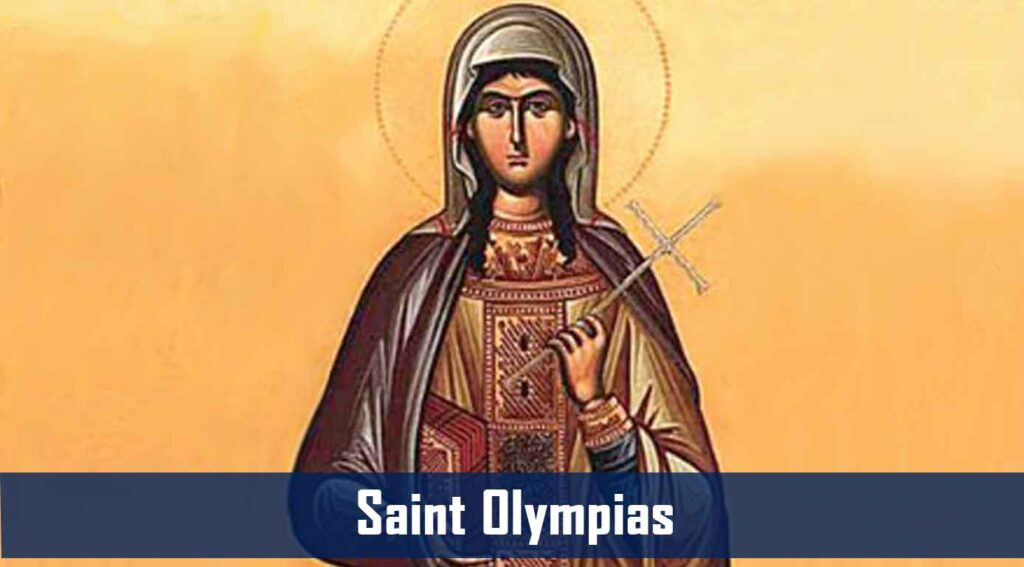
Saint Olympias is described as the ‘beloved daughter’ born to Seleucus and Alexandra. At eighteen years of age, Olympias married Nebridius, a nobleman who served as prefect of Constantinople. She was widowed after two years of marriage. Having refusing many offers of marriage, she dedicated her life to the church, serving as a deaconess. She would later become a friend of Saint John Chrysostom.
Her good works included building a hospital and an orphanage and looking after monks who had been led in exile from Nitria. This led John Chrysostom to tell her that she had done almost too much.[12] Her support for Chrysostom led to her exile in 404. Having lost her house, she lived the rest of her life in Nicomedia, dying on July 25, 408, after a long illness.
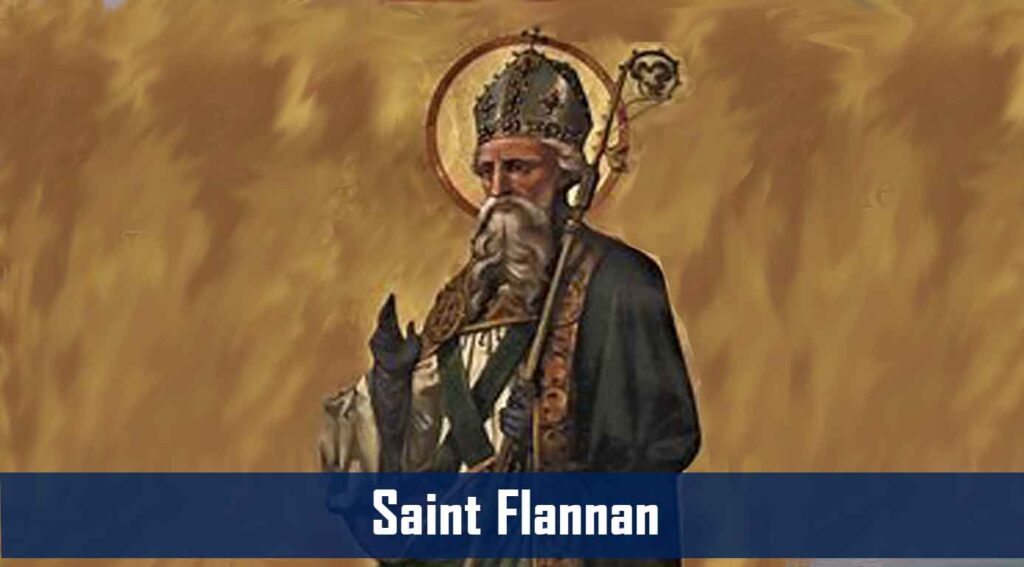
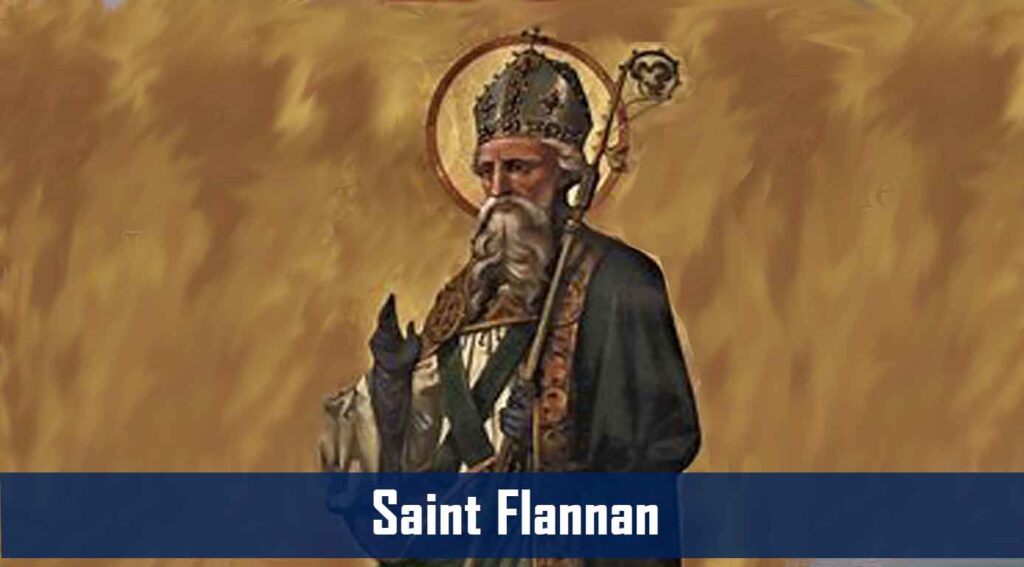
Saint Flannan was an Irish saint who lived in the 7th century and was the son of an Irish chieftain, Toirdhealbhach of Dál gCais. He entered Mo Lua’s monastery at Killaloe, where it is believed he became an Abbot. He is remembered as a great preacher.
He made a pilgrimage to Rome where Pope John IV consecrated him as the first Bishop of Killaloe, of which he is the Patron Saint. He also preached in the Hebrides. His feast day is 18 December.
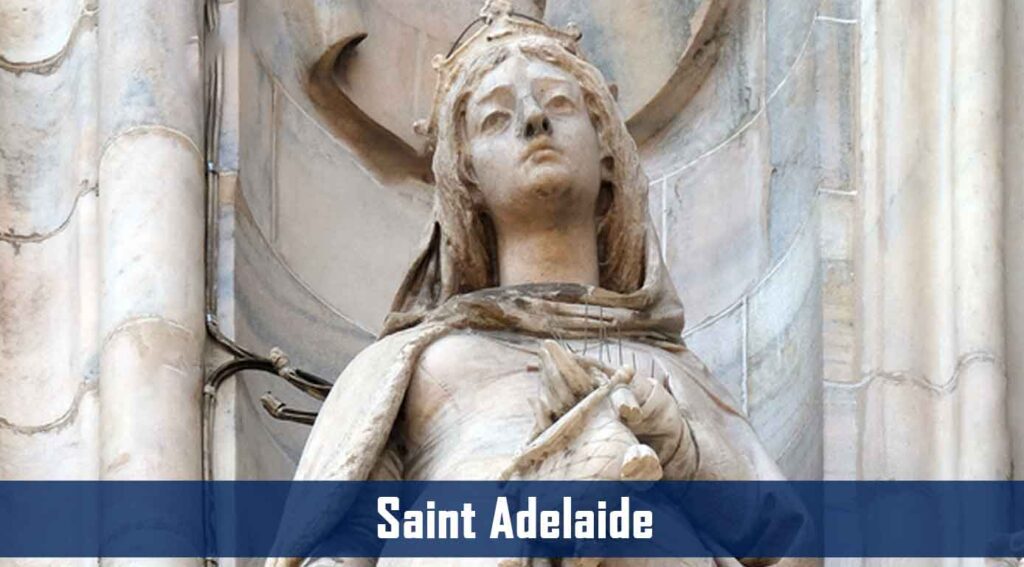
Adelaide of Italy, also called Adelaide of Burgundy, was Holy Roman Empress by marriage to Emperor Otto the Great. She was crowned with him by Pope John XII in Rome on 2 February 962. She was the first empress designated consors regni, denoting a “co-bearer of royalty” who shared power with her husband. She was essential as a model for future consorts regarding both status and political influence. She was regent of the Holy Roman Empire as the guardian of her grandson in 991–995.
She became involved from the beginning in the complicated fight to control not only Burgundy but also Lombardy. The battle between her father Rudolf II and Berengar I to control northern Italy ended with Berengar’s death, and Rudolf could claim the throne
Adelaide had constantly devoted herself to the service of the church and peace, and to the empire as guardian of both; she also interested herself in the conversion of the Slavs. She was thus a principal agent — almost an embodiment — of the work of the pre-schism Church at the end of the Early Middle Ages in the construction of the religious culture of Central Europe. Some of her relics are preserved in a shrine in Hanover. Her feast day, 16 December, is still kept in many German dioceses.
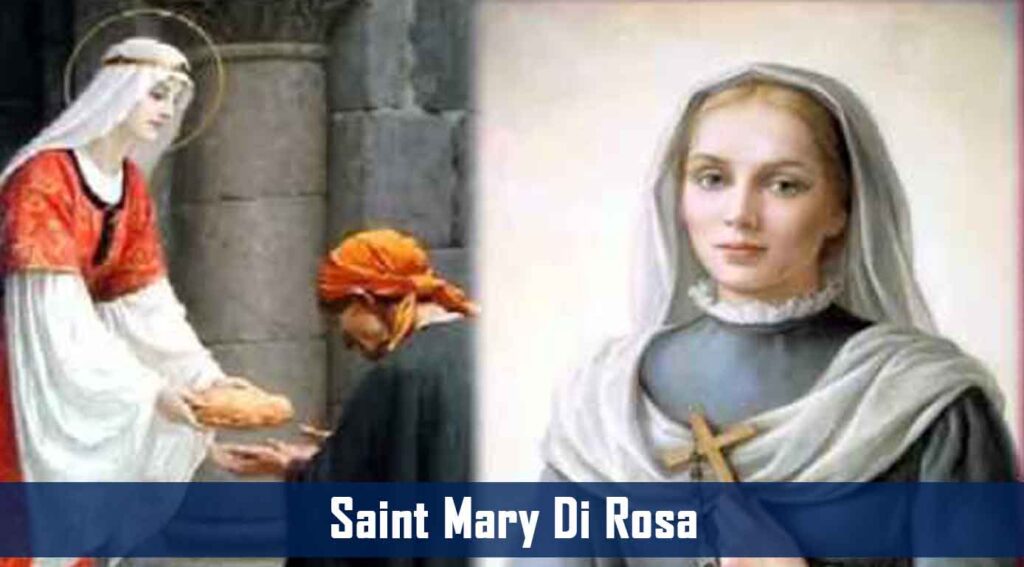
Saint Mary Di Rosa, birth name Paola Francesca Di Rosa, was born on 6 November 1813 in Brescia as one of nine children born to the rich industrialist Clemente Di Rosa and Countess Camilla Albani.
Di Rosa was educated by the Visitation Sisters in their convent in Brescia; She left school after her mother died in 1824. She began working in her father’s large spinning mill in Acquafredda where she took an instant notice of the working conditions; she became the manager when she turned nineteen. She began caring for the female workers and devoted herself to looking after their material and spiritual needs which was something that her father encouraged her to do. Di Rosa lived at home for the next decade increasing her involvement in various forms of social work.
Di Rosa died at a hospital in Brescia on 15 December 1855 after suffering from a prolonged illness.
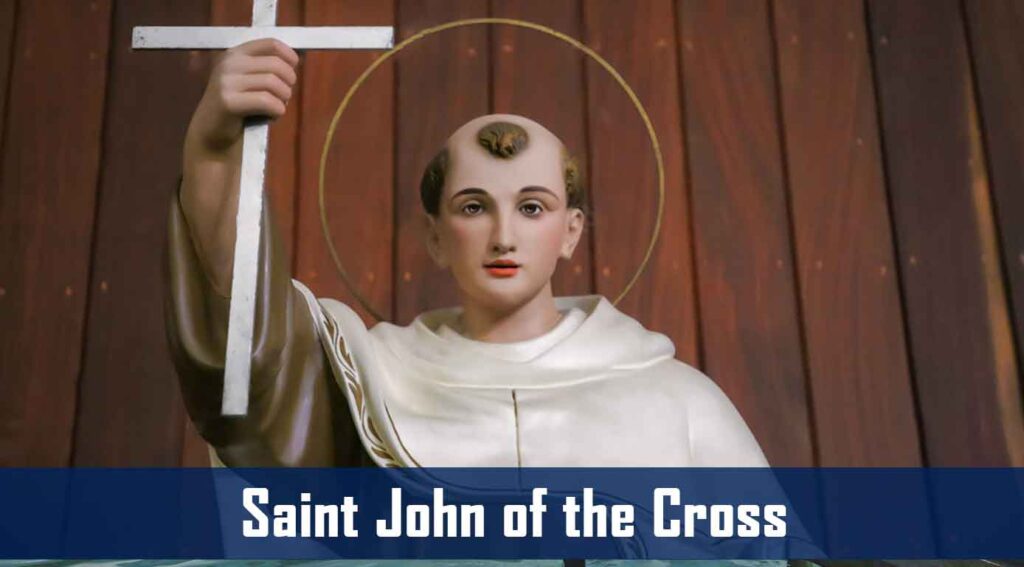
John is a saint because his life was a heroic effort to live up to his name: “of the Cross.” The folly of the cross came to full realization in time. “Whoever wishes to come after me must deny himself, take up his cross, and follow me” (Mark 8:34b) is the story of John’s life. The Paschal Mystery—through death to life—strongly marks John as reformer, mystic-poet, and theologian-priest. Ordained a Carmelite priest in 1567 at age 25, John met Teresa of Avila and like her, vowed himself to the primitive Rule of the Carmelites. As partner with Teresa and in his own right, John engaged in the work of reform, and came to experience the price of reform: increasing opposition, misunderstanding, persecution, imprisonment. He came to know the cross acutely—to experience the dying of Jesus—as he sat month after month in his dark, damp, narrow cell with only his God. Yet, the paradox! In this dying of imprisonment John came to life, uttering poetry. In the darkness of the dungeon, John’s spirit came into the Light. There are many mystics, many poets; John is unique as mystic-poet, expressing in his prison-cross the ecstasy of mystical union with God in the Spiritual Canticle. But as agony leads to ecstasy, so John had his Ascent to Mt. Carmel, as he named it in his prose masterpiece. As man-Christian-Carmelite, he experienced in himself this purifying ascent; as spiritual director, he sensed it in others; as psychologist-theologian, he described and analyzed it in his prose writings. His prose works are outstanding in underscoring the cost of discipleship, the path of union with God: rigorous discipline, abandonment, purification. Uniquely and strongly John underlines the gospel paradox: The cross leads to resurrection, agony to ecstasy, darkness to light, abandonment to possession, denial to self to union with God. If you want to save your life, you must lose it. John is truly “of the Cross.” He died at 49—a life short, but full.
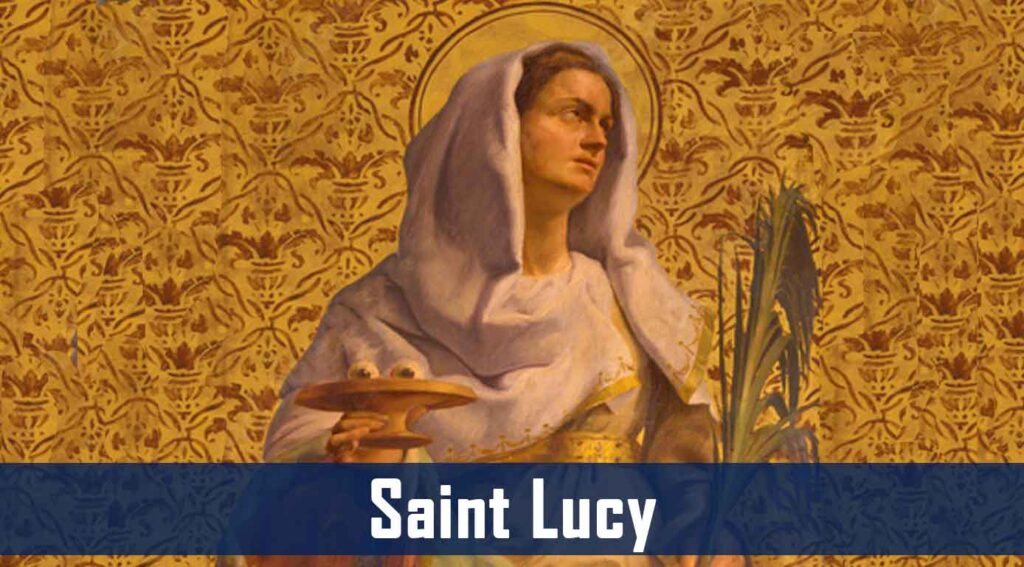
Saint Lucy, also known as Lucia of Syracuse, was a Christian martyr. She was born to a rich and noble family.
She was also one of the best known virgin martyrs, she had consecrated her virginity to God, and aimed to distribute her dowry to help the poor. According to accounts of Saint Lucy’s life, news that the patrimony and jewels were being distributed came to Lucy’s betrothed, who denounced her to Paschasius, the Governor of Syracuse. Paschasius ordered her to burn a sacrifice to the emperor’s image. When she refused, Paschasius sentenced her to be defiled in a brothel. Some said that when the guards came to take her away, they could not move her even when they hitched her to a team of oxen. Bundles of wood were then heaped about her and set on fire, but would not burn.
Finally, she met her death by the sword thrust into her throat. Saint Lucy is venerated on her feast day, December 13. In Sweden, St. Lucia’s Day marks the beginning of the Christmas celebration. The festival is meant to bring hope and light during the darkest time of the year.
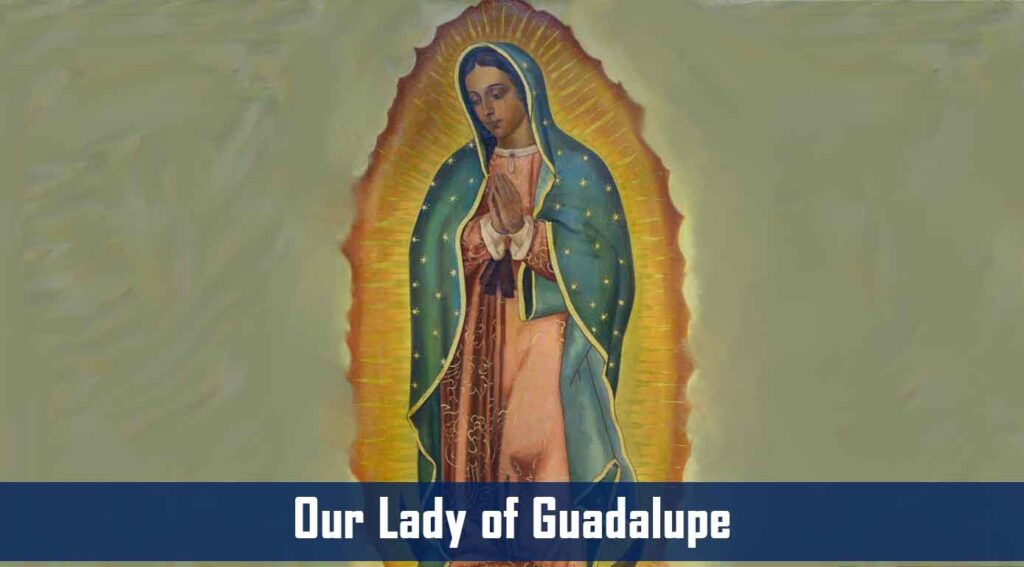
Our Lady of Guadalupe, also referred to as the Nuestra Señora de Guadalupe or the Virgin of Guadalupe, is associated with a series of five Marian apparitions, which are believed to have occurred in December 1531, and a venerated image on a cloak enshrined within the Basilica of Our Lady of Guadalupe in Mexico City.
The symbolism of Our Lady’s dress is obvious to over eight million Native Mexicans, whom all speak different languages. She is brighter than the sun, more powerful than any Aztec god, yet she is not a god herself, and she prays to one greater than her. Her gown is adorned with stars in the correct position as in the night sky, and the gold fringe of her cloak mirrors the surrounding countryside. Millions of natives will convert at the news of what has happened. Millions more will make pilgrimages over the next five centuries to see the miraculous tilma, and to honor Our Lady of Guadalupe. Great miracles continue to occur, even today.
Pope Leo XIII granted the image a decree of canonical coronation on 8 February 1887 and was pontifically crowned on 12 October 1895.
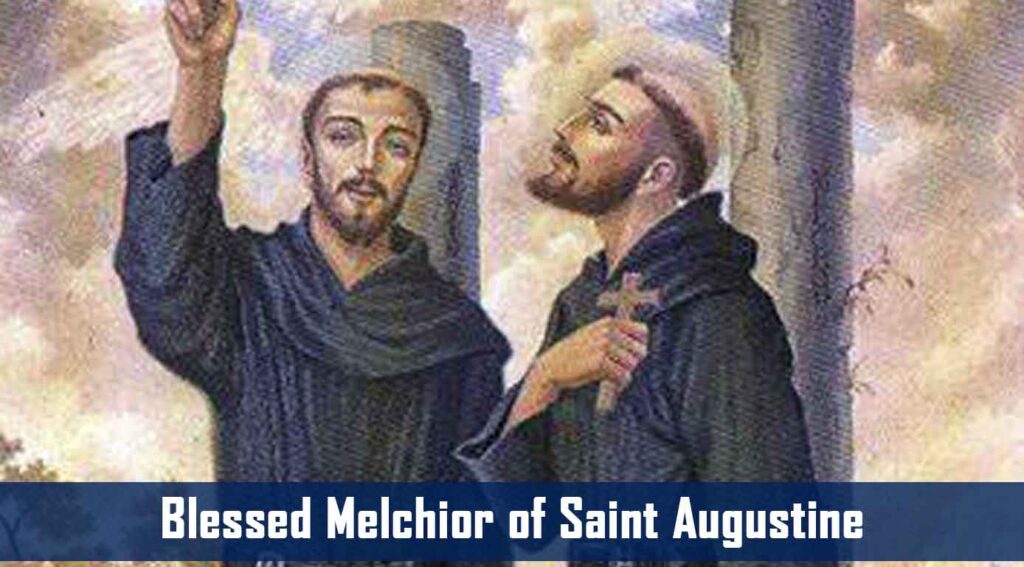
Blessed Melchior entered the Augistinian Order and received the Recollect habit at the young age of 18. In 1621, he left and set sail to the Philippines for his missionary work.
After his ordination in Mexico, they arrived at the monastery of Saint Nicholas in Manila. One of his duties in the Philippines was to preach to the people. In 1632, Blessed Melchior went to Japan to care for the Christians who were being persecuted there. However, he was reported to the Japanese officials by some of the people who helped transport him to Japan.
He was tortured and persecuted along with the other Christians. He died on December 11, 1632 when he was burned at the stake. He was beatified by Pope John Paul II on March 26, 1989.
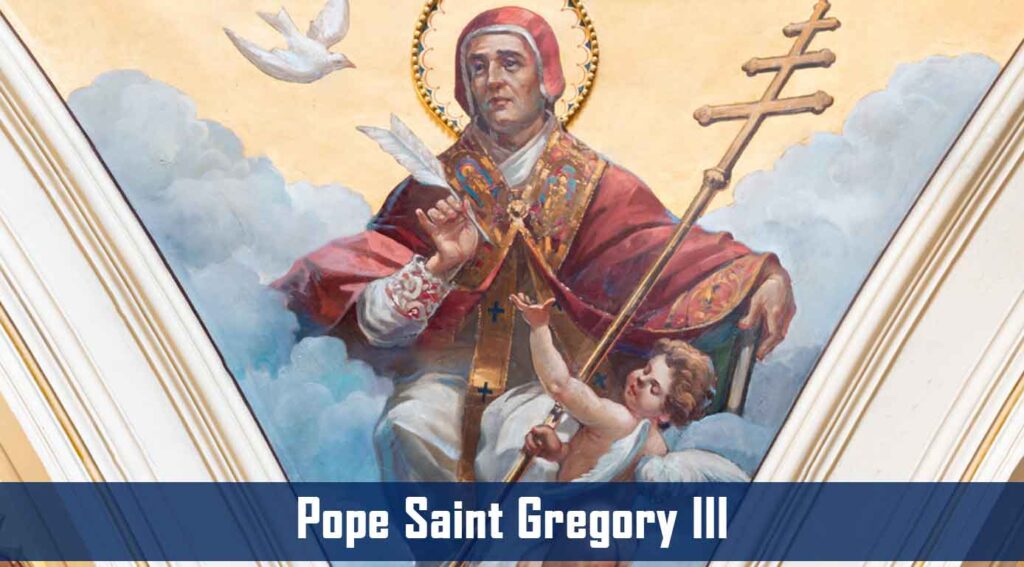
A priest when elected pope by acclamation, he was the last pope to seek approval of his election from the imperial exarch in Ravenna. His pontificate was one of the most critical in papal history. He was immediately confronted with the Iconoclastic Controversy, begun when his predecessor St. Gregory II condemned the Byzantine emperor Leo III’s destruction of religious images. Gregory denounced the Iconoclasts at a Roman council in 731. A comparatively peaceful period followed, during which he encouraged the Christianizing of the German tribes and appointed (732) St. Boniface, organizer of the Frankish church, as metropolitan of Germany. When in 739 the Lombards sacked the exarchate of Ravenna and threatened Rome, Gregory appealed to the Franks for aid. This unprecedented act began a relationship between the Franks and the Holy See that secured the papacy when Frankish power rose.