Daily Reflections

Luke 6:24-26

A Double Blessing

“But woe to you who are rich, for you have received your consolation. But woe to you who are filled now, for you will be hungry. Woe to you who laugh now, for you will grieve and weep. Woe to you when all speak well of you, for their ancestors treated the false prophets in this way.”

Reflection:

Is it dangerous to be rich, to be filled, to laugh, and to have all speak well of you? According to Jesus, it appears so. Why would Jesus warn against these things? And before that, why would He pronounce it blessed to be poor, hungry, weeping and insulted? Essentially, Jesus was condemning four common sins—greed, gluttony, intemperance, and vainglory—and promoting their opposite virtues.

Poverty, in and of itself, is not sufficient for holiness. But in Luke’s Gospel, Jesus declares it blessed to be poor, literally. This goes further than Matthew’s Gospel which says it is blessed to be “poor in spirit.” To be poor in spirit is to be spiritually detached from the material things of this world so that you can be fully open to the riches of God. One common tendency among those with material wealth is to rationalize that even though they have many things, they are detached from them. Hopefully that is the case. However, in Luke’s version of the Beatitudes, Jesus directly says, “Blessed are you who are poor” and “woe to you who are rich.” In this teaching, we discover a second blessing not found in Matthew’s version. In addition to spiritual detachment (poverty of spirit) being identified as a blessing, literal poverty is proclaimed as the easier way to achieve this spiritual detachment. Material wealth, though not a sin in and of itself, brings with it many temptations toward attachment, self-reliance, and self-indulgence. Thus, spiritually speaking, it is easier to be detached when one is poor, rather than when one is rich. This is a hard truth for both the poor and the rich to accept. The poor often want to be rich, thinking that if they were, they would share their wealth with others and remain detached. The rich often enjoy being rich and believe that they are more spiritually detached than they actually are.

Being “hungry” is also identified as a blessed state, whereas being “filled” is a dangerous state. When you are literally hungry, either from fasting or from lack of an abundance of food, it is easier to turn your hunger and thirst toward God so as to be filled by Him and to more easily trust in His providence. An abundance of food, especially fine food, tempts you with a gluttonous satisfaction that makes it difficult to hunger and thirst for God and His holy will in a complete way. Therefore, if you refrain from indulgence and experience hunger, you will be blessed to be free from gluttony and even the temptation toward it.

“Laughing” and “weeping” in this case are not referring to joy and despair. Rather, they are referring to those who are always seeking fun and an indulgent life. Many people live for fun, entertainment, and momentary pleasures. Weeping refers to those who have discovered that the fleeting pleasures of the world can never satisfy. Constant entertainment, therefore, brings with it a real temptation, whereas the loss of that form of fleeting pleasure helps eliminate that temptation.

Finally, Jesus declares it blessed to be hated, excluded, insulted, and denounced as evil on account of Him rather than being spoken well of by all. In this case, Jesus is referring to the praise that comes from things that mean nothing from an eternal perspective. When all speak well of us, praising qualities and accomplishments that are not true Christian virtues, we will be tempted to rely upon that praise for our satisfaction. But this form of satisfaction is nothing other than vainglory and never truly satisfies in the end. However, when one sees and praises the virtues of God within us, God is praised first and foremost, and we are blessed to share in God’s glory.

Reflect, today, upon whether you prefer to be rich, to indulge in the best of foods, to be constantly entertained and to be the envy of others, or whether you see the temptations this type of life brings. Reflect also upon the concrete spiritual blessings that come to those who are literally poor, hungry, temperate and humble. This is a very demanding teaching from Jesus. If it doesn’t sit well with you, then know that it is a sign that you still have various attachments in life. Reflect, especially, upon the beatitude that is most difficult to embrace, and make that beatitude the source of reflection and prayer. Doing so with honesty and openness will result in you being among those who are truly blessed in the eyes of God.

Source: https://catholic-daily-reflections.com/2025/09/09/a-double-blessing-3/
Luke 6:24-26 Read More »

Luke 6:17-19

Hearing and Healing

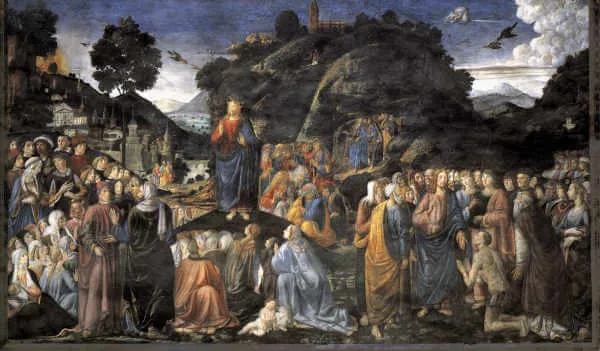
And he came down with them and stood on a stretch of level ground. A great crowd of his disciples and a large number of the people from all Judea and Jerusalem and the coastal region of Tyre and Sidon came to hear him and to be healed of their diseases; and even those who were tormented by unclean spirits were cured. Everyone in the crowd sought to touch him because power came forth from him and healed them all.

Reflection:

The Gospel of Luke presents us with what is traditionally known as the “Sermon on the Plain.” Almost everything Luke includes in this sermon is also found in Matthew’s “Sermon on the Mount.” Matthew, however, adds some teachings not found in Luke. Matthew’s sermon has three chapters while Luke’s has only one.

In this, the introduction to this “Sermon on the Plain,” from which we will be reading all week, Luke points out that large numbers of people came from far and wide to listen to Jesus. This crowd included many Jews but also included many people from the pagan territory of Tyre and Sidon. And what was it that drew so many of them? They came to “hear” Jesus preach and “to be healed.” They wanted to hear the words of Jesus since He spoke with great authority and in a way that was changing lives. And they were especially amazed by the healing power that Jesus manifested. The last line of the passage above gives great emphasis to this desire for healing. “Everyone in the crowd sought to touch him because power came forth from him and healed them all.”

It’s interesting that Jesus performed so many powerful miracles as He went about His public ministry. This was especially the case as He began His ministry. He became a sort of instant celebrity to many and was the talk of the many surrounding towns. But it’s also interesting to note that, as time went on, Jesus gave more emphasis to His teaching than He did to the miracles.

What is it that draws you to our Lord? Perhaps if there were numerous manifest miracles performed today by God, many people would be amazed. But physical miracles are not the greatest work of our Lord and, therefore, should not be the primary focus of our relationship with Him. The primary reason we should be drawn to our Lord is because His holy Word sinks in deeply, changes us and draws us into communion with Him. This is clearly seen by the fact that now that the Gospel message has been deeply established and the Church formed, physical miracles are rare. They do happen, but not in the same way that they did as Jesus first established His public ministry.

Reflect, today, upon the primary reason you find yourself drawn to our Lord. Seek out His living Word, spoken within the depths of your heart. The most important miracle that takes place today is that of interior transformation. When a person hears God speak, responds to that Word, and allows Him to change their life, this is among the most important miracles of grace that we could ever encounter. And this is the central reason we should be drawn to Him, seek Him out and follow Him wherever He leads.

Source: https://catholic-daily-reflections.com/2025/09/08/hearing-and-healing-4/

Luke 6:17-19 Read More »

Matthew 1:20-21

The Birth of the Mother of God

Joseph, son of David, do not be afraid to take Mary your wife into your home. For it is through the Holy Spirit that this child has been conceived in her. She will bear a son and you are to name him Jesus, because he will save his people from their sins.

Reflection:

Today we celebrate one of the most consequential birthdays in the history of the world! Certainly, the only birthday more important is that of our divine Lord Himself. But today we honor His mother, and our mother, too.

The Blessed Virgin Mary was born into our world without the stain of original sin. She was preserved from experiencing fallen human nature through the gift of her Immaculate Conception. Thus, she was the first to be born in the perfection of human nature after the fall, and she continued to experience this grace throughout her life, responding to God with her free will every step of the way.

All of us enjoy celebrating our birthdays. Children especially love it, but most everyone looks forward to that special day each year when family and friends honor them and celebrate them in a special way. For that reason, we can be assured that even our Blessed Mother loved her birthday while here on earth and continues to enjoy this special celebration in Heaven. Of course, she did not enjoy her birthday because she wanted to be pampered or given special attention. She, perhaps more than anyone other than her divine Son, rejoiced on her birthday because of the deep spiritual gratitude she had to God for all that He did in her life.

Try to ponder the heart and soul of our Blessed Mother from her perspective. She would have been intimately united to each person of the Most Holy Trinity throughout her life. She would have known God, living in her soul, and would have been in awe of what God had done to her. She would have pondered these graces with deep humility and exceptional gratitude. She would have seen her soul and mission from the perspective of God, keenly aware of all that He had done for her.

As we honor the birthday of our Blessed Mother, it’s also an important opportunity for each of us to ponder the incredible blessings that God has bestowed upon each one of us. No, we are not Immaculate as Mother Mary was. We were each born into original sin and have sinned throughout our lives. But the blessings of grace, given to each one of us, is exceptionally real. We only need to work to have the eyes to see these graces. Baptism, for example, bestows upon the soul an eternal transformation. Though our sin may cloud that transformation at times, the transformation is eternal. Our souls are changed. We are made new. Grace is poured into our hearts, and we become children of God. And for the soul who is able to perceive the countless other ways that God bestows blessings, gratitude is the only appropriate response.

Reflect, today, upon the glorious celebration of the birthday of the Blessed Virgin Mary, Mother of God. Begin by trying to rejoice in her life through her eyes. Try to imagine what she saw as she looked into her own graced soul. From there, try to rejoice, also, in your soul. Be grateful for all that God has done for you. Work to have eyes that see these countless graces and allow yourself to rejoice in God’s blessings with our Blessed Mother. 

Source: https://catholic-daily-reflections.com/2025/09/07/the-birth-of-the-mother-of-god-3/

Matthew 1:20-21 Read More »

Luke 14:25-26

Hating So As To Love

Great crowds were traveling with Jesus, and he turned and addressed them, “If anyone comes to me without hating his father and mother, wife and children, brothers and sisters, and even his own life, he cannot be my disciple.”

Reflection:

Why would Jesus exhort the “great crowds” to hate their families? In fact, Jesus went even further than that. He said they must also hate their own lives. If they do not, then they cannot be His disciples. One thing that this shocking teaching did was to shake people out of their lukewarm faith. Sometimes we think of Jesus only as a kind and gentle soul Who always brightens people’s days. We see images painted of the smiling Jesus Who always made people feel welcomed and loved. And though these images have truth, it is also true that one way He brightened their days was by challenging them to the core of their being to convert. And that is what Jesus does today in our Gospel.

To hate your father, mother, children, siblings and even your very self is obviously not a reference to the sin of hate that flows from anger. In this case, the word “hate” refers to the best way to love others and to love even your own self. To begin, let’s look at the conclusion. Jesus said that this form of hate is a requirement of being His disciple. This is the key. Unless we are first and foremost a disciple of Christ, we cannot love others and we will not even love ourselves in the proper way. “Hate” in this context refers to selfish attachments. This means that people and things can easily get in the way of our love of God. When they do, we must see them as an obstacle to both the love of God, as well as to the authentic love of others and even ourselves. For example, if a family member were to demand in some way that you love them more than you love God, then this must be rejected with passion. This could be referred to as holy hatred of the temptation, not the person. Say a spouse criticizes you for attending Mass and tries to stop you from doing so. If you listen to them, then you are placing them before God. Or say someone hurts you and you choose to forgive them, only to have a family member challenge you and try to stir up anger in you toward that person. If you listen to them, then you are not listening to God. In these cases, we must “hate” in the sense that we reject the temptation.

What about yourself? How do you hate yourself? This is a reference to the many ways that our disordered appetites are drawn to sin. If we indulge in the disordered desires, or even worse, if we treat those disordered desires as normal and good for us, then we have chosen the disordered desire over God. In that case, we must learn to hate and reject the selfish and disordered desire, choosing God and His will alone.

When we are able to choose the love of God first and foremost in our lives, rejecting the temptations that come through others and even the temptations within our disordered desires, then, and only then, are we in a position to love others and ourselves, in the right way. Jesus obviously wants us to love others and ourselves. But this is only possible when our love is pure and holy and flows from the love of God. Any other form of “love” is not love at all. It is a selfish attachment that hinders our true mission as lovers of God and instruments of that love to others.

Reflect, today, upon the passion that you must have to reject all forms of sin. This includes sin that tempts you through the mediation of your family and friends. It also includes every form of temptation that arises within you on account of your disordered human nature. This holy hatred is an act of love in that it seeks to eliminate everything that keeps you from true love. Choose, today, to be a faithful disciple of Jesus and commit yourself to reject all that seeks to interfere with this choice. Doing so will not only increase your love for God, it will also increase your love for others, and even your love for your own soul.

Source: https://catholic-daily-reflections.com/2025/09/06/hating-so-as-to-love/

Luke 14:25-26 Read More »

Luke 6:5

The Divine Law of Our Lord

The Son of Man is lord of the sabbath.

Reflection:

This short yet powerful statement by Jesus was spoken in response to the Pharisees who questioned Jesus as to why His disciples were apparently doing what was unlawful on the sabbath. They were walking through a field of grain, picking grain as they walked, and eating it for nourishment on their journey from one town to another.

This challenge from the Pharisees highlights their scrupulous approach to the moral law. Recall the Third Commandment given through Moses: “Remember the sabbath day—keep it holy. Six days you may labor and do all your work, but the seventh day is a sabbath of the LORD your God. You shall not do any work…” (Exodus 20:8–10). From this Commandment, the Pharisees had developed a complex commentary which went into great detail about what kind of work was forbidden on the Sabbath in their view. One such regulation was to pick and mill grain. Thus, they judged that this was what the disciples were doing and were, therefore, violating the Third Commandment.

The laws of God, as they are given by God, must be followed perfectly. His divine Law refreshes us, enlivens us and enables us to live in union with Him. The Pharisees, however, deeply struggled with a need to control the lives of the people through their human interpretation of the divine Law. By saying that “The Son of Man is lord of the sabbath,” Jesus made it clear that this scrupulous interpretation of the Third Commandment taught by the Pharisees did not align with the truths of that divine Law.

One lesson to learn from this encounter is that each one of us can easily fall into a similar trap. It’s easy to replace God’s true Law with our perception of faith and morality. We are weak human beings, and there are many things that affect our thinking and our convictions in life. Emotions, habits, family relationships, friendships, media and so many other things affect us in powerful ways. Sometimes for good and sometimes for ill. We can easily arrive at certain judgments of faith and morality that are slightly erroneous, being based on subtle errors. As a result, we can easily begin to get off track in our thinking and convictions and, over time, can find that we have deviated far from the truths of God. When this happens, it can be difficult to humbly admit it and change our convictions.

Reflect, today, upon the humble truth that Jesus and Jesus alone is Lord of the divine Law. This means that we must perpetually remain open to changing our opinions when we hear our Lord speak to us. Ponder any way in which you have become overly attached to your own opinions. If they bring forth peace, joy, charity and the like, then they are most likely in union with God. If they are burdensome, a cause of confusion, contention or frustration, then you may need to step back and humbly reexamine the convictions you hold, so that He Who is Lord of all will be able to speak His divine Law to you more clearly.

Source: https://catholic-daily-reflections.com/2025/09/05/the-divine-law-of-our-lord-4/

Luke 6:5 Read More »

Luke 5:37–39

Courage to Change

“Likewise, no one pours new wine into old wineskins. Otherwise, the new wine will burst the skins, and it will be spilled, and the skins will be ruined. Rather, new wine must be poured into fresh wineskins. And no one who has been drinking old wine desires new, for he says, ‘The old is good.’”

Reflection:

This short parable comes at the beginning of Jesus’ public ministry. He just called Levi, the tax collector, to become one of His disciples, and then Levi invited Jesus to dine at his home with other tax collectors and sinners. When the scribes and Pharisees saw this, they objected and challenged our Lord. In response, Jesus tells this parable as a way of explaining that He came to call everyone to change and to experience a new transformation of their life.

The “new wine” spoken of in this parable is the grace poured forth from the Cross. Remember that blood and water sprung forth from His side as He hung upon the Cross. This has been symbolically understood as the grace and mercy given to us from the Cross, which is transmitted today through the Sacraments of Baptism and Holy Communion. Baptism transforms us into a new creation, and, as a new creation in Christ, we must desire the new wine of the Most Holy Eucharist so as to be daily transformed by our Lord.

Many of the Church Fathers point out that the “old wine” that many prefer is a reference to those who wanted to continue living according to the old law. This is especially true of the scribes and Pharisees to whom Jesus was speaking this parable. Jesus was bringing them a new teaching and preparing them for a new grace. But they rejected it, preferring the old life they were living.

One thing this tells us is that if we are to receive this new wine of the grace of God, we must be ready and willing to abandon our old selves and become new. Change can be hard. Even as evangelized Christians who are already living in the grace of Christ, we will be continually called to a deeper and deeper change in our lives. Too often we can easily become complacent and content with the life we are living. When that happens, it will hinder our Lord from pouring the new wine of His grace into our souls in ongoing superabundance.

How do you deal with change in life? If you want to grow in holiness, you can be certain that change is the only constant in life. We must become new creations each and every day, growing, being more fully transformed, changing our ways, giving up the old and embracing that which is ever new. This requires a certain amount of courage as we come face-to-face with the daily need to be changed by grace. It means daily death to our old self and daily becoming a new creation in God.

Reflect, today, upon the courage it takes to change. What is it in your life that you may be afraid to change? What “old wine” do you prefer over the “new wine” of God’s grace? What old habits or attachments do you have that our Lord wants you to let go of? Face the changes God wants for you with courage and trust, and You will indeed become more fully the new creation in Christ you are meant to be.

Source: https://catholic-daily-reflections.com/2025/09/04/courage-to-change-6/

Luke 5:37–39 Read More »

Luke 5:8

A Personal Encounter

When Simon Peter saw this, he fell at the knees of Jesus and said, “Depart from me, Lord, for I am a sinful man.”

Reflection:

Consider carefully this very moving action of Simon Peter. Jesus had just begun His public ministry, healing Simon’s mother-in-law as one of His first miracles. After that, Simon witnessed Jesus heal many other sick people and cast out many demons. And then, shortly after these initial miracles, Jesus got into the boat of Simon, directed him to “Put out into deep water and lower your nets for a catch.” As soon as Simon obeyed, he caught so many fish that they needed a second boat to come and help them. The response of Simon to this additional miracle is recorded above.

Three things take place in this passage. First, “Simon Peter saw this…” And though he saw this, literally with his eyes, we should see his “seeing” as something even deeper. Simon Peter saw not just the best day of fishing he had ever had. He saw God’s grace at work through Jesus and was deeply moved interiorly by what he saw. Jesus used that which was one of the most central parts of Simon Peter’s life (fishing) to manifest His divine power. In a sense, Jesus brought this lesson home to Simon, using fishing as the source of His lesson.

Secondly, Simon’s response was perfect. By encountering this divine miracle, Simon immediately was aware of his sin. Though we do not know what Simon’s sin was, it is clear that this encounter with our Lord led him to immediately call to mind whatever he was guilty of. Perhaps he had struggled with some ongoing habitual sin for years, or perhaps he had done something of a grave nature that still haunted him. But all we know is that Simon’s encounter with this very powerful and personal miracle moved him to an awareness of his sin.

Thirdly, Simon falls at the knees of Jesus and tells the Lord to depart from him. And though Jesus’ mercy is so great that Jesus would never depart from him, Simon is not only aware of the fact that he is unworthy to be in Jesus’ presence, but he also manifests this conviction through his humble action of repentance. 

What does Jesus do? He said, “Do not be afraid…” And when these new disciples arrived at shore, “they left everything and followed him.”

Each one of us must encounter our Lord in this same way. We must see Jesus. We must be deeply attentive to Him. We must recognize His presence, hear His voice and see His action in our life. If this is done well and through faith, then our personal encounter with our Lord will shine light on the sin we need to repent of. This is not so that we remain in guilt and shame; rather, it is so that we can also humble ourselves before Jesus and acknowledge we are not worthy of Him. When this humble admission is done well, we can be assured that Jesus will also say to us, “Do not be afraid.” His consoling words to us must then be responded to with the same choice made by Simon and the others. We must be ready and willing to leave everything behind so as to follow Him.

Reflect, today, upon this image of Simon Peter on his knees before Jesus. See his humility and honesty. See his sincerity and interior awareness. And see his understanding of the divine power of Jesus before him. Pray that you, too, will see our Lord, experience your sin, humble yourself before Him and hear Him call you to radically and completely follow after Him wherever He leads.

Source: https://catholic-daily-reflections.com/2025/09/03/a-personal-encounter-4/

Luke 5:8 Read More »

Luke 4:38-39

Laying the Foundation

After Jesus left the synagogue, he entered the house of Simon. Simon’s mother-in-law was afflicted with a severe fever, and they interceded with him about her. He stood over her, rebuked the fever, and it left her. She got up immediately and waited on them.

Reflection:

If you wanted to share some important message with a group of people, you would first need to get their attention. This could be done through a variety of means, such as through a charismatic personality, a powerfully moving story, a heroic act of virtue, or anything else that leaves people impressed or even amazed. Once you have their complete attention, you can share the message you want to share. This is what Jesus did in today’s Gospel.

Jesus began His public ministry in Nazareth, but the people of his hometown rejected Him from their Synagogue. Therefore, He immediately traveled some 20 miles on foot to Capernaum, a town just north of the Sea of Galilee, where Jesus would spend much of His time. In this first visit to Capernaum, at the beginning of His public ministry, Jesus taught in their Synagogue, cast out a demon, and then went to the home of Simon (who eventually was given the name Peter) to perform His first recorded physical healing in Luke’s Gospel. He cured Simon’s mother-in-law, who suffered from a severe fever. Then, later that evening, many people brought to Jesus the sick and possessed, and Jesus “Laid his hands on each of them and cured them.” He certainly got their attention. And the next morning, as Jesus was preparing to leave Capernaum after this first visit during His public ministry, the people tried to convince Jesus to stay. However, Jesus said to them, “To the other towns also I must proclaim the good news of the Kingdom of God, because for this purpose I have been sent.”

Has Jesus ever gotten your complete attention? Though you most likely have never witnessed a miraculous healing first hand or seen a demon being cast out of one who was possessed, Jesus still wants your full attention. He wants you to be so amazed at Him and so impressed by Him that you find yourself seeking Him out so as to be more fully fed by His divine teaching.

Some people give their full attention to our Lord after a powerful experience on a retreat. Others are struck by a powerful sermon. And there will be countless other ways by which Jesus has gotten your attention so as to fill you with a desire to listen to Him and be with Him. Such experiences lay a wonderful foundation by which we are continually invited to turn to our Lord. If this is not an experience to which you can relate, then ask yourself the question “Why?” Why haven’t you been amazed by our Lord to the point that you fervently seek Him out so as to listen to His nourishing Word?

Reflect, today, upon this initial way by which our Lord got the attention of the people of Capernaum. Though some would eventually turn from Him, many did become faithful followers on account of these personal experiences. Reflect upon any way that you have encountered our Lord powerfully in the past. Have you allowed that experience to become an ongoing motivation for you to seek Him out? And if you cannot point to any such experience, beg our Lord to give you an interior drive to desire more of Him and to be fed by His holy Word and divine presence.

Source: https://catholic-daily-reflections.com/2025/09/02/laying-the-foundation-4/

Luke 4:38-39 Read More »

Luke 4:36-37

Authority and Power

They were all amazed and said to one another, “What is there about his word? For with authority and power he commands the unclean spirits, and they come out.” And news of him spread everywhere in the surrounding region.

Reflection:

Jesus had just encountered the wrath of many in His hometown of Nazareth, so He left there and traveled about 30 miles to Capernaum, a town just north of the Sea of Galilee. This was to become His new home during His public ministry. The reaction He received in Capernaum was much different than that which He received in Nazareth. As He taught in the Synagogue in Capernaum, a man with a demon came to Him, Jesus rebuked the demon and cast it out, and the people were amazed. Word spread about Jesus quickly. After this, Jesus performed many other miracles, and the people continued to be in awe of Him.

What was it that impressed the people of Capernaum? In part it was the “authority and power” with which Jesus spoke and acted. But it was not only this, since Jesus had done so also in Nazareth where the people failed to believe in Him. In Capernaum it wasn’t that Jesus was different, it seems that the people were different. Jesus won over many hearts in Capernaum because the people were open to the gift of faith. In fact, when Jesus was preparing to leave from Capernaum, the people begged Him to stay. Though eventually Jesus would also encounter resistance from the people there, their initial reaction was one of faith.

Do you want Jesus to act powerfully in your life? Do you want Him to act upon you with authority and power? Many people, from time to time, can feel as though their lives are somewhat out of control. They experience weakness, confusion, a lack of direction and the like. For that reason, true spiritual “authority and power” is very welcome. What sort of authority and power do you need Jesus to exert over your life today?

Think of a small child who is frightened. When this happens, the child turns to a loving parent for comfort and security. The embrace of a parent immediately helps to dispel the fear and worry of the child. So it is with us. We must see Jesus as the source of calm in our lives. He is the only one Who is capable of ordering our lives, freeing us from the attacks of the evil one, bringing peace and calm to our disordered emotions and clarity to our questions and doubts. But this will only be possible if we are open. His power never changes, but it can only enter our lives when we change and when we recognize our weakness and our need for Him to take control.

Reflect, today, upon the infinite spiritual authority and power of our Lord. It is a power beyond anything else we could imagine. He wants to exercise this authority in your life out of love. What is hindering Him from taking greater control of your life? What sin or temptation does Jesus want to rebuke in your life? From what oppression does He want to set you free? Reflect upon yourself being a member of the town of Capernaum who fully welcomes Jesus, is amazed at Him and desires Him in your life. His working in your life depends upon you and your response to Him. Call on Him and let Him in.

Source: https://catholic-daily-reflections.com/2025/09/01/authority-and-power-4/

Luke 4:36-37 Read More »

Luke 4:28-30

An Emotional Reaction to Jesus

When the people in the synagogue heard this, they were all filled with fury. They rose up, drove him out of the town, and led him to the brow of the hill on which their town had been built, to hurl him down headlong. But he passed through the midst of them and went away.

Reflection:

It’s hard to believe that those people who knew Jesus, those from the town in which He had been raised, reacted in such a severe way to our Lord. Jesus had just entered the Synagogue and read from the Prophet Isaiah who stated that “the Spirit of the Lord” was upon him and that he had come to “proclaim liberty to captives.” Jesus’ mission was clear. He was the Messiah, sent from the Father, in fulfillment of the teachings of the prophets, and yet Jesus was rejected to the point that the people drove Him out of the town and tried to throw Him off a cliff near the town to kill Him. Again, it’s hard to comprehend the extreme emotions that people experienced in regard to Jesus. Some came to love Jesus with the deepest passion, others were outraged at Him and sought His life.

One thing that these extreme emotions experienced by many should tell us is that we cannot remain indifferent to Jesus when we truly listen to His words. Indifference comes when Jesus is ignored. But when He is heard and understood, it is clear that His message demands a response. If we do not fully accept Him as we listen to His message, then we will be tempted to reject Him and all that He speaks.

Jesus wants to do the same with us. He wants a response from us. First, He wants us to hear Him, to understand the radical nature of His message, and then to make a choice. He wants us to follow Him with passion and zeal, to believe in everything He teaches, and to radically change our lives as a result. And if we will not change, then Jesus’ words will challenge us and evoke a response.

One example of this that is common today is the strong response that sometimes comes from a teenager or young adult when a loving parent confronts them when they begin to go astray. When confronted in love and with the truth, emotion is often evoked and stirred up. But that is not always bad. The temptation on the part of the parent is to back off and compromise. But that’s not what Jesus did with the townspeople. He spoke the truth in love and accepted their response. So it is with those in our lives. At times we must speak the hard but loving truth others need to hear even if we know they will lash out. In the end, challenging them with compassion and truth may ultimately win them over. We do not know what ultimately happened to those townspeople who tried to kill Jesus that day out of anger, but it is entirely possible that the extreme emotion they experienced eventually led them to the truth.

Reflect, today, upon the courage and love Jesus had as He directly confronted and challenged His own townspeople for their lack of faith. Try to understand that Jesus’ challenge of them was a mercy He offered them to move them from indifference. In your life, are there ways in which you need to be challenged? Are there things you have reacted strongly to and even with a form of rage? Try to see yourself as one of those townspeople who became enraged by our Lord. Be open to any way that you have reacted negatively to that which Jesus has spoken to you. Consider, also, any ways that Jesus may want to use you to speak His clear message of love to another, even if you know it may not immediately be received. Pray for courage, compassion, clarity and love so that you will be able to imitate Jesus as He sought to move those of His own hometown out of the indifference they were experiencing.

Source: https://catholic-daily-reflections.com/2025/08/31/an-emotional-reaction-to-jesus-4/

Luke 4:28-30 Read More »