June 2026

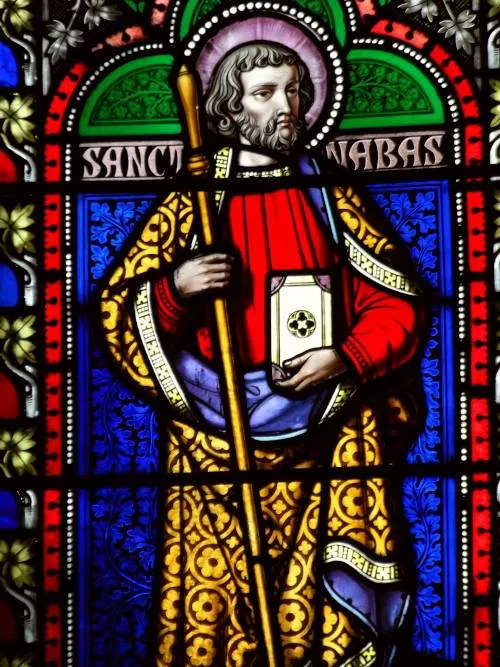
Saint Barnabas the Apostle

Early First Century–c. 61; Patron Saint of Cyprus, Antioch, and peacekeeping missions; Invoked against hailstorms; Pre-Congregation canonization

Saint Barnabas, originally named Joseph, was born on the isle of Cyprus and was a Jew of the tribe of Levi (see Acts 4:36). Nothing else is known about his early life. During Jesus’ public ministry, Joseph became His fervent follower and might have been one of the seventy-two disciples whom Jesus sent out on a mission (see Luke 10:1–24). After Pentecost, as the Church in Jerusalem began to grow, the Apostles changed Joseph’s name to Barnabas, which means “son of encouragement.” His name change might have occurred because Barnabas supported the Church when he “sold a piece of property that he owned, then brought the money and put it at the feet of the apostles” (Acts 4:37). This is the first mention of Barnabas in the New Testament.

Three years later, after Saint Paul had undergone his conversion to the Christian faith and spent three years fasting and praying in Arabia, he traveled to Jerusalem to consult with the Apostles. The Apostles and the Christian community were at first hesitant to receive him, for they were aware of the persecutions he had issued against the Church. Barnabas, however, “brought him to the apostles, and he reported to them how on the way he had seen the Lord and that he had spoken to him, and how in Damascus he had spoken out boldly in the name of Jesus” (Acts 9:27). After spending a short period of time in Jerusalem, Saint Paul returned to his hometown of Tarsus to avoid persecution. He remained in Tarsus for the next several years.

During that time, some of the Christians who left Jerusalem after the martyrdom of Saint Stephen traveled north to Antioch in Syria, where many Greek Gentiles lived. In Antioch, the Greek-speaking Christians began to preach the Word of God to the Gentiles. As a result, many of the Gentiles converted and accepted the faith. When the Apostles in Jerusalem heard about this, they sent Barnabas to minister to these new converts. Barnabas was so impressed that he went to find Saint Paul in Tarsus and brought him back to Antioch to help share the Good News. It was there, in Antioch, that the word “Christian” was first used, perhaps because the new converts were Gentiles who converted not to the Jewish faith, but directly to Christ.

After a year in Antioch, Paul and Barnabas returned to Jerusalem on a relief mission to assist those suffering from a famine. They brought with them money that was raised among the Christians in Antioch. After returning to Antioch, the Holy Spirit revealed to the Christian community that Paul and Barnabas were to be “set apart” for a special mission. The two were then ordained as bishops and sent forth on a mission, bringing with them Barnabas’ relative, John Mark, the Gospel writer. Over the next year, they traveled to Seleucia, Cyprus, Salamis, Paphos, Perga of Pamphylia, Antioch of Pisidia, Lystra, Derbe, Iconium, and back to Antioch, Syria. During this journey, they won many converts; some Greeks even tried to worship the two as gods. They also encountered opposition, including an unsuccessful attempt to kill Paul by stoning. The two later returned to Jerusalem to help settle disputes about Gentile converts before being sent off on another mission. Before the second journey, Barnabas and Paul disagreed about John Mark’s involvement in the mission, since John Mark had previously abandoned them for an unknown reason while in Pamphylia. The disagreement was so severe that Paul and Barnabas parted ways. Barnabas took John Mark with him to Cyprus, and Paul took Silas with him to Syria and Cilicia.

Nothing else is known for certain about Barnabas’ missionary activity with John Mark in Cyprus. Based on Paul’s first letter to the Corinthians and his letter to the Colossians, the disagreement the two had over John Mark did not have any lasting effect on their friendship. Even John Mark is later affectionately mentioned by Paul.

The only source we have that details Barnabas’ martyrdom comes from the fifth century, which makes its historicity uncertain. According to that tradition, Barnabas was preaching the Gospel around the year 61 and was arrested, dragged out of the city, and either burned to death or stoned. One tradition states that John Mark found his remains and buried them.

Another legend holds that in the year 478, Saint Barnabas appeared to the Archbishop of Cyprus and revealed the location of his burial to him. Archbishop Anthemios then found Saint Barnabas’ body incorrupt, holding the Gospel of Matthew. The Roman emperor then erected a church at the site and buried Saint Barnabas there. Though the church was later lost to history, excavations of the site have found a tomb believed to be that of Saint Barnabas. Saint Barnabas is the patron saint of Cyprus because he was the first missionary bishop on that island.

As we honor this great apostolic bishop, ponder the impact his ministry has had over time. Although the number of converts during his lifetime might have only been in the hundreds or thousands, the effect those converts had on subsequent generations multiplied over and over again. Saint Barnabas traveled, preached, baptized, celebrated the sacraments, and founded many Christian communities. He endured rejection, hardship, violence, and martyrdom, but he pressed on. His fervor stemmed from knowing his Lord, not only through his firsthand witness of Jesus’ ministry but also through his life of prayer and his reception of the Holy Spirit. Try to see his mission as one similar to yours. You, too, are called to zealously preach the Gospel to others. Do not hesitate to do so, no matter the cost. Pray that God uses you as He wills, and offer yourself to His service in imitation of this holy Apostle.

Source: https://mycatholic.life/saints/saints-of-the-liturgical-year/june-11—saint-barnabas-the-apostle/

Saint Barnabas the Apostle Read More »
Matthew 5:20

Humiliation Fosters Humility

Jesus said to his disciples: “I tell you, unless your righteousness surpasses that of the scribes and Pharisees, you will not enter into the Kingdom of heaven.”

Reflection:

This statement would have been shocking to Jesus’ audience. At that time, the scribes and Pharisees were well-known for their meticulous observance of the Law of Moses, attending scrupulously to even the smallest details. They prided themselves on their strict adherence and often made their “righteousness” highly visible, earning them great respect among the people as models of holiness and fidelity to the covenant. However, their fidelity was often purely external, lacking the interior disposition of love and worship of God, which is the heart of the covenant. For this reason, Jesus spoke bluntly to the people, even in the presence of the scribes and Pharisees, declaring that their level of righteousness was insufficient to enter the Kingdom of Heaven.

Imagine the humiliation felt by these religious leaders. Jesus’ words would have stung deeply, confronting them with the inadequacy of their righteousness. Such a confrontation can lead to one of two responses: Either the sting of humiliation fosters the virtue of humility, repentance, and conversion, or it magnifies pride, leading to anger and rejection. While some of the scribes and Pharisees might have chosen the path of humility and repentance, the majority likely did not.

Jesus followed up this statement with a teaching on anger and how it can move from an interior disposition to severe hatred. While that teaching is important, it is also useful to pause and place ourselves in the shoes of the scribes and Pharisees, pondering how we would have reacted if we were them. Many of them had spent their whole lives studying the Law, following it, and teaching others to do the same. When Jesus came along, He essentially told them that much of what they had been doing was worthless and fruitless because they were not following the will of God. Place yourself in their shoes.

Consider your ability—or inability—to endure the humiliation that those religious leaders felt. Imagine that you had put great time and effort into cultivating a particular moral and spiritual attitude and approach to your faith, only for Jesus to reveal that you have not been listening to God at all, but have gone astray from His will. Hearing such a holy rebuke would be painful and humiliating, requiring profound humility to accept. Imagine further that you listened to all that Jesus said to you. You felt the sting of wounded pride and self-righteousness, but you humbled yourself, repented, and began to change. When that happens, external humiliation produces internal humility and bears an abundance of good fruit. When it doesn’t happen, we reject the truth and become even more obstinate in our ways, allowing pride to harden our hearts further.

In truth, none of us is righteous enough to attain the Kingdom of Heaven by our own efforts. We all fall short of fulfilling God’s will and cooperating with His grace. The real question is not whether we need ongoing change, but whether we are willing to receive Jesus’ loving rebuke and change our ways.

Saint Faustina, in her Diary, stated, “O my Jesus, nothing is better for the soul than humiliations” (#593). Humiliations are a gift from God because they reveal our self-righteousness and pride, and invite us to rely more fully on His grace. The sting of having that pointed out is itself a humiliation, but that humiliation has the power to lead us to profound humility, repentance, and ultimately, holiness.

Reflect today on the many humbling truths God desires to reveal to you. Each humiliation, though painful, is a step on the path to true righteousness and holiness, drawing us closer to the Beatific Vision in Heaven. Only in Heaven will we be fully purified of every sin. Until that day, we must embrace every humiliation God allows, recognizing these painful truths as gifts that correct us, purify us, and set us firmly on the path to true righteousness.

Source: https://catholic-daily-reflections.com/2026/06/10/humiliation-fosters-humility/

Matthew 5:20 Read More »

Saint Ephrem, Deacon and Doctor

c. 306–373; Patron Saint of spiritual directors and spiritual leaders; Pre-Congregation canonization; Declared a Doctor of the Church by Pope Benedict XV in 1920

Ephrem was born in the town of Nisibis, near Syria’s border with present-day Turkey. At the time of Ephrem’s birth, Nisibis was part of the Roman Empire. Nisibis was a diverse city of Syrians, Arameans, Arabs, Greeks, Jews, Parthians, Romans, and Iranians. Among the religious beliefs were Judaism, Christianity, and polytheism. Aramaic was commonly spoken, and to a lesser extent, Greek and Latin.

When Ephrem was just a boy, Emperor Constantine the Great issued the Edict of Milan, legalizing Christianity throughout the empire. Ephrem likely learned the faith from his mother at an early age. Stories from his youth, however, suggest that even though he was raised in the Christian faith, he failed to practice it. One story relates that one day when Ephrem was walking through a field and saw a cow, he decided to have fun by throwing rocks at it, forcing the beast to run. Ephrem pursued the cow, pelting it all the more until the poor animal died. When Ephrem later encountered the cow’s owner, he denied ever seeing the animal. He would come to regret his double sin.

Some months later, Ephrem was spending time with a friend who was a shepherd. After the shepherd had too much to drink, he lost the sheep to thieves or wolves. As a result, the shepherd and Ephrem were arrested and imprisoned on the charge that they stole the sheep. Within that prison, something life-changing took place. An angel was sent to chastise Ephrem, explaining that even though he was innocent of the crime against the sheep, he was not innocent of other crimes, such as the death of the cow. The angel’s holy rebukes did wonders in Ephrem’s soul, and he was filled with remorse and repentance as he came face-to-face with Divine Justice. By God’s grace, when the sorrowful Ephrem was released from prison after two months, he vowed to turn his life around.

Some time after his release, Ephrem consulted with the local bishop-monk, Saint James of Nisibis, seeking spiritual direction. Bishop James took Ephrem under his wing and began to teach him in his school, mentoring him in the ways of monastic life. At that time, Syrian monasticism was different from the monastic life that was developing in Egypt. In Egypt, monks would escape into the wilderness, seeking silence and solitude from the Roman Empire and society, so that they could focus exclusively on God. Saint Anthony of the Desert is among the most renowned of these desert fathers. In northern Syria, where Ephrem lived, those who sought out the monastic life did so within the community of believers. They lived as ascetics, doing penance and praying devoutly, but they also remained servants of the local church, serving the community and addressing their needs. This is the life that Ephrem undertook after vowing to live in poverty and celibacy.  As a hermit, he spent time in the solitude of caves and in the wilderness. Within the community, he performed good works.

Over the next forty to fifty years, Ephrem studied under Bishop James and lived an ascetic life of prayer, penance, and service. He used his many gifts for the glory of God. Ephrem’s enduring legacy is his writings. He was a prolific writer of hymns, poems, biblical commentaries, and homilies. It is believed that during his lifetime, he composed as many as 400 hymns and 3,000 poems that were tools for catechetics and worship. They were rich in imagery, theologically precise, insightful, melodic, and covered important topics such as the Incarnation, the Blessed Virgin Mary, the sacraments, and the purpose of the Christian life. His hymns and poems were also apologetical, meaning, a defense of the faith. At that time, numerous heresies abounded, and some heretics sought to push their beliefs on others by composing hymns, since a hymn was easily remembered. Ephrem took the same approach, only with orthodox poems and hymns that sought to dispel the heresies’ errors. Ephrem’s gifts of artistically presenting the deep truths of the faith led many over the centuries to refer to him as the “Harp of the Holy Spirit.” 

Around the year 350, Ephrem’s mentor, Bishop James, formally opened the School of Nisibis, which became an important center for education within the Syriac church. Ephrem assisted the bishop, becoming a respected and influential teacher.

In 363, Roman Emperor Jovian lost a battle to the Persians and had to surrender the Roman town of Nisibis. All Christians were expelled from Nisibis. Ephrem settled in the town of Edessa, about 125 miles to the west, a flourishing Christian city. In Edessa, Ephrem continued to teach, write, and serve the community in any way he could. He founded a school there, which became another important Christian center for learning. In Edessa, Ephrem became known as the saint of daily living because he often came out of his solitude to teach people how to live the faith in a practical way. At some point, he was ordained a deacon, and as a deacon, he became a true servant of others. When famine hit Edessa, he helped distribute food to the poor. When a plague struck, he cared for the sick. During a plague in 373, Ephrem contracted the disease and became a martyr of charity.

Though Saint Ephrem died in the fourth century, he was declared a Doctor of the Church in 1920 by Pope Benedict XV. Saint Ephrem is the only Syrian Doctor of the Church and is not only highly revered in the Eastern Catholic Church but in the Orthodox Church as well. It might be that the 1920 declaration was done in part as a way of further bridging the gap between the Catholic Church and the Orthodox Church.

As we honor this great saint, ponder especially the powerful effect that music has upon the human person. What types of songs do you listen to? Consider following the example of Saint Ephrem by filling your mind with hymns that give praise and glory to God and do so in a clear and theologically rich way. Such a habit will certainly help you grow in holiness.

Source: https://mycatholic.life/saints/saints-of-the-liturgical-year/june-9—saint-ephrem-deacon-and-doctor/

Saint Ephrem, Deacon and Doctor Read More »

Matthew 5:14-16

Radiating the True Light of Heaven

“You are the light of the world. A city set on a mountain cannot be hidden. Nor do they light a lamp and then put it under a bushel basket; it is set on a lampstand, where it gives light to all in the house. Just so, your light must shine before others, that they may see your good deeds and glorify your heavenly Father.”

Reflection:

Light and darkness are not opposing forces; rather, darkness is simply the absence of light. When light enters, darkness is dispelled. In a similar way, good and evil are not equal forces. Evil is the absence of God’s presence and grace, and where God’s light shines, evil is overcome.

Today’s Gospel is part of the Sermon on the Mount, one of Jesus’ most well known teachings. The simile of light follows the Beatitudes, in which Jesus reveals the paradox of true blessedness in the Kingdom of God compared to fleeting worldly blessings. After teaching that true happiness is found in spiritual poverty, holy sorrow, meekness, righteousness, mercy, purity, peacemaking, and love in the face of persecution, Jesus calls His followers to radiate this blessedness to the world. They are to shine as a light in the midst of darkness, becoming beacons of God’s presence and grace, dispelling evil by their witness to divine truth and love.

In John’s Gospel, Jesus proclaims, “I am the light of the world. Whoever follows me will not walk in darkness, but will have the light of life” (John 8:12). In today’s Gospel from Matthew, Jesus extends this mission to His followers, teaching that they are the light of the world. As bearers of His light, they must not hide this gift but allow it to shine brightly for others, so that through their good works, God may be glorified.

This invitation to be light in the world, dispelling darkness, resonates deeply within the natural longing of every human heart. As beings created in the image and likeness of God, we are naturally drawn to goodness, truth, and beauty. The desire to make a positive difference and to bring goodness into the world is inscribed into our very nature by God. No one living in accord with human reason seeks to make the world worse. Even those who choose evil often do so out of a distorted or misguided understanding of what is good. This confusion arises from the absence of God’s light in their hearts, leading them to pursue false or incomplete goods instead of the ultimate good, which is found in union with God.

This call to be light, therefore, is not simply a duty—it is a return to our truest selves, a fulfillment of our deepest purpose. In choosing to reflect the light of Christ through our good deeds, we not only dispel the darkness around us but also restore within ourselves the divine image that sin seeks to obscure. We become who we were made to be.

Yet, Jesus’ teaching points us beyond the fulfillment of a natural desire to make a positive difference. He elevates this longing by inviting us to participate in His supernatural mission, by which the Father is glorified. Through the grace of the Holy Spirit we are transformed into vessels of God’s light and love. It is not by our own power but through God’s light within us that we are able to radiate His truth and goodness to the world.

Reflect today on the desire God has placed within your heart to make a difference in the world. Begin with that desire but allow Christ to elevate it. Recognize that the greatest good you can do is to radiate God’s light. Jesus is the True Light, but He calls you to be a beacon, reflecting His love for all to see. When God’s light shines through us, we do not glorify ourselves but give glory to the Father, leading others to share in His glory. This mission—to be a lampstand for God’s light—is the highest calling of your life and the only way to fulfill the longing He has written into your heart. Embrace that mission, nourish it through prayer and the sacraments, and rejoice as God uses you to further His eternal glory.

Source: https://catholic-daily-reflections.com/2026/06/08/radiating-the-true-light-of-heaven/

Matthew 5:14-16 Read More »

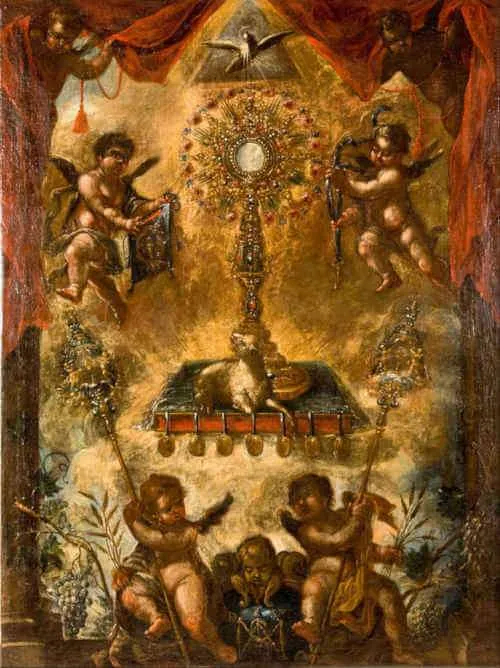
The Most Holy Body and Blood of Christ

Of the greatest and most valuable treasures one could obtain in this world, nothing is more precious, more sacred, and more valuable than the Most Holy Body and Blood, Soul and Divinity of Jesus Christ, our Sovereign and Eucharistic Lord. Millions, billions, or even hundreds of trillions of dollars do not come close to the infinite value and transforming power of the Body and Blood of Christ. No amount of earthly wealth can buy happiness, but the Eucharist bestows it freely. No amount of money can purchase Heaven, but the Eucharist transforms you into a member of the Body of Christ Whom you consume, leading you to Heaven. At the end of our lives, when we stand before the Just Judge, we will realize the transforming power of this Gift. Those who adored Him and received Him faithfully in Communion will be forever grateful they did.

Human dignity demands that we show respect to one another, reverencing the presence of God in each person as a living tabernacle of the Lord. However, we do not bow down before God’s presence in others, nor do we kneel before them in adoration and worship. In this world, the only One Whom we worship and adore, in hidden yet physical form, is our Lord Who is fully present in the Eucharist. The Eucharist is not only a fraternal meal we share with one another, it’s a communion with God Himself that unites us with Him. It is that union with God that also unites us with every other person who is united to God through the sharing of the Most Holy Eucharist.

The Solemnity of Corpus Christi originated with a mystic named Saint Juliana of Cornillon. She was born near Liège, Belgium around the year 1191. At the age of five, she and her sister were orphaned and entrusted to the care of Augustinian nuns. Within that convent, Juliana grew in her faith, participated in Eucharistic adoration, and frequented Holy Communion. She eventually joined the Augustinians and became a nun herself.

At the age of sixteen, she had a mystical vision during Eucharistic adoration in which she saw the moon with a dark stripe. By divine intuition, she understood that the moon symbolized the Church’s life on earth, and the dark stripe symbolized the absence of a feast that was specifically dedicated to the Body and Blood of Christ. In the convent, she had the same vision several more times but kept it to herself for twenty years.

Around the age of thirty-six, she shared her vision with two friends, one a local hermit and the other a fellow nun. Together, these holy women grew deep in their love of Christ in the Eucharist, especially adoring His hidden presence and receiving Him frequently in Holy Communion. After sharing her vision with the bishop, he reluctantly approved a local annual feast in honor of the Blessed Sacrament, and some other bishops followed. However, as word spread about Juliana’s visions, her superior and some clergy opposed her. She had to leave the convent, taking refuge in various Cistercian monasteries for ten years.

In 1258, around the age of sixty-seven, Juliana was adoring Jesus in the Most Blessed Sacrament in her cell when she died and was taken into the unveiled presence of God in Heaven. Prior to her death, the local Archdeacon in Lièges, Jacques Pantaléon of Troyes, had become familiar with Juliana and believed that her visions were from God and that a universal feast of Corpus Christi was God’s will. In 1261, Archdeacon Jacques Pantaléon was elected pope and took the name Pope Urban IV.

In 1263, a Eucharistic miracle took place in Bolsena, Italy, about ten miles from where Pope Urban was residing in Orvieto in the Papal States, modern-day Italy. A German priest named Father Peter of Prague stopped at the church in Bolsena to offer Mass during a pilgrimage at the tomb of Saint Christina, a fourth-century martyr. By his own admission, he was struggling to believe in the true presence of Christ in the Eucharist. During the consecration, the host he was holding began to bleed and flow onto his hands and the linen corporal on the altar. He immediately went to Orvieto to reveal the miracle and his lack of faith to Pope Urban. Pope Urban absolved him and then sent a delegation to investigate the miracle. They brought the corporal back to the cathedral in Orvieto with great solemnity where it remains enshrined today.

In 1264, Pope Urban instituted the universal Solemnity of Corpus Christi and asked the renowned theologian Father Thomas Aquinas to compose the liturgical texts for the feast. Among the texts the future saint and doctor of the Church composed are the revered and frequently sung hymns, “Pange Lingua,” “Tantum Ergo,” “Panis Angelicus,” and “O Salutaris Hostia.” The Thursday after the Solemnity of the Most Holy Trinity was chosen for the annual feast in honor of the day that the Eucharist was instituted.

After the death of Pope Urban IV, the Solemnity of Corpus Christi was removed from the universal calendar for about fifty-three years until Pope John XXII added it back in 1317. Since that time, the solemnity has grown and become an important annual celebration that often includes Eucharistic processions, adoration, and Mass. In many locations where it is not a holy day of obligation, the solemnity is moved to the following Sunday so as to extend the celebration to the entire people of God. In 1869, Pope Pius IX canonized Saint Juliana of Lièges, adding even greater credence to her miraculous visions and solidifying the importance of this holy solemnity.

As we celebrate the Solemnity of Corpus Christi, spend time pondering the profound mystery of the true presence of Christ in the Eucharist. As we kneel before Him, we truly kneel before His throne in Heaven, despite the reality being veiled from our eyes. As we consume the Blessed Sacrament, we truly consume Christ Himself—Body and Blood, Soul and Divinity—and receive Him into our souls. Though we might not feel Him with our bodily senses, we must allow our spiritual sense of faith to grow so that our love for Him in this Most Precious Gift exponentially increases. Let’s conclude with the “Tantum Ergo,” which is taken from the last two verses of the beautiful hymn of Saint Thomas Aquinas, the “Pange Lingua:”

Down in adoration falling, Lo! the sacred Host we hail; Lo! o’er ancient forms departing, newer rites of grace prevail; faith for all defects supplying, where the feeble senses fail. To the everlasting Father, and the Son who reigns on high, with the Holy Ghost proceeding forth from Each eternally, be salvation, honor, blessing, might and endless majesty. Amen. Alleluia.

Source: https://mycatholic.life/saints/saints-of-the-liturgical-year/corpus-christi—body-and-blood-of-christ–solemnity/

The Most Holy Body and Blood of Christ Read More »

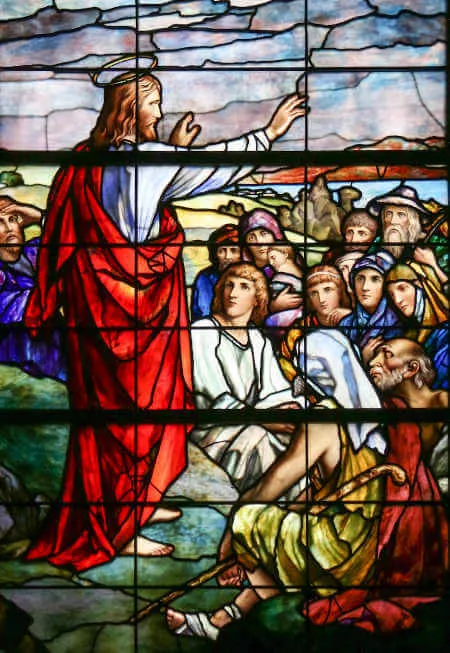
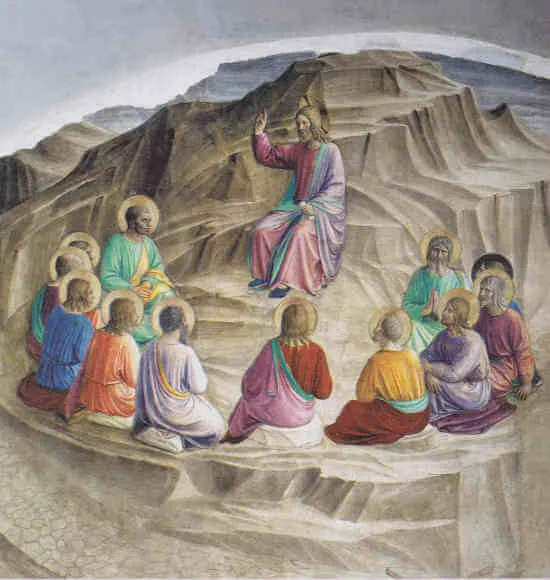
Matthew 5:1–3

Beyond Worldly Wisdom

When Jesus saw the crowds, he went up the mountain, and after he had sat down, his disciples came to him. He began to teach them, saying: “Blessed are the poor in spirit, for theirs is the Kingdom of heaven…”

Reflection:

Like Moses, Jesus “went up the mountain” to deliver divine teaching. Rather than issuing commandments, He proclaimed invitations to partake in God’s very life. The Beatitudes do not merely set forth a moral code; they unveil the interior dispositions of those who live in communion with God’s grace, revealing a blessedness that transcends worldly notions of morality. Jesus did not receive these divine laws as a prophet; He delivered them as God—not inscribed on stone tablets, but written upon the hearts of those who receive His wisdom in faith.

The Ten Commandments, given by God through Moses, present moral precepts that are easily understood. The Beatitudes, however, can only be grasped through the gift of divine insight. For this reason, they can be challenging at first. Why would anyone desire to be poor in spirit, to mourn, to be meek, to hunger and thirst for righteousness, to be merciful, pure of heart, a peacemaker, or to suffer persecution and insult? Because those who embrace this way of life are rewarded with the Kingdom of Heaven: They will receive divine comfort, be satisfied, obtain mercy, see God, be called children of God, and receive great reward in Heaven.

The Beatitudes are divine paradoxes. They reveal how true blessedness is found not in earthly power, wealth, or comfort, but in spiritual poverty, humility, and even suffering for the sake of righteousness. They overturn worldly expectations, teaching that those who seem least in the eyes of the world are, in fact, greatest in the eyes of God. By embracing these paradoxes, a disciple of Christ discovers that what appears to be weakness is, in reality, the path to divine strength, and what seems like loss is, in truth, the means to eternal gain.

For those who enjoy earthly power, wealth, or comfort, the Beatitudes are exceptionally challenging. Yet for those who are weak, poor, or afflicted, the Beatitudes offer profound consolation. Divine Wisdom is the fullness of Truth, accessible only through the gift of grace. No amount of human reasoning or philosophical argument can fully unveil the depth of the Beatitudes—only God, through His grace, can open the mind and heart to their truth.

Throughout life, we are confronted with countless competing opinions about how we ought to live. A deep desire for happiness is inscribed upon every human soul, yet people seek its fulfillment in vastly different ways. While worldly wisdom may offer guidance for a healthy and comfortable life, only divine Wisdom can fulfill the soul’s deepest longing for true and lasting happiness.

Do you want to be happy? Of course you do. Though many people experience unhappiness and even engage in actions that lead to misery, human nature is such that every choice we make is ultimately driven by our innate longing for happiness. As the saying goes, “You can’t not want to be happy!” The key to attaining happiness is discovering the true path. Since God Himself has placed this natural longing within our souls, we must turn to Him for its fulfillment. The answer He has given is the Beatitudes.

Reflect today on your desire for happiness. Because of our fallen human nature, we suffer from what the Church calls “concupiscence.” Concupiscence distorts our passions and desires, obscures our thinking, and weakens our will, making it difficult to discover the true path to the fulfillment we desire. The Beatitudes remedy concupiscence by exposing our fallen tendencies and the false promises of happiness we so easily believe, redirecting us toward the truth. Embrace the wisdom of the Beatitudes, strive to live them by the aid of grace, and you will discover that your deepest desires are fulfilled—not in passing pleasures, but in the truth of these interior dispositions.

Source: https://catholic-daily-reflections.com/2026/06/07/beyond-worldly-wisdom/

Matthew 5:1–3 Read More »

Saint Norbert, Bishop

c. 1080–1134; Patron Saint of expectant mothers and Bohemia; Canonized by Pope Gregory XIII on July 28, 1582

Saint Norbert did not begin his life as a saint. He was born in the town of Xanten, within the Holy Roman Empire and the Kingdom of Germany, to noble parents. Because of his nobility, he was educated at the Church of Saint Victor in Xanten and later became a canon in that church. Though not ordained, he was considered a cleric, receiving the ministry of subdeacon. In his role as a canon, Norbert prayed the Divine Office each day with the other canons and received a salary for this simple duty—the primary reason he accepted the canonry. However, he soon discovered a way to increase his income. He paid someone to take his place praying the Divine Office each day in Xanten and moved to the court of the Prince-Archbishop of Cologne. Soon after, he became a member of the court of Holy Roman Emperor Henry V and was put in charge of distributing the royal alms. The income from his canonry and his position at the court enabled him to live a very comfortable lifestyle.

In the court of King Henry, Norbert witnessed firsthand an ongoing controversy between the pope and the emperor. In 1111, Henry V traveled to Rome to resolve a dispute called “the lay investiture controversy.” The emperor wanted to retain spiritual authority to appoint and invest bishops, to which the pope was opposed. Once negotiations broke down, Henry apprehended the pope and held him captive until the pope agreed to his terms. The pope finally agreed, but once Henry left, the pope excommunicated Henry. Norbert was sympathetic to the pope’s position and was shaken by this controversy.

Over the next year, Norbert began to have a moral awakening. That awakening came to a head one day as he rode his horse during a violent storm. Lightning struck, knocking him off his horse. In that near-death experience, Norbert sensed God asking him why he was living such a vain life, to which Norbert replied, “Lord, what do you want me to do?” The Lord responded, “Turn from evil and do good; seek peace and pursue it.” This experience initiated a profound conversion. He resigned from the emperor’s court and spent the next three years in prayer and penance in the Abbey of Siegburg, just south of Cologne.

After his three-year-long period of prayer and penance, Norbert approached the Prince-Archbishop of Cologne in 1115 and requested priestly ordination, which was granted. He then returned to his hometown, to the church of Saint Victor in Xanten to celebrate Mass and preach. The newly converted Father Norbert was not well received by the younger and worldly canons of that church. His newfound zeal and opposition to worldly living convicted them. They eventually forced him to leave. After leaving, Father Norbert sold all his property and possessions, distributed the money to the poor, and began walking from town to town across Europe, often barefoot, preaching the Gospel, calling for the reform of the Church, and begging for food as he went.

In 1118, controversy with King Henry V continued under the new pope, Gelasius II. Soon after, the pope had to flee Rome for fear of Henry. While the pope was in exile, Father Norbert met up with him in France and sought his direction for his priestly ministry. The pope encouraged Father Norbert and granted him universal faculties to preach and minister anywhere he felt called.

In 1119, after Pope Gelasius died, Father Norbert sought out the counsel of his successor, Pope Calixtus II, who encouraged him to found a religious order. At the invitation of the bishop of the Diocese of Laon, in northern France, Father Norbert and his one companion decided to found their monastery of priests in a remote part of the diocese called Prémontré, a valley within a forest. Upon arriving, they were joined by twelve others. They built small huts around a chapel and later built a larger monastery. They adopted the rule of Saint Augustine and structured their daily life in such a way that they could become true contemplatives so that they could then bring that contemplative union they enjoyed into their priestly ministry to the people. The order was named Canons Regular of Prémontré, or the Premonstratensians. Later, it would become known as the Norbertines after their founder. Within a few years of its founding, women’s branches were established, and more than a dozen monasteries were erected in France, Germany, and Belgium.

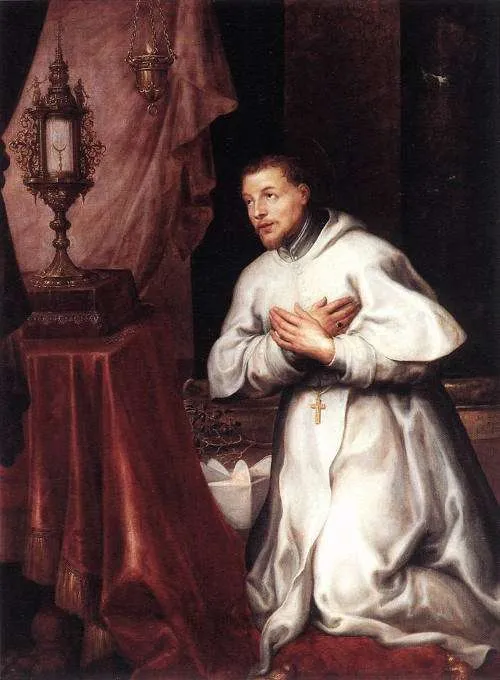
Father Norbert continued his traveling, founding, and preaching. While traveling through the city of Antwerp, in modern-day Belgium, Father Norbert came upon a large group of people who had started following a heretical itinerant preacher named Tanchelm. Among his heretical teachings was a denial of the true presence of Christ in the Eucharist. Tanchelm was so fierce that he even had his followers confiscate, desecrate, and discard the Eucharist in hidden places. To combat that heresy, Father Norbert preached powerfully, won over many of Tanchelm’s followers, and then commissioned them to gather up the desecrated hosts. When they found the hosts, they were discovered to be untouched and unsoiled, despite many of them being thrown into dirt and moisture. The hosts were gathered together, and Father Norbert carried them in procession back to the local church. For this reason, sacred art often depicts him carrying a monstrance or ciboria containing the Blessed Sacrament.

In 1126, Father Norbert and his companions traveled to Rome to obtain final papal approval for his new order from Pope Honorius II. On their way home, they traveled through the city of Würzburg, where Father Norbert cured a blind woman. He also cast out demons and restored peace between feuding noble families. The people were so impressed that they and others from Magdeburg rallied to have him appointed as their bishop. The king of the Germans and the papal legate agreed, and the pope appointed him as Archbishop of Magdeburg, a post Norbert reluctantly accepted.

Bishop Norbert served as archbishop for about eight years until his death. As archbishop, he continued to work on reforming the Church by weeding out immoralities among the clergy, resolving schisms, securing the right of the Church to govern itself without the interference of the civil authority, helping the Premonstratensian Order to grow, and preaching to the people, converting many.

Saint Norbert started his life as a worldly cleric, living a lavish lifestyle. After experiencing a profound encounter with God, he entered a period of deep prayer to more clearly discern God’s will. During this time, God took hold of him and never let go, leading him to great fruitfulness for the Church. If you find yourself pursuing worldly goals, let Saint Norbert’s story inspire you. Choose to focus on that which is eternal, and God will begin to work great spiritual transformations within your soul today.

Source: https://mycatholic.life/saints/saints-of-the-liturgical-year/june-6—saint-norbert-bishop/

Saint Norbert, Bishop Read More »

Mark 12:43–44

Radical Generosity

“Amen, I say to you, this poor widow put in more than all the other contributors to the treasury. For they have all contributed from their surplus wealth, but she, from her poverty, has contributed all she had, her whole livelihood.”

Reflection:

How generous are you? This is a challenging question, yet one worth considering. Does your generosity reflect God’s boundless generosity? Do you struggle with selfishness and greed, failing to live out the Gospel call to poverty, detachment, and charity? Most people likely fall short of this ideal. Acknowledging this, though difficult, is an act of honesty and humility. Such humility disposes us to receive an outpouring of heavenly riches, which far surpass any earthly possessions or attachments we may cling to or desire.

In today’s Gospel, set just days before His Passion, Jesus warns the people about the scribes. In a previous discourse, He had highlighted their limited understanding of His divine identity and their overly legalistic approach to Scripture. Today, He condemns them for their excessive attachment to external displays of piety—such as “long robes” and public honors—as well as their greed, neglect of the poor, and hypocritical religiosity. He concludes His warning with a sobering statement: “They will receive a very severe condemnation” (cf. Mark 12:38–40).

The scribes likely thought highly of themselves and sought to outdo one another in outward show. They fasted, meticulously followed the Law as they interpreted it, recited lengthy prayers in public, and cultivated a religious culture that held them in high esteem. Yet Jesus’ harsh condemnation of them was spoken out of love. They, more than anyone in the Temple area, needed to hear His words and repent. Perhaps some were convicted by His rebuke, but for most, His words only hardened their hearts—ultimately leading to their plot to crucify Him.

That same day, Jesus taught the people—and the scribes who were listening—that the Law’s fulfillment is found in love, not in multiplying empty displays of piety. When asked by a scribe which commandment in the Law was the greatest, He proclaimed: “You shall love the Lord your God with all your heart, with all your soul, with all your mind, and with all your strength…. You shall love your neighbor as yourself” (Mark 12:30–31).

In today’s discourse, Jesus provided the people and the scribes who were listening with a concrete, visual example of His teaching. He pointed to a poor widow who placed two small coins in the Temple treasury, declaring that she had “put in more” than all the others. The coins she gave were called lepta (sometimes referred to as “mites”), the smallest denomination in circulation at the time. A single lepton was worth approximately 1/128 of a denarius, the standard daily wage for a laborer. In modern terms, if a daily wage were $170 USD, her two coins would amount to roughly $2.66—a seemingly insignificant sum, yet one of immense spiritual value in God’s eyes.

When God looks at your generosity, He looks into your heart and judges according to what He sees. He is not impressed by wealth or poverty, nor does He measure generosity by the size of a gift. Rather, He looks at your willingness to put love into action—loving “with all your heart, with all your soul, with all your mind, and with all your strength.” This love is first directed to God and then expressed through an unwavering love of neighbor. How much should we give to God and others? Like the poor widow, we must give our “whole livelihood,” meaning the totality of who you are and what you can do. That is what Jesus praised, and it is what He expects of us.

Reflect today on the radical generosity to which we are all called. As finite beings, we cannot meet every need in the world—but that is not our duty. Our duty is to offer all that we are and have to God in service of His will. Though such generosity may feel difficult, the pain we experience does not come from giving but from the remnants of selfishness resisting detachment. Pray for the grace to be so generous that it purges all selfishness from your heart, soul, mind, and strength. When that happens, God will see your goodness and bless you abundantly.

Source: https://catholic-daily-reflections.com/2026/06/05/radical-generosity/

Mark 12:43–44 Read More »

Saint Boniface, Bishop and Martyr

c. 675–754; Patron Saint of Great Germania; Pre-Congregation canonization

Once Christianity was legalized in the Roman Empire in the fourth century, many people in Roman-Britain began to convert. However, in the fifth century, after the fall of the Roman Empire, Britain slowly fell to invasion and conquest by the Angles, Saxons, and Jutes from modern-day Germany, Denmark, and the Netherlands. These people brought with them the religious practice of Germanic paganism, which held a polytheistic belief in both major and minor gods who were invoked for war, governance, fertility, prosperity, and many other aspects of human life. These Germanic pagans also practiced ancestor and nature worship; engaged in rituals, festivals, and magical spells; and had a strong oral tradition. At the end of the sixth century, Saint Augustine of Canterbury began a missionary expedition that marked the beginning of the re-Christianization of the British Isles.

Less than a century later, today’s saint, Saint Boniface, a descendant of the Germanic pagans who had conquered Roman Britain just a couple of centuries earlier, was born into one of those recently Christianized kingdoms of England. Later in life, Saint Boniface would return to the lands of modern-day Germany and the Netherlands, from which his ancestors came, to convert the pagans, help organize the Church, and unite it more closely with the pope in Rome.

Saint Boniface (named Wynfrid at birth) was born into a noble family in the Kingdom of Wessex in southern England. As a youth, Wynfrid was raised in the Catholic faith and received a good education. When missionary monks visited his hometown, Wynfrid was inspired to follow their example. His father initially disapproved but eventually gave his consent. Wynfrid was first sent to a nearby Benedictine monastery for seven years and then to the Abbey of Nursling, about 100 miles away.

At Nursling, Wynfrid excelled in his studies and prayer life, made vows as a Benedictine monk, and was ordained a priest at the age of thirty. As a young priest, Father Wynfrid quickly became known as an excellent preacher and teacher with a profound understanding of Sacred Scripture, as well as an excellent administrator, organizer, and diplomat.

During the first several years of Father Wynfrid’s priestly ministry, he kept sensing a call to evangelize the people of his ancestral homeland. Though he had no personal connection with the people, he did share their language, or at least a dialect of that same language. In 716, after being a priest for about ten years, Father Wynfrid began to realize his missionary calling by obtaining permission from his abbot to travel north to Frisia, modern-day Netherlands, to assist a missionary priest in that territory. At the time, the local pagan king was at war with the Christian Frankish king, which made missionary activity difficult. The pagans were unlikely to convert to the religion of those they were fighting. Father Wynfrid also observed that the Frankish Church needed reform, organization, and stability if it was going to flourish.

After what could be seen as a failed mission to Frisia, Father Wynfrid returned home to his monastery in Nursling. In the fall of 718, he traveled to Rome to consult with the Holy Father regarding his desire to evangelize the Germanic pagans. Pope Gregory II received him, evaluated his motives, and on May 15, 719, sent him north to evangelize the pagans. The pope also changed Wynfrid’s name to Boniface, which means “doer of good.” Despite expected challenges, within three years there was much good fruit, and the pope called Father Boniface to Rome for an update and new orders.

In Rome, in 722, Pope Gregory II was so pleased with Father Boniface that he ordained him a bishop. The pope named Boniface the regional bishop of all of Germany and sent him back with letters to the Frankish king and the clergy of the various dioceses, instructing them that Bishop Boniface was now in charge. With this new authority, Bishop Boniface went to work to better organize the Frankish Church, build new monasteries and churches, and improve relations between the Catholics and pagans.

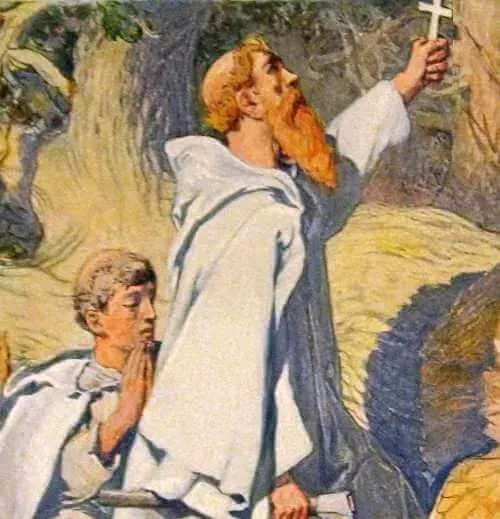
Legend has it that Bishop Boniface won the esteem of many of the pagans one day when he felled a huge oak tree considered sacred by the locals. It is said that after striking the tree with an ax, a powerful wind came and blew it over. The people were so surprised that Thor, the god of thunder, didn’t strike Boniface down that they began to inquire more about the Catholic faith. Bishop Boniface then used the wood of that tree to build a chapel and monastery under the patronage of Saint Peter.

Over the next thirty years, Bishop Boniface was a powerhouse of evangelization, organization, and reform. He built monasteries and churches, called synods in which clear ecclesiastical laws of governance for the Frankish church were established, worked with the Frankish kings and local authorities, served under four popes, and continued to create the foundational framework for the important mission of evangelization of the pagans.

At the age of seventy-nine, after being satisfied with his organization of the various dioceses throughout Germany, Bishop Boniface decided to return to Frisia, where it all had started, to preach and convert the remaining pagans. After much success, while preparing to celebrate the Sacrament of Confirmation for the new converts, Bishop Boniface and dozens of his companions were murdered, most likely by common thieves. When the murderers pillaged through their belongings, they found nothing of value to them, mostly books and letters that they threw in the forest, since they didn’t know how to read. Those books and letters were later found and are preserved, including a Bible believed to have been used as a shield by Bishop Boniface as he was slain by a sword. The bishop and his companions died with courage, not fighting back. The bishop’s last words are recorded as, “Cease, my sons, from fighting, give up warfare, for the witness of Scripture recommends that we do not give an eye for an eye but rather good for evil. Here is the long awaited day, the time of our end has now come; courage in the Lord!”

Saint Boniface is known as the “Apostle of Germany.” Early in his life, he heard God calling him to be a missionary, and he generously responded. As a result, God did powerful things through him for the good of his ancestral home and beyond. His impact was so great that the seeds he planted in Germany greatly contributed to the shaping of modern-day Europe. As you ponder the great fruit born by Saint Boniface’s courage and zeal, prayerfully offer your own life to God, vowing to serve Him and His Church in any way He calls.

Source: https://mycatholic.life/saints/saints-of-the-liturgical-year/june-5—saint-boniface-bishop-and-martyr/

Saint Boniface, Bishop and Martyr Read More »

Mark 12:35–37

Understanding “with delight”

As Jesus was teaching in the temple area he said, “How do the scribes claim that the Christ is the son of David? David himself, inspired by the Holy Spirit, said: The Lord said to my lord, ‘Sit at my right hand until I place your enemies under your feet.’ David himself calls him ‘lord’; so how is he his son?” The great crowd heard this with delight.

Reflection:

Today’s Gospel presents us with one of Jesus’ many teachings in the Temple area just days before His Passion. Just prior to this Gospel, Jesus praised one of the scribes for his understanding of Scripture, saying to him, “You are not far from the kingdom of God” (Mark 12:34). He then turned His attention to a large crowd and revealed the limited understanding that many of the scribes and teachers of the Law had about the Messiah.

Though the scribes rightly understood from Scripture that the Messiah would be born of King David’s lineage, their understanding of the Messiah was incomplete. Many believed that, as David’s descendant, the Messiah would be a great king who would lead the Jewish nation militarily and free them from Roman oppression. What they failed to understand was that the Messiah was not only a “Son of David” but also divine.

Jesus quotes Psalm 110:1, one of the most frequently cited Old Testament passages in the New Testament: “The LORD says to my lord: ‘Sit at my right hand while I make your enemies your footstool.’” King David, who was inspired by the Holy Spirit, refers to the Messiah as his lord or master, expressing that the Messiah would not only be his descendant but also greater than David. Furthermore, David reveals that the LORD—the Father in Heaven—would exalt the Messiah to a position of divine authority.

To “sit at my right hand” was a favor granted only to one who was divine; not even David could sit at God’s right hand. To “make your enemies your footstool” was a reference to the ancient practice by which a victorious king would have his enemies lay prostrate before him, placing his foot upon them as a symbol of absolute dominion. However, Jesus’ kingship is not merely earthly but spiritual and eternal. The true enemies placed under His feet are sin, death, and the demons (1 Corinthians 15:25–26, Colossians 2:15).

Though we understand Jesus’ identity as the Son of David, the Messiah, and God Himself, it is important to humbly recognize that, like the scribes, we, too, struggle to fully grasp the mysteries of faith. In Heaven, when we see God face to face in the Beatific Vision, we will receive a full and immediate understanding of Him in His essence, far greater than anything we can comprehend today. Though this full revelation will be given to us at that time, we must continuously strive for greater clarity now.

The first and most important foundational step toward that end is to prayerfully reflect on the Scriptures. This is more than merely acquiring intellectual knowledge of Scripture, as the scribes did. Study is a human effort, and while valuable, the only way to arrive at true understanding of Scripture—and of God, Whom Scripture reveals—is through the guidance of the Holy Spirit. Here and now, we must be open to illumination that comes only from God.

Many of the scribes criticized Jesus because they relied solely on their own interpretation of Scripture. Most of them failed to be open to the guidance of the Holy Spirit in their study. Perhaps the one scribe who spoke to Jesus with understanding and was “not far from the kingdom of God” stirred Jesus’ Sacred Heart with a longing that all scribes—and all of us—would approach His Word with the same openness.

Reflect today on the scribes and see yourself in them. Pray for the gift of divine illumination as you spend time in God’s Word, seeking to follow the example of the one scribe who understood. Invite the Holy Spirit to guide your understanding so that, like those listening to Jesus in the Temple, you, too, may understand His Word “with delight.”

Source: https://catholic-daily-reflections.com/2026/06/04/understanding-with-delight/

Mark 12:35–37 Read More »