January 2026

Saint John Bosco, Priest

1815–1888; Patron Saint of apprentices, boys, editors, laborers, magicians, students; Canonized by Pope Pius XI on April 1, 1934

The youngest of three sons, John Bosco was born into a poor family in northwest Italy in the rural hamlet of Becchi. His father, a farmhand for a neighboring family, died when John was only two. His mother continued to raise her sons with much love and affection.

Until the age of twelve, John spent most of his time trying to support the family by working as a shepherd and farmhand like his father. His family’s poverty made it difficult for him to obtain a good education. His learning came from his lived experience, homelife, and the sermons at church that he listened to attentively.

At the age of nine, John had the first of many dreams that would greatly influence him. In his dream, he came across a group of rough boys who were talking and cursing. John became angry with them and raised his fists to threaten them for their cursing. Suddenly, a man appeared in his dream who was radiant like the sun. The man said to John, “Conquer the hearts of these, your friends, not with violence but with charity. Begin at once. Teach them the evil of vice and the excellence of virtue.” When John asked the man who he was, the man replied, “​​I am the Son of the lady I will send to be your teacher.” With that, the Blessed Mother appeared in the dream and began to teach John about his future mission of caring for boys with kindness.

John began his “ministry” when he was only ten. He would attend the shows of entertainers who performed juggling, magic tricks, and acrobatics. John studied their shows and then attempted to imitate them for other boys, always including prayers within the show and lessons he learned from Sunday sermons.

As was typical with many boys, John and his brother were always fighting with each other. This was one of the reasons that John decided to leave home at age twelve to look for work. A few years later, John caught the attention of a newly ordained priest and future saint, Father Joseph Cafasso, who saw his intellectual gifts and assisted him with his education. By the time John was twenty, Father Cafasso, with the help of some money from John’s mother, helped him enroll in the seminary. After six years of study, at the age of twenty-six, John was ordained a priest.

After ordination, Father John joined his mentor, Father Cafasso, in Turin to continue his studies at the Institute of Saint Francis where Father Cafasso was in charge. The two also engaged in ministry to the poor and imprisoned, cared for girls at a boarding school, and assisted in country parishes. It was in the prisons that Father John became aware of the number of boys who needed help. Of this experience, he later wrote in his Memoirs, “I saw large numbers of young lads aged from 12 to 18, fine healthy youngsters, alert of mind, but seeing them idle there, infested with lice, lacking food for body and soul, horrified me. Public disgrace, family dishonor, and personal shame were personified in those unfortunates.” He thought to himself, “Who knows?…if these youngsters had a friend outside who would take care of them, help them, teach them religion…they could be steered away from ruin…” Many of them were repeat offenders, and Father John’s heart was drawn to help them. His dream from when he was nine years old began to come to fruition as he sought to teach them, encourage them, listen to them, and befriend them as a mentor and spiritual father.

Father John’s plan was to found an oratory to provide structure and purpose for these boys. He helped them get jobs by teaching trades. At the same time, he provided them with food and shelter, taught them catechism, and gave them moral guidance and hope. Within ten years, Father John was assisting as many as 800 boys in need.

Less than a decade later, in 1861, some of the boys Father John mentored wanted to follow in his footsteps and assist other boys. Therefore, Father John founded the Society of St. Francis de Sales with a priest, seminarians, and a high school boy. The Salesian Order was formally approved by the Vatican in 1869. In 1871 Father John expanded his mission by founding a Salesian religious order of women called the Daughters of Mary Help of Christians to care for girls. Finally, in 1874 he founded the Salesian Cooperators, a lay organization that worked with the male and female Salesian Orders.

Saint John Bosco saw a need as he encountered troubled, imprisoned, poor, orphaned, but good-hearted young boys. He followed his inspiration not to be harsh with them, but to offer them loving discipline, friendship, education, skills to support themselves, and a family within his oratory. This loving concern for these young boys overflowed into the hearts of many others, and God used this saintly man to save the souls of many by raising up an army of workers to care for them.

Ponder those in your life who are troubled, abandoned, disgraced, or struggling in other ways. Strive to imitate Saint John Bosco by seeing the good in them and helping to draw that goodness out so that they will find hope in the midst of their struggles with despair.

Source: https://mycatholic.life/saints/saints-of-the-liturgical-year/january-31-saint-john-bosco-priest/

Saint John Bosco, Priest Read More »

Mark 4:35-38

Overcoming Unfamiliarity and Fear

Let us cross to the other side.” Leaving the crowd, they took Jesus with them in the boat just as he was. And other boats were with him. A violent squall came up and waves were breaking over the boat, so that it was already filling up. Jesus was in the stern, asleep on a cushion.

Reflection:

Our Lord’s words were prophetic, but so were His actions. Today’s Gospel begins after a long day of Jesus teaching parables to the people by the Sea of Galilee. One might think that, after a long day, Jesus and His disciples would have remained in Capernaum for the night, getting a good night’s sleep. Instead, Jesus invites His disciples to join Him for a long night on a boat, crossing to the other side of the sea to the territory of the Gerasenes.

The Gerasenes were a predominantly Gentile population living in a region that formed part of the Decapolis—a group of ten cities heavily influenced by Greco-Roman culture and pagan practices. The area was culturally distinct from the Jewish territories around the Sea of Galilee, characterized by its Hellenistic architecture, customs, and beliefs. Jesus’ invitation to cross the sea was not only an invitation to a long night, but also an invitation to spend the next day within a culturally distinct and perhaps an uneasy setting different from their Jewish hometown.

This dual invitation should be seen as a prophetic action by which Jesus invited His disciples—and us—to leave our comfort zone and travel into the challenging and unfamiliar. This lesson has numerous practical implications for our lives. There are many things we do not feel like doing and many ways God calls us out of our comfort zone into the unfamiliar. Fear must never deter us from answering the call, even when we are tired and prefer to rest. When God calls, we must respond.

The journey across the Sea of Galilee is also packed with prophetic lessons. The journey by boat from Capernaum to the territory of the Gerasenes was about five to six miles. Under calm conditions, the journey might have taken one to two hours. However, the storm likely extended this time, possibly making the trip several hours long, especially if the disciples had to work against the wind and waves.

One important aspect of the journey is that Jesus is asleep during the storm. Because it would have been difficult for anyone to sleep while “waves were breaking over the boat, so that it was already filling up,” we should see our Lord’s sleep as intentional, to reveal a spiritual lesson. Though God might seem distant at times, or asleep during our time of need, He is there, waiting for us to turn to Him, wake Him, and call on Him.

Though these were experienced fishermen and boatmen, they were terrified. Jesus permitted them to experience this terror to reveal their need for faith and trust in Him. His calm presence, even as He slept, was a reminder that no storm—whether physical or spiritual—can overpower the One who created the seas. His rebuke of the wind and waves, “Quiet! Be still!” not only restored peace to the sea but also revealed His divine authority, revealing Himself as God: “LORD, God of hosts, who is like you? Mighty LORD, your faithfulness surrounds you. You rule the raging sea; you still its swelling waves” (Psalm 89:9–10).

Reflect today on Jesus’ invitation to the disciples to make the journey across the sea after a tiring day. Similarly, God sometimes calls us to enter the chaos of this world to bring His grace where it is not found. Though rest is important, sometimes we must deny ourselves and enter into the sea toward the unfamiliar—reaching out to neighbors or others with whom we feel hesitant, volunteering in ministries, or embracing new challenges that call us out of our comfort zone. As you ponder this scene, let the words of Christ echo in your heart, bringing peace to your soul: “Quiet! Be still!” Do not fear. Have faith. Trust that His command will calm every storm, and hold on to the knowledge that He is always with you, guiding you safely to the other side.

Source: https://catholic-daily-reflections.com/2026/01/30/overcoming-unfamiliarity-and-fear/

Mark 4:35-38 Read More »

Saint Marianne Cope, Virgin

1838–1918; Patron Saint of lepers, outcasts, those with HIV/AIDS, Hawaii; Canonized October 21, 2012, by Pope Benedict XVI

Born in Germany, Barbara Koob was brought to the United States by her parents before the age of one. The immigrant family settled in Utica, New York, and joined Saint Joseph Parish where Barbara later attended grade school. After grade school, Barbara began working in a textile factory to support the family after her father became too ill to work. Despite her longing to enter religious life, Barbara continued to financially support her family for the next nine years.

In 1862, at the age of twenty-four, Barbara finally realized her desire for religious life by entering the Sisters of Saint Francis in Syracuse, New York. Upon receiving the religious habit, she took the name Sister Marianne. For the next twenty-one years, she served as a teacher, principal, mother superior, provincial superior, hospital founder, and administrator. She was a trailblazer who specialized in caring for the outcasts of society with love and affection. Although this caused some to look down on her, Barbara’s care for society’s outcasts also won her much love and admiration from the German-speaking Catholics of central New York.

In 1883, now the Mother Provincial of her order, Mother Marianne’s life would change forever. She received a request from the government in Hawaii asking her to send sisters to care for those suffering from the dreaded disease of leprosy. With joy and enthusiasm that would have delighted Saint Francis, her order’s founder, she responded “Yes!” “I am hungry for the work…” Her heart was flooded with desire as she saw the great privilege of leaving home and family to care for these poor souls who suffered so greatly. At that time, more than fifty religious orders had already turned down the same request out of fear of their members contracting the disease. Mother Marianne responded in haste, going herself with six of her sisters. Though she did not realize it at the time, she would never return to New York. Instead, she spent the next thirty-five years exercising the great privilege of caring for the bodies, minds, and souls of God’s precious outcasts with Hansen’s Disease (leprosy).

Upon arriving in Hawaii, Mother Marianne and her sisters went right to work, cooperating with the Church and the government to better the lives of these poor ones of God. Mother Marianne and her sisters helped those with leprosy, despite their fatal condition, to live dignified lives—teaching them, having fun with them, praying with them, and caring for their physical needs. Mother Marianne’s administrative skills were of great use when she was called upon to open new homes, establish a residence and school for the children of those with leprosy, correct government abuses of her poor ones, and consolidate facilities as needed.

In 1884, Mother Marianne met the future Saint Damien de Veuster who devoted his life to the care of those with leprosy on the isolated island of Molokai. Two years after their meeting, Father Damien contracted leprosy himself. In 1888, Mother Marianne went to Molokai to care for him during his last year of life, since he was now an outcast too. She pledged to continue his good work, and with his passing, took over the home for boys he had established.

For twenty-seven more years after Father Damien’s death, Mother Marianne cared for the outcasts and their families. She often said to her sisters that it was their duty and privilege “to make life as pleasant and as comfortable as possible for those of our fellow creatures whom God has chosen to afflict with this terrible disease…” Mother Marianne died of natural causes at the age of eighty, never contracting the disease herself.

Two days after her death, one Honolulu newspaper wrote, “Throughout the Islands, the memory of Mother Marianne is revered, particularly among the Hawaiians in whose cause she has shown such martyr-like devotion…she was a woman of splendid accomplishments, and had fine executive ability. She impressed everyone as a real ‘mother’ to those who stood so sorely in need of ‘mothering.’”

As we honor Saint Marianne Cope, consider the quality of your affection and sincere concern toward society’s “outcasts.” The alcoholic, addict, criminal, impoverished, foreigner, and sinner are all images of Jesus waiting for your love. Allow this holy woman to inspire you to always see it as a privilege to love those most in need.

Source: https://mycatholic.life/saints/saints-of-the-liturgical-year/january-23-saint-marianne-cope-virgin-usa-optional-memorial/

Saint Marianne Cope, Virgin Read More »

Mark 4:33-34

Hearing the Living Word Speak

With many such parables he spoke the word to them as they were able to understand it. Without parables he did not speak to them, but to his own disciples he explained everything in private.

Reflection:

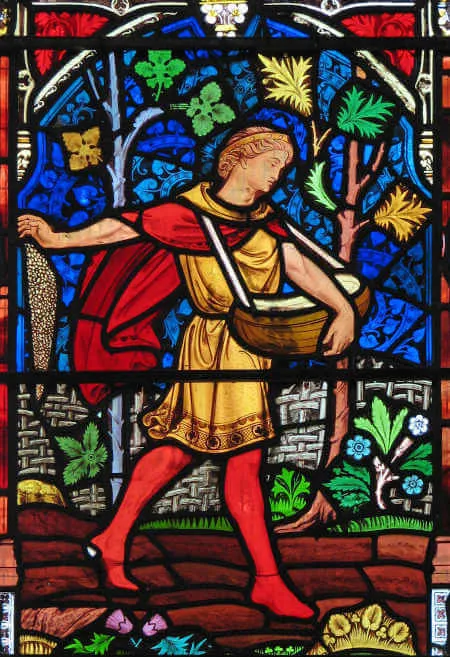
Today’s Gospel begins with two parables about the Kingdom of God, using the familiar image of seeds. Both of these parables point to the Kingdom of God as something that grows mysteriously and abundantly, often beyond human understanding or control.

The first parable points to the mysterious growth of the seed that the sower scatters on his fields: “and would sleep and rise night and day and the seed would sprout and grow, he knows not how” (Mark 4:27). This emphasizes the hidden and gradual work of God’s grace. Like the seed that grows in the soil without the sower fully comprehending how, the Kingdom of God grows quietly and powerfully, primarily through divine initiative.

The second parable is about the mustard seed, the smallest of seeds, which, when planted, “springs up and becomes the largest of plants and puts forth large branches, so that the birds of the sky can dwell in its shade” (Mark 4:32). This parable reveals the transformative power of the Kingdom, which begins from the humblest beginnings but grows into something expansive and life-giving. God often works through what appears insignificant to accomplish great things.

Though these parables are important and provide us with spiritual nourishment through prayerful reflection, what the Gospel writer says next, as is quoted above, is just as important. Parables were meant to draw the listener into divine mysteries. We have to ponder the message prayerfully and allow the Holy Spirit to reveal God’s Word to us. Because Jesus spoke only in parables to the crowds, we must see ourselves among their number. However, we must also work to be counted among Jesus’ own disciples: “to his own disciples he explained everything in private.”

God’s Word is alive. The Scriptures are not only like an ancient philosophy book that requires study and interpretation, which certainly play a proper role in understanding the Word of God. However, because God’s Word is a Living Word, it is more than an intellectual exercise. When we read it or hear it proclaimed, God is present. It is God Himself Who speaks to minds and hearts that are open and attentive. When we approach God’s Word in this way, God will “explain everything in private.”

“Private,” in this case, means “personal.” Engaging God’s Word draws us into a personal conversation with Him. It enables God to speak to us directly, revealing Himself in His Word, filling us with the spiritual gifts of Wisdom, Knowledge, Understanding, and Counsel. These Gifts of the Spirit are essential to our spiritual growth and are the primary way to grow in faith, hope, and charity.

Do you see the Word of God as the Living Word, inviting you into a personal dialogue with God? Consider the depth of the invitation extended to you in this Gospel passage. Jesus desires to speak to you “in private,” unveiling the mysteries of His Kingdom in a way that is deeply personal and uniquely suited to your personal journey.

Reflect today on how you approach the Word of God in your daily life. Take time to prayerfully ponder the parables and their meaning in your life. Consider setting aside a specific moment each day to read and meditate on a short passage from Scripture. Allow God to sow the seed of His Word in your heart and, like the farmer, marvel in wonder and awe as the Kingdom takes root and grows in your life. Trust that even the smallest acts of faith, like the mustard seed, can grow into something extraordinary when authentic and nurtured by God’s grace. Open your heart to receive the gifts of the Holy Spirit, asking for Wisdom to discern God’s voice, Knowledge to understand His will, Understanding to grasp the depths of His truth, and Counsel to act upon His Word.

Source: https://catholic-daily-reflections.com/2026/01/29/hearing-the-living-word-speak/

Mark 4:33-34 Read More »

Saint Sebastian, Martyr

c. 255–c. 288; Patron Saint of archers, pinmakers, athletes, against epidemics, and of a holy death; Pre-Congregation canonization

The glorious crown of martyrdom was placed on the head of Saint Sebastian not once but twice. He was born at Narbonne, Gaul (modern-day France), but was raised in Milan, Italy. During his childhood, the persecution of Christians was temporarily on hold, only to resume when Sebastian reached adolescence. Sebastian was a strong Christian who desired to assist those being persecuted for the faith. This holy desire led Sebastian to join the Roman army under the Emperor Carinus in 283, where he kept his Christian faith secret so he could have access to jailed Christians. In 284, Diocletian became Emperor and made Sebastian one of his bodyguards and intelligence officers, not knowing that Sebastian was a Christian. Shortly after this promotion, Sebastian discovered that Marcus and Marcellianus, brothers imprisoned for their faith, were being pressured by their pagan family and friends to save their lives by denying Christ. Their very own pagan parents pleaded, teary-eyed, with their twin sons to deny Christ.

Sebastian knew it was risky, but he openly revealed to all at the jail that he was a Christian. He exhorted the imprisoned brothers to stay strong in the faith, even if it meant their deaths. Sebastian preached so persuasively that eventually the brothers’ parents, the jailer, sixteen other prisoners, and more than sixty other family and friends were converted and baptized. Two of these received miraculous healings at the same time. When the ailing governor of Rome, Chromatius, heard about these healings, he sent for Sebastian. Sebastian then healed the governor himself and subsequently instructed him in the faith. After Chromatius and his son were baptized by the priest Polycarp, a future saint and martyr, Chromatius left his governorship and assisted in the conversion of many others to the Christian faith.

Sebastian and Polycarp decided that one of them should go with Chromatius and many of the new converts to the countryside for safety while the other would stay in Rome to help the persecuted Christians. After consulting the pope, it was decided that Sebastian would remain in Rome to be the “Defender of the Church,” since he enjoyed the favor of the emperor. During the following two years, despite his high status and access to the emperor, several of Sebastian’s converts were nonetheless martyred, including the twin brothers Marcus and Marcellianus.

In the year 286, the Emperor Diocletian found out that Sebastian was a Christian. Feeling betrayed, he ordered Sebastian’s death. The execution was to be public and brutal in an attempt to intimidate other Christians. Sebastian was bound, arrested, tied to a post, and blindfolded. The archers stretched their bows and were ordered to fill him with as many arrows “as an urchin is full of pricks” (The Golden Legend Vol. II). After penetrating his torso and limbs with arrows, they untied him and left his pierced body for dead. But Sebastian did not die! Instead, a holy woman named Irene came to bury his body and found him still alive! She was the wife of Saint Castulus, an officer in the Diocletian’s household, who had been martyred earlier that year. Irene carefully removed Sebastian’s arrows, took him to her home and nursed him back to health. Saint Irene would herself die a martyr just two years later.

After he had regained his health, many urged Sebastian to flee for his life. Instead, Sebastian presented himself before the emperor and firmly accosted him for his cruelty toward Christians. A nineteenth-century biographer placed these words on Sebastian’s lips as he confronted the most powerful man in the world: “Hearken to me O Prince! The priests of your temples deceive you by their wicked falsehoods against the Christians. They tell you, that we are enemies of the Empire; yet it is by our prayer that the Empire is made to prosper. Cease your unjust persecutions against us, and remember the day of reckoning is near at hand when you, too, shall be judged by an all-knowing Judge. (The Acts of the Early Martyrs, Fastré S.J.) The emperor, angered by Sebastian’s words and shocked that Sebastian was still alive, ordered again that he be executed. This time, Sebastian was beaten to death with clubs and thrown into a sewer.

After Sebastian’s death, he appeared in a vision to a holy woman named Lucina and asked her to remove his remains from the sewer and bury him in the catacombs of Callixtus. She did so that night. A basilica was later built there in his memory. This church and cemetery remain an important pilgrimage site today. In the centuries that followed his martyrdom, Saint Sebastian became well known for his intercessory power, especially in fighting off the bubonic plague in the fourteenth century. More recently, he has also been honored as the patron saint of athletes because of his dogged perseverance.

Source: https://mycatholic.life/saints/saints-of-the-liturgical-year/january-20-saint-sebastian-martyr/

Saint Sebastian, Martyr Read More »

Mark 4:21-23

Being Christ’s Lampstand

Jesus said to his disciples, “Is a lamp brought in to be placed under a bushel basket or under a bed, and not to be placed on a lampstand? For there is nothing hidden except to be made visible; nothing is secret except to come to light. Anyone who has ears to hear ought to hear.”

Reflection:

What guides your life? What influences your decisions? Many are motivated by worldly desires, such as wealth or status. Others seek fulfillment in fleeting pleasures. Some take their inspiration from cultural icons or those deemed successful by society. But as Christians, we are called to draw our inspiration and motivation from one source: the Light of God’s Truth.

In today’s Gospel, the lamp symbolizes Christ Himself, Who illuminates our minds and guides our decisions, just as a lamp lights up a dark room. A lamp cannot fulfill its purpose if it is hidden under a bushel basket or bed. Similarly, Christ must enlighten every aspect of our lives and shine forth in our words, deeds, and witness to others.

If the lamp symbolizes Christ, Who is divine Truth, then the lampstand represents the means by which we elevate and share that Truth. Though God, His grace, and the Truth of the Gospel are the light, that light comes to us in various ways. Our first goal as Christians is to make sure that God’s Light is the center of our lives. This means that when questions arise in our lives, we turn first to the Light as the one and only Source of Truth and guidance. We do this by turning to the Scriptures, the Catechism, the lives of the saints, and the inspiration of other holy people.

Just as a lampstand supports and elevates a lamp, it also provides a firm foundation, ensuring the light remains steady and visible even amid the winds of life’s challenges. Similarly, prayer, sacraments, and good works help stabilize the Light of Truth in our lives, enabling it to shine brightly and consistently.

Once our lives are enlightened and we clearly see the path God has chosen for us, we naturally begin to radiate that light to others. This is the essence of evangelization. By our daily prayer, sacramental life, acts of charity, and courage in witnessing to the Gospel, we become the lampstand that lifts high the Light of Christ. As others encounter that light through our example, they too are invited to draw closer to its Source, allowing the Truth of the Gospel to illuminate their lives.

Sometimes we can struggle in our efforts to evangelize. When we encounter others who express no interest in the Gospel, it is tempting to remain silent and cover up the Light of Christ. But that leaves others in darkness. The evil one often deceives us into thinking that we shouldn’t act as a lampstand for the Light of Christ if others prefer the darkness. We might fear offending them or sounding “holier than thou!” This is a dangerous trap.

Charity demands evangelization. All people need Christ in their lives, even if they do not know it or are hostile to Christ’s light. If you struggle being a lampstand for Christ, reflect on Jesus’ next words: “For there is nothing hidden except to be made visible; nothing is secret except to come to light.” In other words, we all will stand one day before the judgment seat of Christ when every hidden thought and action will come to light, visible to us and all who stand before Christ at the Final Judgment. On that day, will we regret having done everything possible to be a lampstand for Christ’s light to others? Certainly not. Instead, we will rejoice in every effort we made, even if our words and actions seemed futile. The light we shine might not immediately brighten someone else’s path. Yet, like seeds planted in the soil, it has the potential to grow and bear fruit in God’s perfect timing.

Reflect today on whether you have allowed fear, complacency, or self-doubt to hide the light of Christ in your life. Consider the people God has placed in your path who need His light but have not yet encountered it through you. Resolve to be a lampstand for Christ, courageously and lovingly lifting His truth high for all to see.

Source: https://catholic-daily-reflections.com/2026/01/28/being-christs-lampstand/

Mark 4:21-23 Read More »

Saint Thomas Aquinas, Priest and Doctor

1225–1274; Patron Saint of students, Catholic schools, apologists, booksellers, chastity, philosophers, publishers, scholars, theologians; Invoked against storms Canonized by Pope John XXII on July 18, 1323; Proclaimed Doctor of the Church by Pope Pius V in 1567

Among the greatest intellectuals in the history of the Church, Saint Thomas rises far above the rest. He is not only a Doctor of the Church but is given the titles Angelic Doctor, Common Doctor, and Universal Doctor. It is difficult to understate the impact that Saint Thomas has had on the Church’s doctrine and intellectual understanding of the faith.

Thomas was born in a grand castle in central Italy near the town of Aquino. His father was a nobleman, a knight in the army of the Emperor Frederick II. Thomas began his studies when he was only five at the famous Benedictine monastery, Monte Cassino, where his uncle was abbot. Thomas’s parents hoped he would one day become the abbot himself. When he was fourteen, because of military conflicts, Thomas moved from Monte Cassino to the newly founded University of Naples to continue his studies. It was there that he came in contact with the Dominicans who influenced him greatly and who made plans for Thomas to join their newly founded order. Thomas’ intellect shone forth at that time as he openly engaged in discussions, and his reputation for brilliance became widely known.

At the age of nineteen, the year after his father died, Thomas joined the Dominicans. This news angered his family who were steeped in the social system of feudalism at that time, which valued ownership of land and military service. The Benedictines were among the honored orders within the feudal system, not the Dominicans who were poor mendicant preachers. Thomas’ family wanted him to become the Abbot of Monte Cassino since it was more fitting for the nobility. To remedy this, his mother had Thomas abducted and locked in a family castle where he remained imprisoned for about a year. During that time, his mother, siblings, and many others did all they could to try to convince Thomas to become a Benedictine, but Thomas refused. One day, his family even sent a prostitute to his cell to tempt him, but he chased her away with a burning log. Eventually, his mother permitted him to escape the castle at night as a way of saving the family from further disgrace.

Now twenty years old, Thomas rejoined the Dominicans and was sent to Paris where he became a student of the intellectual giant Brother Albert, who is now known as Saint Albert the Great. Brother Thomas especially became fond of Aristotle’s philosophy, which would become the foundation of much of his future writings, a first in the history of the Church. He continued to study under Brother Albert for several years. Thomas also became much more reserved in class as he grew in the virtue of humility, rarely speaking up, debating, or revealing his keen intellect. His quiet nature led many of the students to conclude that he was unintelligent, and they gave him the nickname “Dumb Ox.” One day, however, his teacher, Brother Albert, decided it was time for everyone to realize how brilliant Brother Thomas was, so he gave him a difficult question to answer and asked him to return the next day to present his answer to the class. After Thomas did so, his fellow students were in awe and Brother Albert said of him, “You call him the Dumb Ox, but in his teaching he will one day produce such a bellowing that it will be heard throughout the world.”

In 1252, at the age of twenty-six, Brother Thomas was given the title “Master in Theology” by the pope. For the next twenty-two years, Brother Thomas wrote numerous books, sermons, commentaries on Scripture, and even composed some of our Church’s most beautiful hymns, including Pange Lingua. He continued as a teacher, preacher, and papal theologian in Paris, Naples, Orvieto, and Rome.

Among his many works, Saint Thomas is best known for the Summa Theologica, or “Summary of Theology,” which he never completed. One tradition states that when he was celebrating Mass in 1273, he had a vision. He later told his scribe, Brother Reginald, that he could no longer write. When Brother Reginald asked him why, he responded, “Reginald, I cannot, because all that I have written seems like straw to me.” Brother Thomas died the next year after a series of illnesses.

Saint Thomas was not only brilliant, he was also a man of deep faith, who loved God, never stopped contemplating the truths of faith, and courageously introduced new methods by which God became better known and understood. His life of prayer produced a wellspring of supernatural truth that was then organized by his intellect and articulated in ways never seen before. Thomas’ humility and sincerity come through in a story told by one early biographer who relates that as Brother Thomas was praying one morning before the crucifix, he anxiously implored the Lord as to whether or not his writings were correct. Jesus spoke to him saying, “You have written well of Me, Thomas, what shall be your reward?” Thomas replied, “Nothing but You, Lord.”

Though you might not be called to a life of intellectual brilliance, know that God wants to speak to your mind, reveal many hidden truths, and help you apply those truths to your daily life. Ponder any ways that you can more fully engage your mind with the truths of faith so that those truths will become the foundation of your mission in life.

Source: https://mycatholic.life/saints/saints-of-the-liturgical-year/january-28-saint-thomas-aquinas-priest-and-doctor/

Saint Thomas Aquinas, Priest and Doctor Read More »

Mark 4:8-10

Relentlessly Pursuing an Obstinate Heart

“And some seed fell on rich soil and produced fruit. It came up and grew and yielded thirty, sixty, and a hundredfold.” He added, “Whoever has ears to hear ought to hear.” And when he was alone, those present along with the Twelve questioned him about the parables.

Reflection:

The Parable of the Sower is one of Jesus’ foundational teachings. When preaching from a boat to a large crowd, Jesus used parables to reveal the mystery of the Kingdom of God. Afterward, His disciples questioned why He spoke in veiled language rather than directly. Jesus responded, “The mystery of the kingdom of God has been granted to you. But to those outside everything comes in parables, so that ‘they may look and see but not perceive, and hear and listen but not understand, in order that they may not be converted and be forgiven’” (Mark 4:11–12).

At first, this response might seem perplexing. Why would Jesus teach in a way that some would not understand, potentially hardening their hearts further? To understand this, we turn to the Prophet Isaiah, whom Jesus quoted (cf. Isaiah 6:8–13). God commissioned Isaiah to preach to a people who were stubborn and unrepentant, saying they would “look and see but not perceive” and “hear and listen but not understand.” Despite Isaiah’s zeal, God permitted their hardness of heart so they could face the consequences of their refusal to repent. This prophetic action sheds light on Jesus’ use of parables.

God “wills everyone to be saved and to come to knowledge of the truth” (1 Timothy 2:4). However, for those who refuse His Word, God sometimes permits their obstinacy as an act of mercy. Parables serve a dual purpose. For those open, they invite reflection and reveal deeper truths that lead to greater faith. For those closed, parables expose their resistance, deepening their awareness of spiritual emptiness. This process, though painful, is a merciful act, meant to confront individuals with the consequences of their sin and lead them to repentance.

The Parable of the Sower, in particular, invites us to examine the “soil” of our own hearts. God, in His generosity, spreads the seed of His Word widely, offering grace and Truth to everyone. What kind of soil are you? Are you like the path, where the Word is quickly devoured by distractions, pride, or indifference, leaving no room for growth? Are you like the rocky ground, receiving the Word with enthusiasm but lacking the roots to endure trials and tribulations? Or are you like the thorny ground, where worldly anxieties, the lure of riches, and divided priorities choke the Word before it can bear fruit?

Ideally, we are none of the above. Jesus calls us to cultivate rich soil—a heart receptive to His Word, where His grace takes root and bears abundant fruit. Only when we are receptive to grace and nurture the truths we have received through fidelity can we see God’s Word flourish in our lives.

This parable also teaches us how to respond to those who appear closed and obstinate. It is tempting to grow discouraged or angry and give up. But that is not what Jesus did, nor is it what Isaiah did. Isaiah fulfilled his mission to preach, even to those who rejected him. Similarly, Jesus continued to preach, using parables to reach all people, knowing that rejection would come.

Reflect today on the soil of your heart and the hearts of those whom you are called to evangelize. Through prayer, nourish the Word of God within you so it can bear fruit. Persevere in sharing God’s Word with others. When Isaiah asked how long he should continue preaching, God responded, “Until the cities are desolate, without inhabitants, Houses, without people, and the land is a desolate waste.” In other words, do not stop, even in the face of rejection. Even when all hope seems gone. Sow the seed of God’s Word faithfully, trusting that even the hardened soil of obstinate hearts can one day bear good fruit.

Source: https://catholic-daily-reflections.com/2026/01/27/relentlessly-pursuing-an-obstinate-heart/

Mark 4:8-10 Read More »

Saint Angela Merici, Virgin

1474–1540; Patron Saint of sickness, death of parents, disabled, handicapped, or physically challenged people; Canonized May 24, 1807 by Pope Pius VII

Angela was the youngest of five children born to her virtuous and faith-filled parents. She was born in the town of Desenzano in northern Italy. Shortly afterward, her family moved to a farm just outside of town where Angela was raised. Angela was well trained in the Catholic faith as a youth. Each day, her father would read to the family about the lives of the saints from “The Golden Legend,” flooding little Angela’s mind and heart with a desire to imitate them. As a teenager, however, tragedy struck her family not once, not twice, but three times. Angela’s father, mother, and sister all died within a short period of time, leaving Angela and her three brothers orphaned.

After the deaths of her parents and sister, Angela and her youngest brother moved to the town of Salò, about fifteen miles north of Desenzano, to live with their uncle, her mother’s brother. Her uncle was also a virtuous man, and Angela continued to grow in her faith under his loving care.

Around the age of twenty or twenty-two, Angela joined the Third Order Franciscans, the lay branch of the larger Franciscan Order. Third Order Franciscans did not take the same vows as consecrated men and women and lived out their vocations in the midst of the world. As a Third Order Franciscan, Angela then began her lifelong custom of wearing the simple Franciscan Tertiary habit. She also informed her uncle that she wanted to dedicate her whole life to Christ, rather than get married. Soon after, her uncle died and Angela decided to move back to her family home in Desenzano to begin a new life as a lay Franciscan. She remained there for about the next twenty years.

At some point it is believed that Angela had one or more visions that increased her trust in God and deepened her commitment to her vocation. Angela was deeply concerned about whether her sister was in Heaven, and her heart longed for reassurance. Her answer came in the form of a vision she had of her sister joining in a Heavenly procession with angels and other young girls. This put Angela’s heart at rest. In that same vision or in a subsequent one, she saw a ladder leading to Heaven and several young virgins climbing that ladder. This vision became the seed of her calling to teach young girls about God and to form them for holy living. Angela began to teach young girls who would gather in her home each day to help them become better Christians. Soon, other young single women began to imitate her, welcoming girls into their homes. These laywomen teachers formed a loose association among themselves, joining in a united mission and lay vocation. After twenty years in Desenzano, Angela was invited to start another house in the nearby city of Brescia.

In Brescia, Angela became well known and well loved by many, especially by young women in need. She counseled many, including former prostitutes, the upper class, the poor, and all who sought her guidance. In 1535, at the age of sixty-one, Angela finally fulfilled the final part of her mission when she gathered twenty-eight other virgins to form the lay organization of women known as the “Company of Saint Ursula.” Saint Ursula was a fitting patron for them, since she was the patron saint of schoolgirls. The Company of Saint Ursula was the first secular institute for laity in the history of the Church. For women at that time, the only two options they traditionally had were either to enter marriage or to join a cloistered convent. This new lay association was the first to offer young women a third option. A couple of years later, Angela was elected the mother of this new company and remained so until her death in 1540. At the time of her death, the Company had about 150 members. Four years after her death, in 1544, Pope Paul III issued a Papal Bull approving the Rule of the Company of Saint Ursula. Though the Company of Saint Ursula remains today, some of the Company’s first members formally branched off into a new religious order called the Ursulines under the leadership of Archbishop Saint Charles Borromeo of Milan in 1572. Both the “Ursulines” and the “Company of Saint Ursula,” which are distinct entities in the Church, point to Saint Angela as their founder.

God used Saint Angela for a unique mission. She fell in love with her God at an early age, dedicated herself solely to Him as her Spouse, and followed His will as it unfolded. At first, her mission was a personal mission of loving girls and guiding them to God in her home. Eventually, God expanded that mission and enfolded it into His Church.

God does not call every person to start a new movement within the Church or to spark the beginnings of a religious order, but He does call us all to see the needs of those around us and work to meet those needs with love and devotion. Saint Angela saw the need to care for and teach young girls. Ponder the needs that are present around you and in imitation of Saint Angela, offer yourself to God so that you may help meet those needs in accord with God’s divine will.

Source: https://mycatholic.life/saints/saints-of-the-liturgical-year/january-27-saint-angela-merici-virgin/

Saint Angela Merici, Virgin Read More »

Mark 3:31-32

A New Family Bloodline

The mother of Jesus and his brothers arrived at the house. Standing outside, they sent word to Jesus and called him. A crowd seated around him told him, “Your mother and your brothers and your sisters are outside asking for you.”

Reflection:

In Jesus’ time, family bloodlines were of great importance. They determined one’s identity as part of the chosen people of Israel, the descendants of Abraham. Being part of God’s covenantal family was understood primarily in terms of physical ancestry. Bloodlines also played a crucial role in determining rights to land ownership, which was tied to one’s family lineage. This connection between lineage and land had important theological significance, as the Promised Land was a visible sign of God’s covenant with Israel.

The lineage of two of the Twelve Tribes of Israel held particular significance. Members of the Tribe of Levi were uniquely chosen to serve as priests in the Temple. Additionally, the Messiah was prophesied to descend from the Tribe of Judah, specifically from the line of King David. This gave David’s lineage an elevated status. This significance is reflected in Matthew’s and Luke’s genealogies, which establishes Jesus’ legal and spiritual claim as the promised Messiah.

It is for these reasons that Jesus’ words in today’s Gospel surprised many. When Jesus’ mother and his brothers—meaning His cousins or other extended family—arrived at the house where He was teaching, they wanted to see Him. First, it should be noted that in Jewish culture, there was no specific word for “cousins” or “extended family,” so the terms “brothers” and “sisters” were used more broadly. Naturally, those present might have expected Him to go out immediately to see them in deference to His familial ties. Yet He takes that opportunity to offer a new teaching when He asks the crowd, “Who are my mother and my brothers?” Answering His own question, He pointed to those around Him, saying, “Here are my mother and my brothers. For whoever does the will of God is my brother and sister and mother” (Mark 3:34–35).

Jesus was in no way diminishing the value of His blood relatives. In fact, the bond He shared with His mother went far deeper than DNA. Instead, He used the opportunity to expand the people’s natural familial bonds to include all those who were united spiritually. He taught that kinship in God’s family is not based on physical descent but on obedience to His will. This redefinition transformed their understanding of what it means to belong to God’s people, opening the door to new bonds of unity based in faith and grace.

Today, families remain the most important foundation of life. “The family is, so to speak, the domestic church” (Lumen Gentium, 11). The family is chosen by God as the primary community from which love, virtue, and faith are born, making them a community of love, participating in the unity of the Trinity. However, natural family bonds are now expanded by the supernatural bonds we share through the Blood of Christ, which unites all of us more deeply. Ideally, those supernatural bonds are first experienced within natural families, but even when they are not, the supernatural bonds we share through Christ’s Blood create a spiritual family that transcends earthly relationships. As Christians, we are called to extend this familial love beyond our households, embracing all who do the will of God as brothers and sisters in faith.

Reflect today on the blessings and challenges you have within your own family. What is of paramount importance is that, within those natural bonds, we strive to move deeper, forging spiritual bonds that are eternal. Reflect also on your wider Christian community. Do you strive to build bonds of faith and charity with others? As you ponder Jesus’ words today, look at your natural family and beyond, giving thanks for those who do the will of God, and work to foster deep relationships grounded in the new Bloodline of Christ’s grace.

Source: https://catholic-daily-reflections.com/2026/01/26/a-new-family-bloodline/

Mark 3:31-32 Read More »